The Power of the String Equation

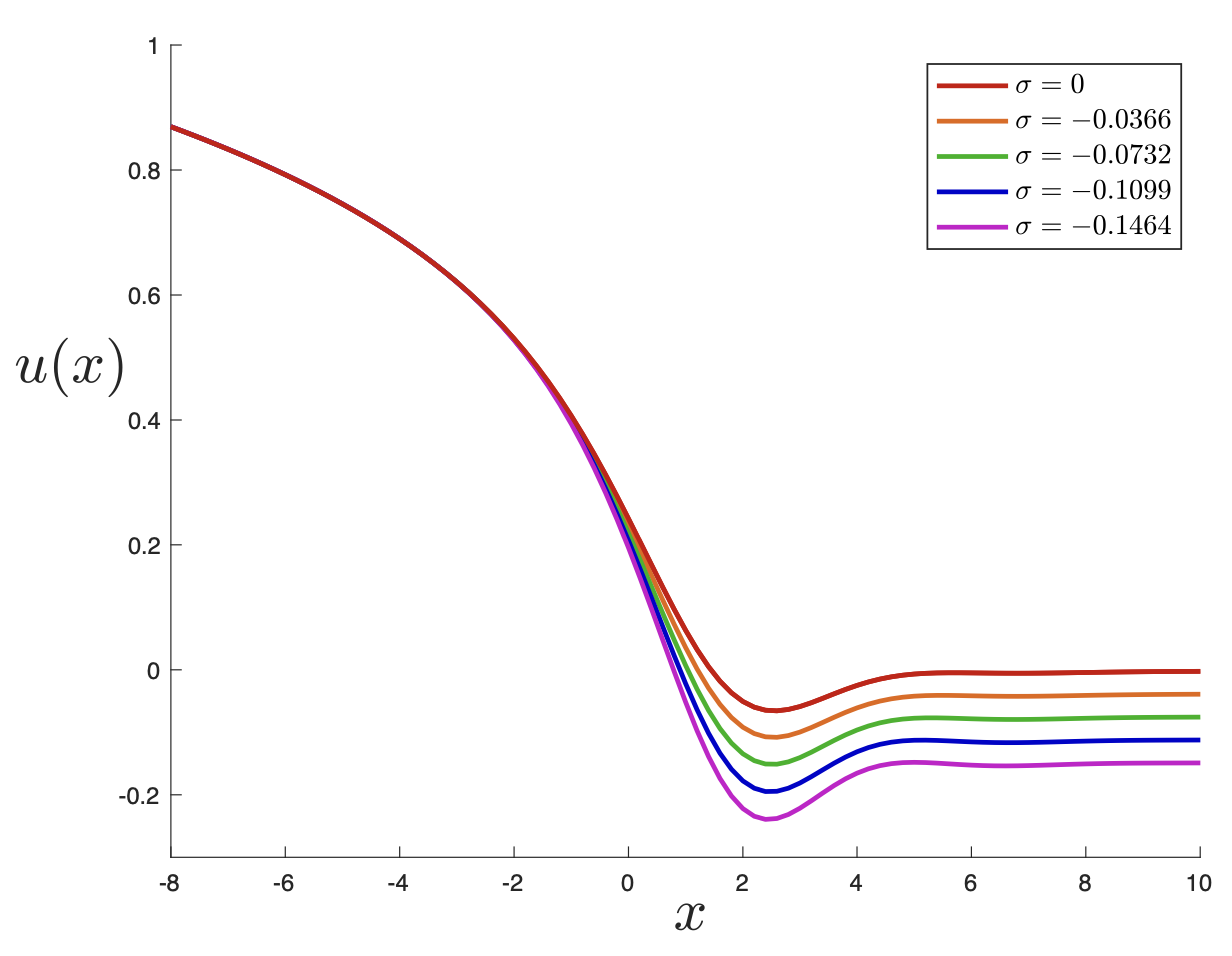
[More technical post follows.] I’ve been working on this project with (UCSB postdoc) Maciej Kolanowski on and off for a while now, but only in the last couple of weeks did I have the time to hunker down and help push the writing of the results to the finish. For your Sunday reading pleasure, it is already up on the arXiv here (it came out Thursday but I’ve been too busy to pause to post about it – partly because I’ve begun work on writing up the next paper in the backlog). The title is “Extended JT supergravity and random matrix models: The power of the string equation”, and it is co-authored with Maciej Kolanowski.

In a way, it is a natural continuation of work I’ve described here from 2023 and 2024, described here and here. At a meeting at the Institute for Advanced Study in December 2023 I described in a talk (YouTube video here, look in particular from minute 35) something miraculous I’d discovered concerning capturing certain special supergravity (and black hole) behaviour using a random matrix model. The effective physics is […] Click to continue reading this post

Super-Fun!

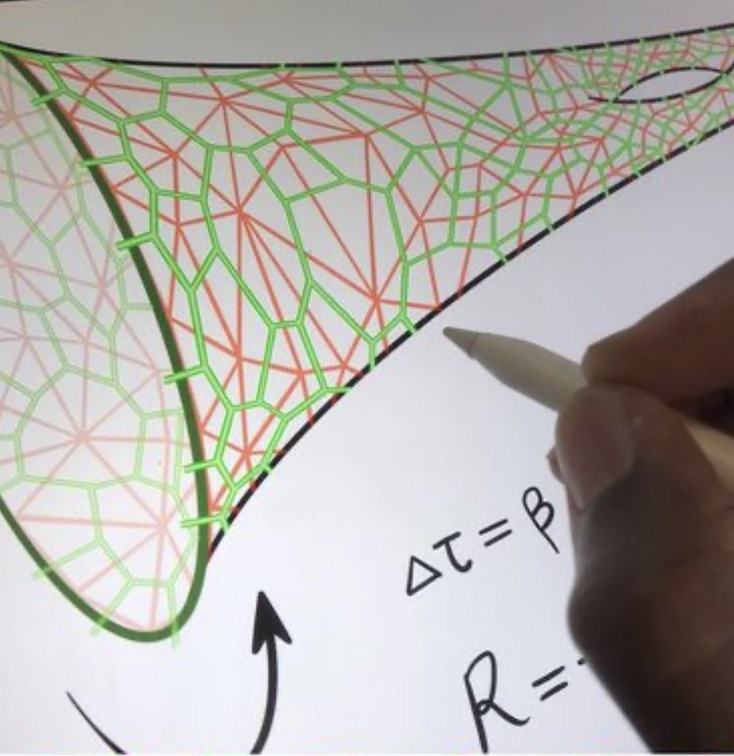
image of completed paper, with pencilIn January 2024 I wrote a paper showing how to define the Supersymmetric Virasoro Minimal String* (SVMS) as a random matrix model, compute many of its properties, and indeed predict many aspects of its physics. This was the first time the SVMS had been constructed. Despite that, a recent paper found it necessary to specifically single out my paper disparagingly as somehow not being a string theory paper, in service of (of course) their own work trying to formulate it. Odd – and disappointingly unkind – behaviour. But I’m used to it.

Anyway, since it remains the case that there is no other working definition of the SVMS out there, I thought I’d revisit the matter, clean up some unpublished work of mine (defining the 0B version) and develop the whole formalism much more. Might be useful for people pursuing other approaches. What I thought would be at most a 10 page paper turned into a 19 page one, packed with lots of fun results.

In particular it is now clear to me how the type 0A vs 0B choices, usually done at the level of perturbative worldsheet CFT methods, show up fully at the level of matrix model string equation solutions. It is often said that random matrix model methods can rather obscure issues like worldsheet supersymmetry, making it unclear what structures pertain to what features in other approaches. That can be true, so these new observations clear show that this is not always the case. (This is true quite generally, beyond this particular family of models.)

Also (and this is lots of fun!) I demonstrate that the basic loop observables of the SVMS …. Click to continue reading this post

Decoding the Universe!

I realised just now that I entirely forgot (it seems) to post about an episode of PBS’ show Nova called “Decoding the Universe: Cosmos” which aired back in the Spring. I thought they did a good job of talking about some of the advances in our understanding that have happened over the last 50 years (the idea is that it is the 50th anniversary of the show) in areas of astrophysics and cosmology. I was a contributor, filmed at the top of Mount Wilson at the Observatory where Hubble made his famous discoveries about the size of the universe, and its expansion. I talk about some of those discoveries and other ideas in the show. Here’s a link to the “Decoding the Universe” site. (You can also find it on YouTube.)

If you follow the link you’ll notice another episode up there: “Decoding the Universe: Quantum”. That’s a companion they made, and it focuses on understanding in quantum physics, connecting it to things in the everyday world. and also back to black holes and things astrophysical and cosmological. It also does a good job of shining a light on many concepts.

I was also a contributor to this episode, and it was a real delight to work with them in a special role: I got to unpack many of the foundational quantum mechanical concepts (transitions in atoms, stimulated emission, tunnelling, etc) to camera by doing line drawings while I explained – and kudos […] Click to continue reading this post

Living in the Matrix – Recent Advances in Understanding Quantum Spacetime

It has been extremely busy in the ten months or so since I last wrote something here. It’s perhaps the longest break I’ve taken from blogging for 20 years (gosh!) but I think it was a healthy thing to do. Many readers have been following some of my ocassional scribblings … Click to continue reading this post

Rattle and Hum

A lot of us have been waiting for a long time to hear this news! The NANOGrav collaboration has announced strong evidence of a background of low frequency gravitational waves emitted from supermassive black hole mergers. Their detection methods are pulsar timing arrays (still one of those fantastically simple, cool … Click to continue reading this post

A New Distribution

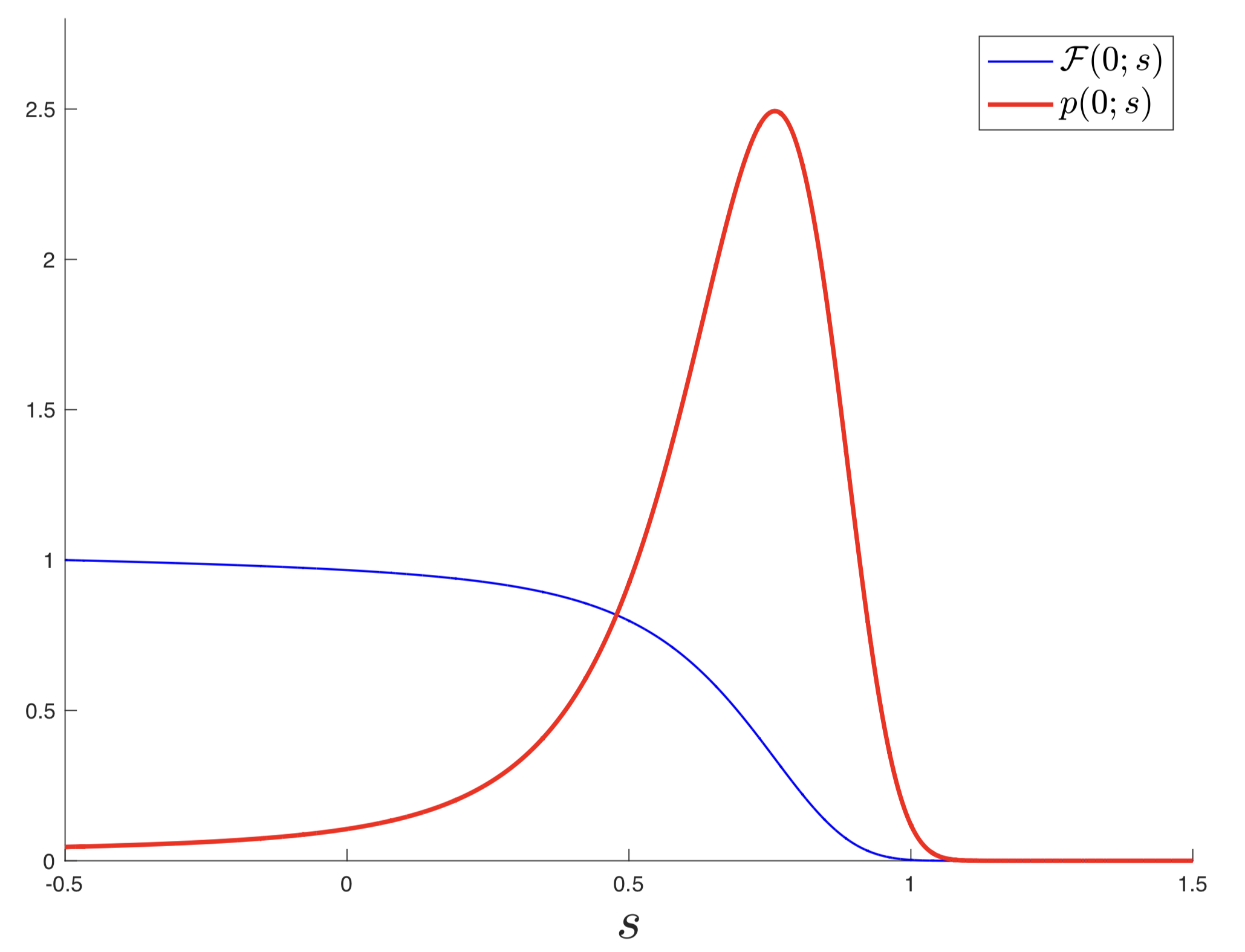
Probability distributionThe red curve in this figure is the probability distribution of the ground state energy [latex]E=s[/latex] of the microstate spectra of quantum completions of JT gravity. Put differently (the way Wigner might have) if you ask what are all the discrete spectra that are compatible with the leading semi-classical result for quantizing JT gravity (the famous Schwarzian result for the density of states: [latex]\rho(E)=e^{S_0}(4\pi^2)^{-1}\sinh(2\pi\sqrt{E})[/latex]), this curve gives the shape of the distribution of ground states. (The blue curve is simply the associated CDF.) I first uncovered this distribution in a paper last year, with further insights and generalizations in a paper earlier this year, along with the distributions for higher energy levels that follow from it. But the exciting new result of my paper from a few weeks ago is that I have now shown that it is a solution of an ordinary differential equation (or a family of them). This allows for some powerful universal things to be said analytically about the properties of the distribution!

This is fully analogous to what happened for the well-known Tracy-Widom distribution for the largest (or smallest) energy of Gaussian random hermitian matrices. While many workers (such as Forrester) had uncovered important aspects of the distribution, and while it was known that it can be expressed as a particular Fredholm determinant, Tracy and Widom broke new ground in 1994 by showing that the distribution was governed by a well known ODE – the Painleve II equation – and in particular can be given in terms of a special solution of it studied earlier by Hastings and McLeod. The result helped forge further connections between properties of random matrix theory and several interesting areas of mathematics and mathematical physics. Furthermore, […] Click to continue reading this post

Embracing Both Wigner and ‘t Hooft

That Feeling

Several weeks ago, while writing up a nice set of results that extended some work I did last year, I found that I was stuck finding the right wording for how I should nuance a (seemingly minor) matter in the introductory remarks. It was partly because, frankly, I’d got bored of the standard introduction I usually make to papers on this particular subject (matrix models and 2D gravity), because I’ve written quite a few in the last two years (10-Yikes!). But I’d found a new feature that warranted a more careful way of saying the usual things, and I wanted to incorporate that aspect, and also get the Reader interested in why this aspect was interesting and worth unpacking. I played around with better ways of saying it, and still was not entirely happy. I chipped away for a bit more over a few days, and kept coming up with something less than satisfactory. I’d carry on with things in the body of the paper that would be there whatever the introduction said. Then, after coming back to the introduction and trying again, I had to stop and explore the consequences of some of the rephrasing I was doing – to make sense of the new way I was trying to say what I wanted to say.

And then it happened…

You might know that feeling: A sort of pop goes off in your head and a tingle through the whole body, and then everything looks different all of a sudden, because you realize that you’ve found a completely new way of looking at things. A way that fits *so* well and incorporates so many of the facts that it just. feels. inevitable.

That’s what happened. And then I tried to see what it would say about the larger picture of physics this all fits in, looking for a way to make it fit, or to challenge the idea to see if it breaks. Not only did not not break, it just kept making sense, and (almost like the idea itself took charge of the process) immediately offered solutions to the problems I threw at it, and readily gobbled up existing challenges that the community has been facing for a while, and explained certain things that have been a puzzle for a long time.

For the next few days I actually could not write properly at the keyboard any more. My hands were trembling every time as I utterly rebuilt the entire paper and my world view, and I could barely sit still at times.

I know this sounds like a lot, and you should know that I am open to the possibility that it is somehow wrong, but it is too compelling not to share, so that’s what my paper that came out earlier this week is all about. I am not going to repeat the paper here, but will try to highlight some features of it that form a foundation for why this changes a lot about how we think about things in this corner of physics.

Random Stuff

Let me start in the simplest way possible, as I have done in the past, with a model that is well known to many different physics communities. The Gaussian random matrix model. Random matrix models have a very long history in trying to understand complicated systems (going back to Wishart (1928), and then Wigner (1955) – physicists seem to always forget to mention Wishart, and I’m sure I’m forgetting someone else too), and they show up in all kinds for systems. There are a lot of powerful results that have been developed, and you’ve read my writings about them here to do with how they get used for understanding aspects of string theory and quantum gravity in 2D, and also in higher dimensions. The “double scaling limit” is something I’ve talked about a lot here in particular. I won’t repeat all of it here, but invite you to go and look at other posts.
[…] Click to continue reading this post

Completing a Story

[A rather technical post follows.]

[caption id="attachment_19916" align="aligncenter" width="499"]Sample image from paper. Will be discussed later in the text. This figure will make more sense later in the post. It is here for decoration. Sit tight.[/caption]

For curious physicists following certain developments over the last two years, I’ll put below one or two thoughts about the new paper I posted on the arXiv a few days ago. It is called “Consistency Conditions for Non-Perturbartive Completions of JT Gravity”. (Actually, I was writing a different paper, but a glorious idea popped into my head and took over, so this one emerged and jumped out in front of the other. A nice aspect of this story is that I get to wave back at myself from almost 30 years ago, writing my first paper in Princeton, waving to myself 30 years in the future. See my last post about where I happen to be visiting now.) Anyway here are the thoughts:

Almost exactly two years ago I wrote a paper that explained how to define and construct a non-perturbatively stable completion of JT gravity. It had been defined earlier that year as a perturbative […] Click to continue reading this post

Matrices and Gravity

So I have a confession to make. I started working on random matrix models (the large $latex N$, double-scaled variety) in 1990 or 1991, so about 30 years ago, give or take. I’ve written many papers on the topic, some of which people have even read. A subset of those have even been cited from time to time. So I’m supposed to be some kind of expert. I’ve written extensively about them here (search for matrix models and see what comes up), including posts on how exciting they are for understanding aspects of quantum gravity and black holes. So you’d think that I’d actually done the obvious thing right? Actually taken a bunch of random matrices and played with them directly. I don’t mean the fancy path integral formulation we all learn, where you take N large, find saddle points, solve for the Wigner semi-circle law that the Dyson gas of eigenvalues forms, and so forth. I don’t mean the Feynman expansion of that same path integral, and identify (following ‘t Hooft) their topology with a tessellation of random 2D surfaces. I don’t mean the decomposition into orthogonal polynomials, the rewriting of the whole problem at large $latex N$ as a theory of quantum mechanics, and so forth. No, those things I know well. I just mean do what it says on the packet: close your eyes, grab a matrix out of the bag at random, compute its eigenvalues. Then do it again. Repeat a few thousand times and see that all those things in the data that we compute those fancy ways really are true. I realized the other day that in 30 years I’d never actually done that, and (motivated by the desire to make a simple visual illustration of a point) I decided to do it, and it opened up some wonderful vistas.

Let me tell you a little more. […] Click to continue reading this post

Full Circle

snapshot of paper

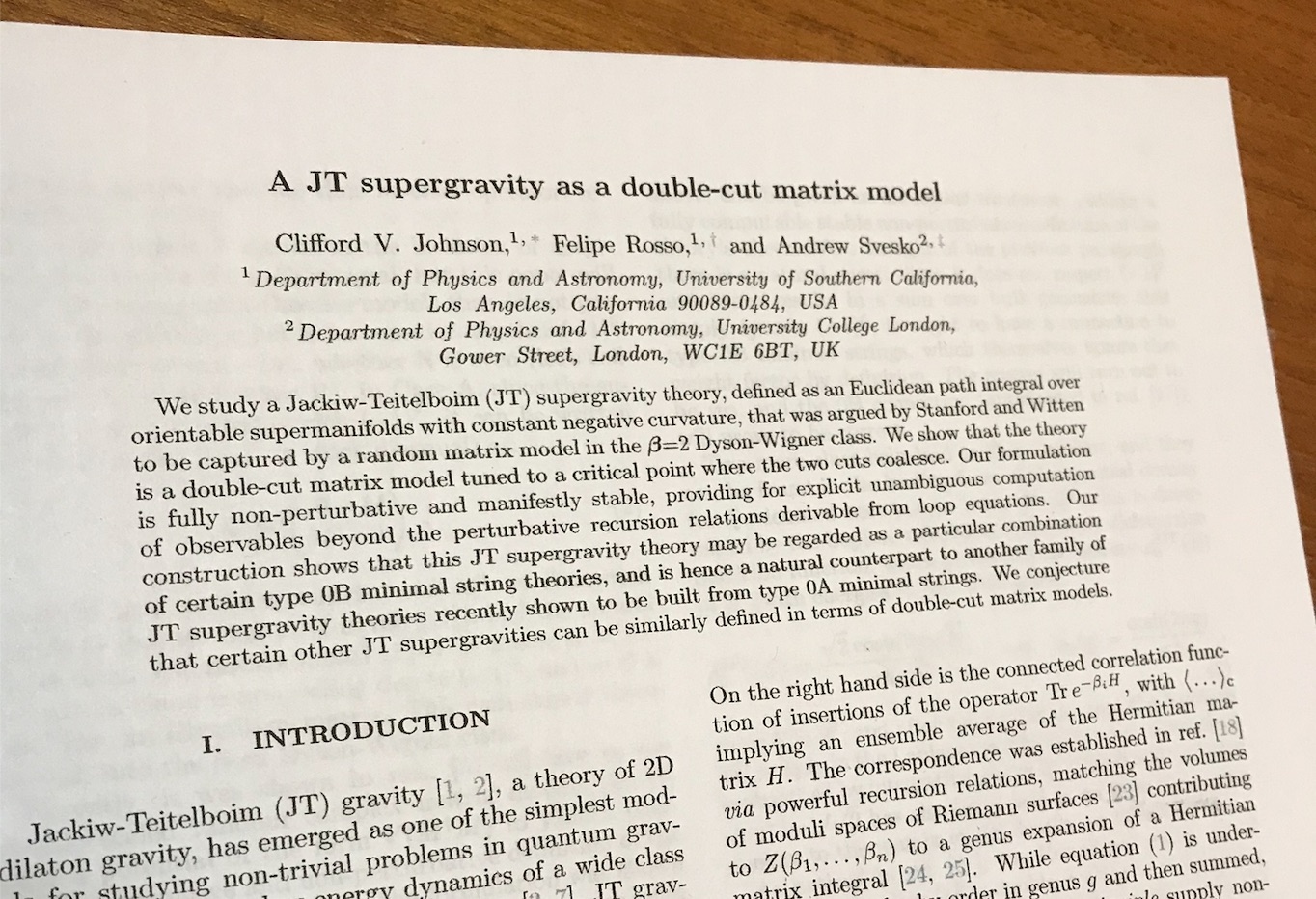
Yesterday I submitted (with collaborators Felipe Rosso and Andrew Svesko) a new paper to the arXiv that I’m very excited about! It came from one of those lovely moments when a warm flash of realisation splashed through my mind, and several fragments of (seemingly separate things) that had been floating around in my head for some time suddenly all fit together. The fit was so tight and compelling that I had a feeling of certainty that it just “had to be right”. It is a great feeling, when that happens. Of course, the details had to be worked out, and everything checked and properly developed, new tools made and some very nice computations done to unpack the consequences of the idea… and that’s what resulted in this paper! It is a very natural companion to the cluster of papers I wrote last year, particularly the ones in May and June.

What’s the story? It’s all about Jackiw-Teitelboim (JT) gravity, a kind of 2D gravity theory that shows up rather generically as controlling the low temperature physics of a wide class of black holes, including 4D ones in our universe. Understanding the quantum gravity of JT is a very nice step in understanding quantum properties of black holes. This is exciting stuff!

Ok, now I’ll get a bit more technical. Some background on all this (JT gravity, matrix models, etc), can be found in an earlier pair of posts. You might recall that in May last year I put out a paper where I showed how to define, fully non-perturbatively, a class of Jackiw-Teitelbiom (JT) supergravity theories that had been defined in 2019 in a massive paper by Stanford and Witten (SW). In effect, I showed how to build them as a particular combination of an infinite number of special “minimal string” models called type 0A strings. Those in turn are made using a special class of random matrix model based on […] Click to continue reading this post

This Feels Great!

[caption id="attachment_19729" align="aligncenter" width="499"]Andrea Ghez accepting the 2020 nobel prize for physics Andrea Ghez accepting the 2020 Nobel Prize for Physics[/caption]You know, it is easy (and healthy) to be steadfastly cynical about the whole prize thing, but sometimes it is just great to simply cast that aside and get into the spirit of it. This is one such time. The Nobel Prize ceremony was today and you can watch the whole thing on YouTube here. (Physics starts at about 36 minutes in.) My interest was in the moments Andrea Ghez and Roger Penrose picked up (literally this year) their prizes for their wonderful work on black boles. The picture I was able to screen grab of Andrea in particular says it all.

I’ve met Andrea Ghez on an number of occasions (and communicated electronically on many more), usually because of our joint interest in making science accessible to the public through talks (where we first met during K C Cole’s excellent Categorically Not! series), TV shows (where we’ve sometimes connected behind the scenes, in the context of shows or films we’re both in, or thinking of being in), and so forth. All our interactions have been […] Click to continue reading this post

Spectral, II

plot of spectral density of (2,2) JT SupergravityWhat’s that now? You want more physics teases? Ok. That dotted line is a (known) JT gravity Schwarzian spectral density. That red line? It’s the fully quantum corrected result! To all orders in topology and beyond. See my paper that appeared today on the arXiv.

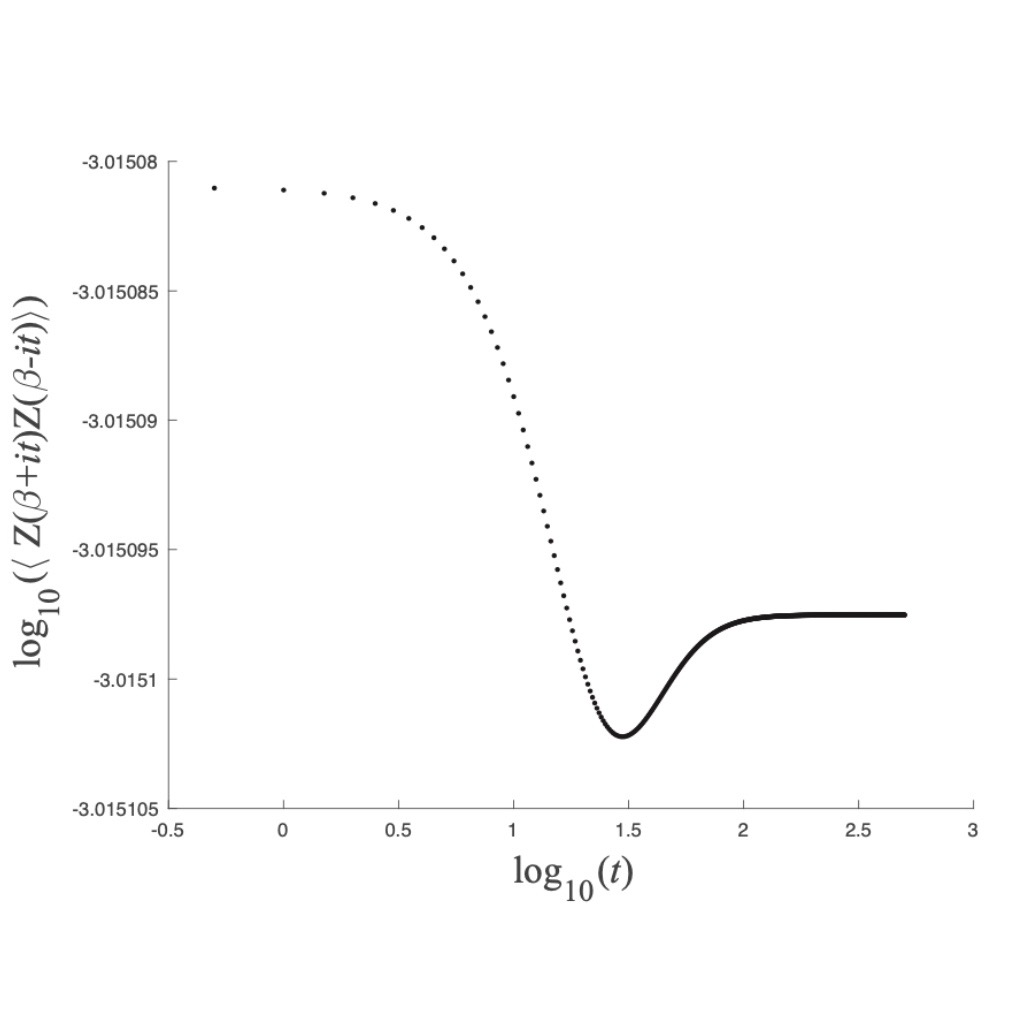
(For experts: The red line is made up of about 2000 points for each of which I know the energy, and the full wave function for an associated problem. Using those I can compute lots of things, to good accuracy. One example is the full non-perturbative spectral form factor, that I showed last post.)

-cvj Click to continue reading this post