Computing Correlators

[A more technical post follows]

My most recent paper, out on the arXiv today, is very exciting to me because it seems to be a genuinely new way of computing some important quantities and it is devilishly simple. So simple that I worried for months that it is all super-obvious to everyone. But another voice within me said to myself: Well if it is so obvious, why has nobody published it? Another (paranoid) voice within said: Maybe someone has published this method, and I just can’t find it in the literature…

Well, I decided that the best way to find out for sure is to put it on the arXiv and within a short time someone will email to say that I missed their important work. So, while I wait for that email (as I start writing it’s only been 30 minutes since it has been “out there”, so there’s time), let me say a few things about why I like the many results in the paper.

I was already pleased enough with the core part of the paper that I was going to write a swift four-pager about it back in February. The core point being that I figured out how to build on work I’d done in a paper back in 2024 (expanded on with followup work I did with Wasif Ahmed and Krishan Saraswat, a student and postoc). Back in 2024, I found (here) a really nice way (almost miraculous in how it worked) of writing all the corrections to the spectral density of a class of models in terms of one function [latex]u_0[/latex] and its derivatives. It was obtainable from one simple ordinary differential equation (ODE) called the Gel’fand-Dikii equation, which takes in the function [latex]u_0(x)[/latex] as input. The ODE is for a special quantity called the diagonal resolvent [latex]{\widehat R}(x,E)[/latex]. You integrate that quantity [latex]\widehat R(x,E)[/latex] with respect to [latex]x[/latex] and you’re more or less home. In general, it is a messy quantity that does not integrate to anything nice. But just when the function [latex]u(x)[/latex] obeys the “string equation” it is supposed to (as dictated by the governing model’s physics), then [latex]{\widehat R}(x,E)[/latex] is a total derivative (a seeming miracle-see later), and the corrections it gives to the density become of just the right form!

Those corrections can be called [latex]W_{g,1}(E)[/latex] where the [latex]g[/latex] is the order in perturbation theory. [latex]g=0[/latex] is leading order, [latex]g=1[/latex] is the torus, [latex]g=2[/latex] the double torus, etc. Indeed [latex]g[/latex] is the number of handles or “genus” of an associated Riemann surface. The one subscript on the other hand, corresponds to the one energy entry available when just discussing the density [latex]\rho(E)[/latex]. All the [latex]W_{g,1}[/latex] end up being written nicely in terms of a function [latex]u_0(x)[/latex] and its derivatives, evaluated at a special point.

An already nice feature (among many) of the construction was that this one ODE, recursively solved, gave rise to the [latex]W_{g,1}[/latex] of many different problems across a range, including certain random matrix models, gravity problems, intersection theory and topology, and so on. All you need to do is change the function [latex]u_0(x)[/latex]. Moreover, for this (wide) class of problems, you can compute the desired results faster and with way less machninery than other methods, such as topological recursion, which was an interesting observation. This includes very famous problems like the Weil-Petersson volumes (of the compactified moduli space [latex]\overline{\cal M}_{g,1}[/latex] of Riemann surfaces with genus [latex]g[/latex] and [latex]n=1[/latex] boundaries) and generalisations. Another nice feature is that you also get non-perturbative data beyond the genus expansion, an aspect I explored recently (in this paper) with student Joao Rodrigues, and expert in resurgence techniques.

The core breakthrough of the new paper is this: For some time, I’ve wondered how to compute correlators for more energies (amounting to multi-point correlators of [latex]\rho[/latex]) in this same way: […] Click to continue reading this post

Nobel Prize in Physics 2025: Who/What/Why

I started a tradition a little while back where every year we have a special departmental colloquium entitled “The Nobel Prize in Physics: Who/What/Why”. This year my job in finding speakers was made easier by having 2/3 of this years newly-minted Nobel Prize winners in physics in the Department! (Michel Devoret and John Martinis.) So our room was a bit more well-attended than normal…(hundreds and hundreds rather than dozens and dozens). Here is a recording of the event, which I was delighted to host, and there’s a celebration afterwards too. (Pls share widely!)
[…] Click to continue reading this post

Fantastic Collaboration!

Well, I can now officially mention that I’ve been part of the filmmaking team (in a way) working hard to bring you an enjoyable and interesting Fantastic Four movie! I think it has been about two and a half years (?) since this all began. This was a nearly perfect model of how science consulting can work in film. I worked with everyone, wherever I was needed, with the director, writers, producers, director of photography, VFX teams, set design, and so on. They made me feel welcome and part of whatever creative team I was talking to, which was great. They were open to lots of ideas right from when they were starting out thinking about tone, story ideas, and so forth, right through to final (key) tweaks right at the end of the process as recently as mere weeks ago.

It began early on with with having great conversations Matt Shakman and his writing team about the fact that Reed Richards is first and foremost a curiosity-driven physicist (and so quite different from the engineer we have in Tony Stark that we see RdJ bring out so well), and how things like his dedication to his work (and his outlook on things that comes from such work) might play out in terms of family dynamic, personal relationships, etc., – Without it turning into the tedious cliches about scientists somehow not being able to navigate the world of human relationships. Obviously, I could speak to this as a physicist who works on precisely the things Reed works on, as well as a family man, and as well as someone who remembers that it’s still all about telling a story. And there are so many stories to tell at that intersection… Anyway, I think these early conversations (as well as suggestions I made in many sets of notes along the way) helped inform (even if only a little bit? who knows?) what Pedro Pascal brought to the character. This aspect of the film is one of the things I’m most pleased about seeing up on screen.

Beyond that, you’ll see lots of things I gave them that I’m also delighted to see made it to the film, in many scenes. This includes (but not limited to!): […] Click to continue reading this post

The Power of the String Equation

[More technical post follows.] I’ve been working on this project with (UCSB postdoc) Maciej Kolanowski on and off for a while now, but only in the last couple of weeks did I have the time to hunker down and help push the writing of the results to the finish. For your Sunday reading pleasure, it is already up on the arXiv here (it came out Thursday but I’ve been too busy to pause to post about it – partly because I’ve begun work on writing up the next paper in the backlog). The title is “Extended JT supergravity and random matrix models: The power of the string equation”, and it is co-authored with Maciej Kolanowski.

In a way, it is a natural continuation of work I’ve described here from 2023 and 2024, described here and here. At a meeting at the Institute for Advanced Study in December 2023 I described in a talk (YouTube video here, look in particular from minute 35) something miraculous I’d discovered concerning capturing certain special supergravity (and black hole) behaviour using a random matrix model. The effective physics is […] Click to continue reading this post

Super-Fun!

image of completed paper, with pencilIn January 2024 I wrote a paper showing how to define the Supersymmetric Virasoro Minimal String* (SVMS) as a random matrix model, compute many of its properties, and indeed predict many aspects of its physics. This was the first time the SVMS had been constructed. Despite that, a recent paper found it necessary to specifically single out my paper disparagingly as somehow not being a string theory paper, in service of (of course) their own work trying to formulate it. Odd – and disappointingly unkind – behaviour. But I’m used to it.

Anyway, since it remains the case that there is no other working definition of the SVMS out there, I thought I’d revisit the matter, clean up some unpublished work of mine (defining the 0B version) and develop the whole formalism much more. Might be useful for people pursuing other approaches. What I thought would be at most a 10 page paper turned into a 19 page one, packed with lots of fun results.

In particular it is now clear to me how the type 0A vs 0B choices, usually done at the level of perturbative worldsheet CFT methods, show up fully at the level of matrix model string equation solutions. It is often said that random matrix model methods can rather obscure issues like worldsheet supersymmetry, making it unclear what structures pertain to what features in other approaches. That can be true, so these new observations clear show that this is not always the case. (This is true quite generally, beyond this particular family of models.)

Also (and this is lots of fun!) I demonstrate that the basic loop observables of the SVMS …. Click to continue reading this post

A New Equation?

Some years ago I speculated that it would nice if a certain mathematical object existed, and even nicer if it were to satisfy an ordinary differential equation of a special sort. I was motivated by a particular physical question, and it seemed very natural to me to imagine such an object… So natural that I was sure that it must already have been studied, the equation for it known. As a result, every so often I’d go down a rabbit hole of a literature dig, but not with much success because it isn’t entirely clear where best to look. Then I’d get involved with other projects and forget all about the matter.

Last year I began to think about it again because it might be useful in a method I was developing for a paper, went through the cycle of wondering, and looking for a while, then forgot all about it in thinking about other things.

Then, a little over a month ago at the end of March, while starting on a long flight across the continent, I started thinking about it again, and given that I did not have a connection to the internet to hand, took another approach: I got out a pencil and began mess around in my notebook and just derive what I thought the equation for this object should be, given certain properties it should have. One property is that it should in some circumstances reduce to a known powerful equation (often associated with the legendary 1975 work of Gel’fand and Dikii*) satisfied by the diagonal resolvent $latex {\widehat R}(E,x) {=}\langle x|({\cal H}-E)^{-1}|x\rangle$ of a Schrodinger Hamiltonian $latex {\cal H}=-\hbar^2\partial^2_x+u(x)$. It is:

$latex 4(u(x)-E){\widehat R}^2-2\hbar^2 {\widehat R}{\widehat R}^{\prime\prime}+\hbar^2({\widehat R}^\prime)^2 = 1\ .$

Here, $latex E$ is an energy of the Hamiltonian, in potential $latex u(x)$, and $latex x$ is a coordinate on the real line.

The object itself would be a generalisation of the diagonal resolvent $latex {\widehat R}(E,x)$, although non-diagonal in the energy, not the […] Click to continue reading this post

Decoding the Universe!

I realised just now that I entirely forgot (it seems) to post about an episode of PBS’ show Nova called “Decoding the Universe: Cosmos” which aired back in the Spring. I thought they did a good job of talking about some of the advances in our understanding that have happened over the last 50 years (the idea is that it is the 50th anniversary of the show) in areas of astrophysics and cosmology. I was a contributor, filmed at the top of Mount Wilson at the Observatory where Hubble made his famous discoveries about the size of the universe, and its expansion. I talk about some of those discoveries and other ideas in the show. Here’s a link to the “Decoding the Universe” site. (You can also find it on YouTube.)

If you follow the link you’ll notice another episode up there: “Decoding the Universe: Quantum”. That’s a companion they made, and it focuses on understanding in quantum physics, connecting it to things in the everyday world. and also back to black holes and things astrophysical and cosmological. It also does a good job of shining a light on many concepts.

I was also a contributor to this episode, and it was a real delight to work with them in a special role: I got to unpack many of the foundational quantum mechanical concepts (transitions in atoms, stimulated emission, tunnelling, etc) to camera by doing line drawings while I explained – and kudos […] Click to continue reading this post

When Worlds Collide…

This morning I had a really fantastic meeting with some filmmakers about scientific aspects of the visuals (and other content) for a film to appear on your screens one day, and also discussed finding time to chat with one of the leads in order to help them get familiar with aspects of the world (and perhaps mindset) of a theoretical physicist. (It was part of a long series of very productive meetings about which I can really say nothing more at the current time, but I’m quite sure you’ll hear about this film in the fullness of time.)

Then a bit later I had a chat with my wife about logistical aspects of the day so that she can make time to go down to Los Angeles and do an audition for a role in something. So far, so routine, and I carried on with some computations I was doing (some lovely clarity had arrived earlier and various piece of a puzzle fell together marvellously)…

But then, a bit later in the morning while doing a search, I stumbled upon some mention of the recent Breakthrough Prize ceremony, and found the video below […] Click to continue reading this post

Catching Up

Since you asked, I should indeed say a few words about how things have been going since I left my previous position and moved to being faculty at the Santa Barbara Department of Physics.

It’s Simply Wonderful!

(Well, that’s really four I suppose, depending upon whether you count the contraction as one or two.)

Really though, I’ve been having a great time. It is such a wonderful department with welcoming colleagues doing fantastic work in so many areas of physics. There’s overall a real feeling of community, and of looking out for the best for each other, and there’s a sense that the department is highly valued (and listened to) across the wider campus. From the moment I arrived I’ve had any number of excellent students, postdocs, and faculty knocking on my door, interested in finding out what I’m working on, looking for projects, someone to bounce an idea off, to collaborate, and more.

We’ve restarted the habit of regular (several times a week) lunch gatherings within the group, chatting about physics ideas we’re working on, things we’ve heard about, papers we’re reading, classes we’re teaching and so forth. This has been a true delight, since that connectivity with colleagues has been absent in my physics life for very many years now and I’ve sorely missed it. Moreover, there’s a nostalgic aspect to it as well: This is the very routine (often with the same places and some of the same people) that I had as a postdoc back in the mid 1990s, and it really helped shape the physicist I was to become, so it is a delight to continue the tradition.

And I have not even got to mentioning the Kavli Institute for Theoretical Physics (KITP) [….] Click to continue reading this post

Multicritical Matrix Model Miracles

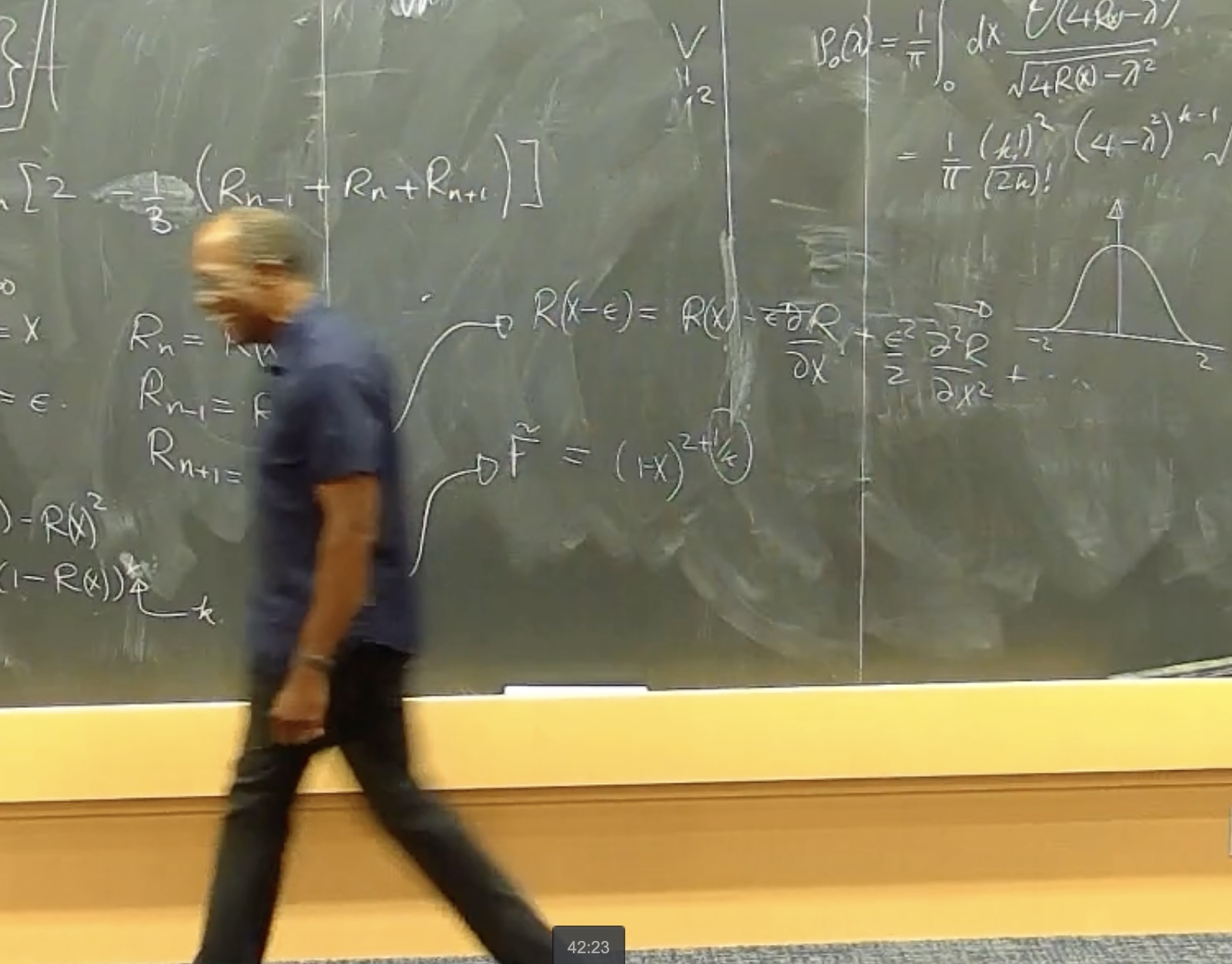
Well, that was my title for my seminar last Thursday at the KITP. My plan was to explain more the techniques behind some of the work I’ve been doing over the last few years, in particular the business of treating multicritical matrix models as building blocks for making more complicated theories of gravity.

chalkboard from KITP seminar

The seminar ended up being a bit scattered in places as I realised that I had to re-adjust my ambitions to match limitations of time, and so ended up improvising here and there to explain certain computational details more, partly in response to questions. This always happens of course, and I sort of knew it would at the outset (as was clear from my opening remarks of the talk). The point is that I work on a set of techniques that are very powerful at what they do, and most people of a certain generation don’t know those techniques as they fell out of vogue a long time ago. In the last few years I’ve resurrected them and developed them to a point where they can now do some marvellous things. But when I give talks about them it means I have a choice: I can quickly summarise and then get to the new results, in which case people think I’m performing magic tricks since they don’t know the methods, or I can try to unpack and review the methods, in which case I never get to the new results. Either way, you’re not likely to get people to dive in and help move the research program forward, which should be the main point of explaining your results. (The same problem occurs to some extent when I write papers on this stuff: short paper getting swiftly to the point, or long paper laying out all the methods first? The last time I did the latter, tons of new results got missed inside what people thought was largely just a review paper, so I’m not doing that any more.)

Anyway, so I ended up trying at least to explain what (basic) multicritical matrix models were, since it turns out that most people don’t know these days what the (often invoked) double scaling limit of a matrix model really is, in detail. This ended up taking most of the hour, so I at least managed to get that across, and whet the appetite of the younger people in the audience to learn more about how this stuff works and appreciate how very approachable these techniques are. I spent a good amount of time trying to show how to compute everything from scratch – part of the demystifying process.

I did mention (and worked out detailed notes on) briefly a different class of […] Click to continue reading this post

Living in the Matrix – Recent Advances in Understanding Quantum Spacetime

It has been extremely busy in the ten months or so since I last wrote something here. It’s perhaps the longest break I’ve taken from blogging for 20 years (gosh!) but I think it was a healthy thing to do. Many readers have been following some of my ocassional scribblings … Click to continue reading this post

Rattle and Hum

A lot of us have been waiting for a long time to hear this news! The NANOGrav collaboration has announced strong evidence of a background of low frequency gravitational waves emitted from supermassive black hole mergers. Their detection methods are pulsar timing arrays (still one of those fantastically simple, cool … Click to continue reading this post