Archive for the 'research' Category

Lines of Thought

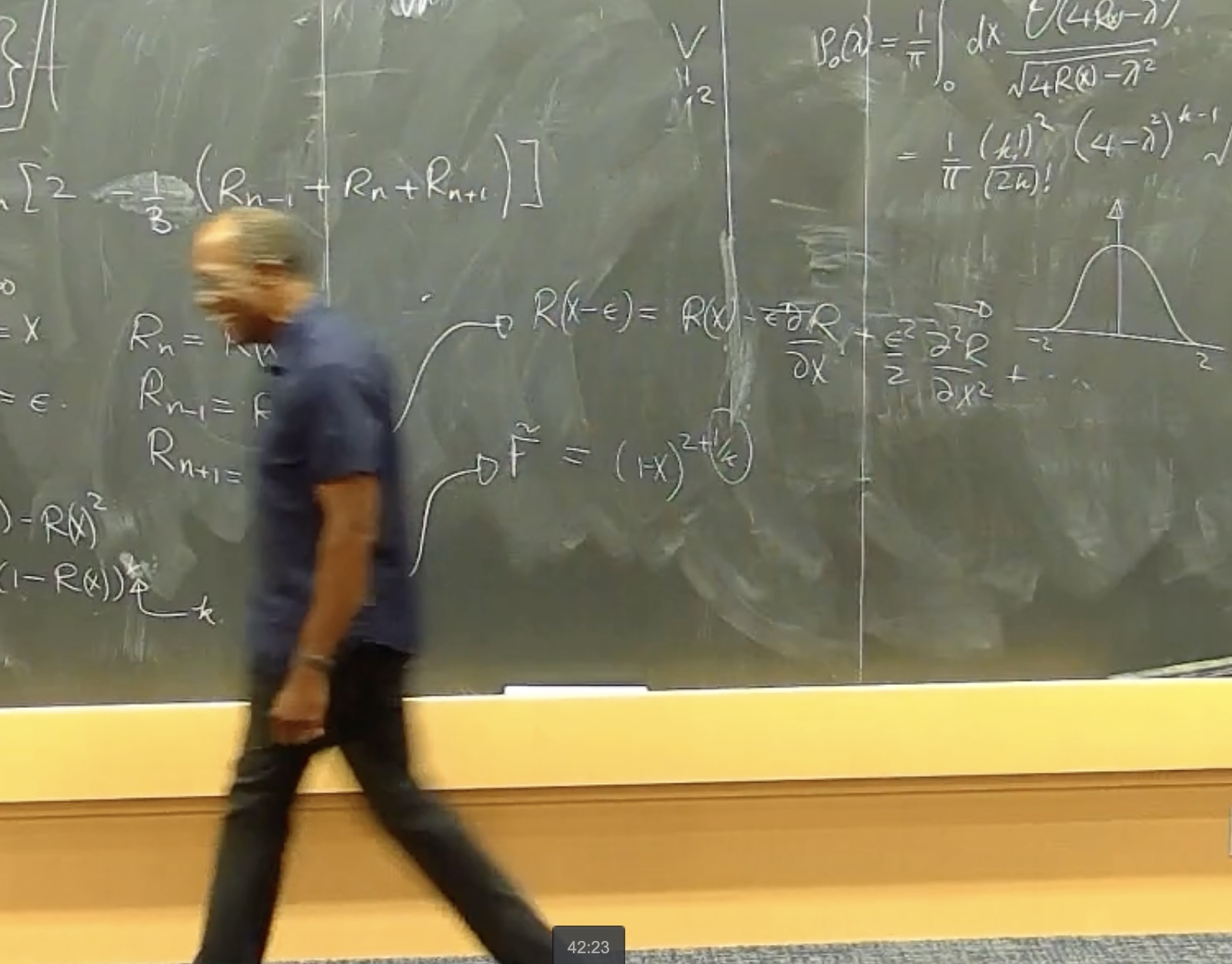
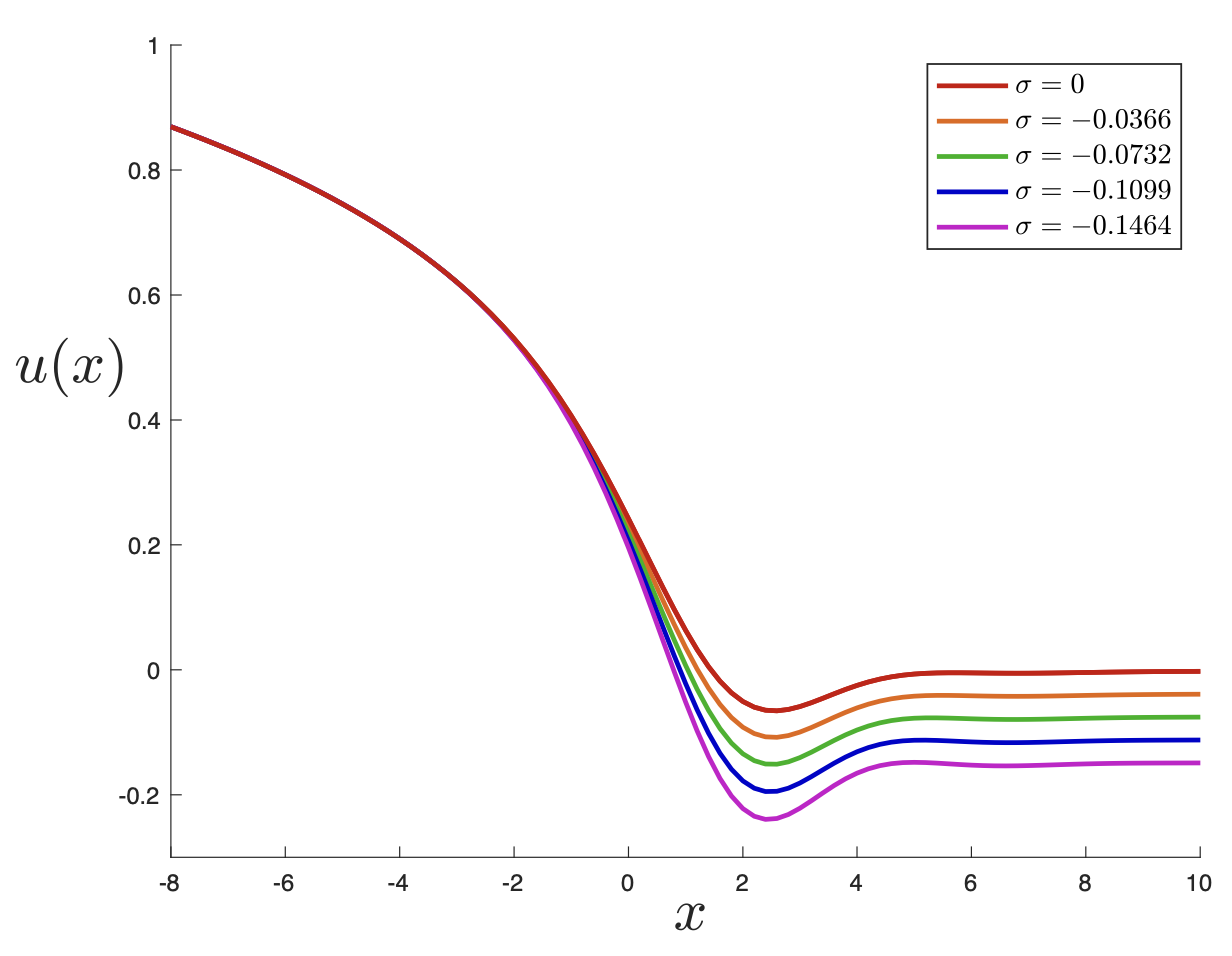
So I’ve moved on to curved lines now, in case you’re wondering. :) (See previous posts.) The last several days (the research parts) have been taken up with more computations. A lot of the time has been spent calibrating the programs, and trying to assess and understand and characterize the inevitable errors that show up, by running the programs and checking the resulting plots of data points against expectations shaped by hand calculations. Calculating on the train to and from work, I’ve filled several pages of my small notebook with computations, alongside sketches of some of my surroundings as usual (people mostly). As a result (fingers crossed) I think I’ve now understood all the key aspects of the results I’ve been getting, and have good numerical control of things. To get such control, I’ve had to push the error tolerance and the size of the grid of points I’m computing on to regimes where I’m back again to waiting for the better part of an hour for each data point. (One sets up the problem on the computer by making continuous variables, such as space and time, into discrete ones, forming a grid. The problem is then to use various Continue reading ‘Lines of Thought’

A Much Shorter Straight Line

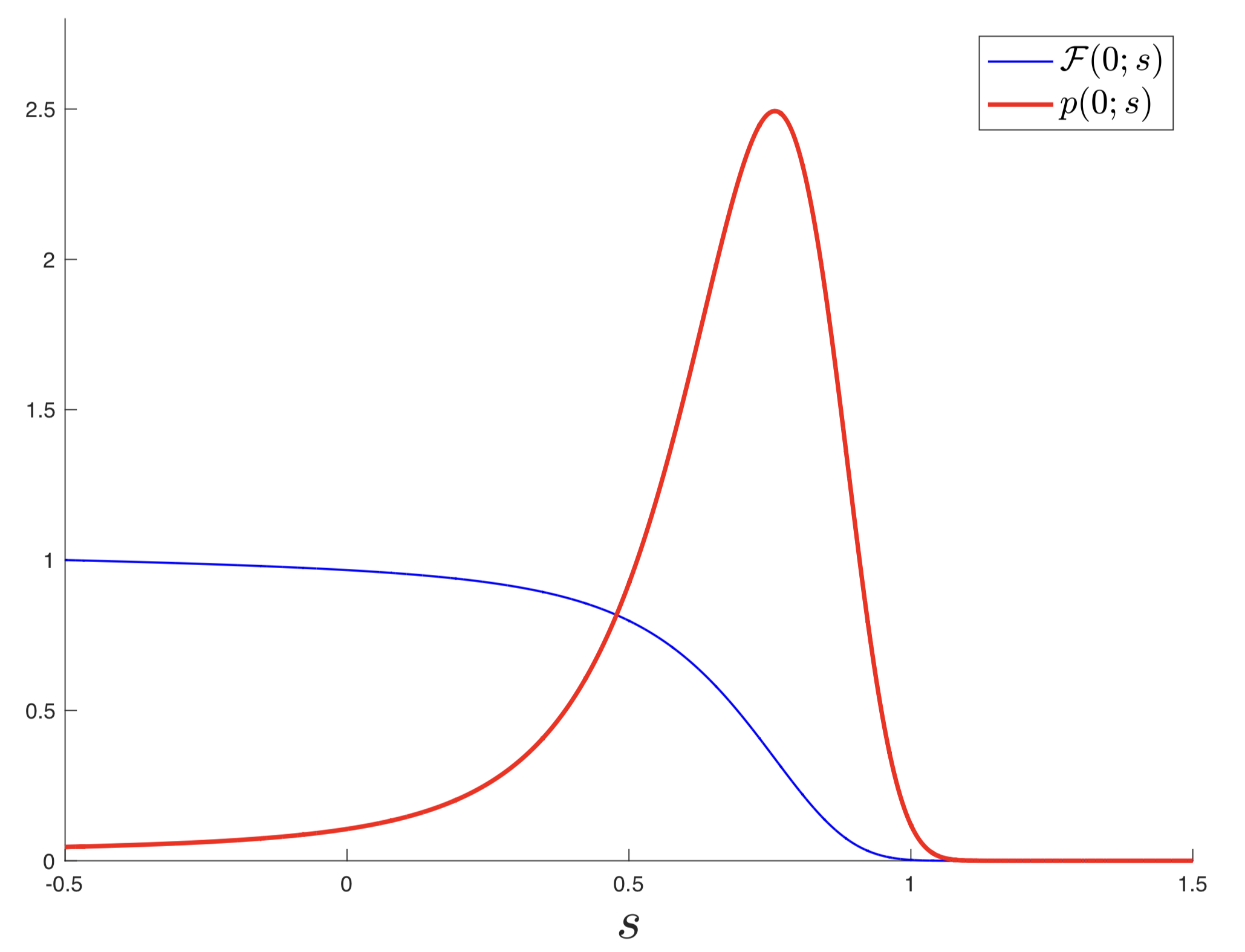
LinePlot2 How is the line coming along? It is very kind of you to ask (if indeed you were). Well, there it is to the left. (See the previous post for background.) In the end, I abandoned Maple since it was taking way too long to do each point, and just for the simple example. (When I tried to do one sample point of the complicated example it took 24 hours and I stopped it before it was done!) The point is that Maple does not easily Continue reading ‘A Much Shorter Straight Line’

A Very Long Straight Line

I’ve been multitasking in an interesting way. Sort of. I’ve reached a certain point with some computations I am doing that I cannot go beyond by analytic means. LinePlotThis means that I can’t extract the physics I need by doing algebra and other exact manipulations on paper any more. Progress can continue however by using numerical means, employing a computer to solve the highly non-linear equations and extract the juice. There are several steps involved, and ultimately, I want to determine how a certain physical quantity depends on another physical quantity. (I’m sparing you the trouble of knowing what the details of the physical quantities are, since it does not matter for the thing I am trying to tell you. It relates to quantum field theory, gravity, and string theory, which connects the two.)

I can see that dependence quite clearly if I simply plot a graph of one versus the other, and in this case I need the computer to work out what the points on that graph are. I actually don’t know the answer for the cases I really am interested in, nobody does (that’s why it is research!), and so that’s what I want to find. I want lots of points to get a nice smooth graph, so the computer has to compute a lot of points, and I need to run it for a long time since I want it to compute the points very accurately. So I wrote a program (in Maple) to work on the problem, studying just one Continue reading ‘A Very Long Straight Line’

TED Youth Talk – Hidden Structures of the Universe

You might recall that last year I gave a talk at TED Youth, in their second year of short TED talks aimed at cvj_TED_Youth younger audiences. You’ll recall (see e.g. here and here) I made a special set of slides for it, composed from hundreds of my drawings to make it all in graphic novel style, and somehow trying to do (in 7 minutes!!) what the TED people wanted. They wanted an explanation of string theory, but when I learned that telescopesI was the only person in the event talking about physics, I kind of insisted that (in a year when we’d discovered the Higgs boson especially!) I talk more broadly about the broader quest to understand what the world is made of, leaving a brief mention of string magnifytheory at the end as one of the possible next steps being worked on. Well, they’ve now edited it all together and made it into one of the lessons on the TED Ed site, and so you can look at it. Show it to friends, young and old, and remember that it is ok if you don’t get everything that is said… it is meant to invite you to find out more on your own. Also, as you see fit, use the pause button, scroll back, etc… to get the most out of the narrative.

I’m reasonably pleased with the outcome, except for one thing. WHY am I rocking Continue reading ‘TED Youth Talk – Hidden Structures of the Universe’

Congratulations!

In other interesting announcements today, the great physicist Alexander Polyakov has been given the Fundamental Physics Prize. (See the announcement here.) There was a remarkable award ceremony in Geneva yesterday, hosted by Morgan Freeman, and with lots of Physicists and others celebrating great work in various areas of physics. Polyakov has been a key and brilliant leader in many areas of theoretical physics, and influenced so many ideas and techniques that have fed into the whole field, and so this is a well deserved recognition.

I must note that it is a bit sad (to say the least) to do a google search on the news about this prize and see so many articles with a lot of just plain stupid focussing on a big prize going to a “string theorist”, as though this is somehow negative or ironic, and also missing the fact that Polyakov’s contributions are so broad and far-reaching Continue reading ‘Congratulations!’

Known Unknowns Decreased a Bit

Well, the day is here. The Planck collaboration has announced a huge amount of results for the consumption of the scientific community and the media today. The Planck satellite looks with unprecedented precision at the very earliest radiation (“cosmic microwave background radiation”, CMB) from the universe when it was very young (a wee, cute 380,000 years old) and helps us deduce many things about what the universe was like then, and what it is like now. Here’s one of the representations of the universe using the new sky mapping Planck did (image courtesy ESA/Planck):

There’s a ton of data, and a raft of papers with analysis and conclusions. And there’s a very nice press release. I recommend looking at it. It is here, and the papers are here. The title of the press release is “Planck reveals an almost perfect Universe”, and some of the excitement is in the “almost” part. A number of anomalies that were hinted at by the previous explorer of the CMB, WMAP, seem to have been confirmed by Planck, and so there are some important things to be understood in order to figure out the origin of the anomalies (if they ultimately turn out to be real physics and not data artefacts). [Update: Andrew Jaffe has two nice posts I recommend. One on the science, and the other on the PR. Jester also has a nice post on the science from a particle physicist's perspective.]

What is the title of my post referring to? Well, the refined measurements have allowed us to update some of the vital statistics of the universe. First, it is a bit older than previous measurements have indicated. The age is now measured as 13.82 billion years. (I’m already updating pages in the draft of my book…) Second, the proportion of ingredients Continue reading ‘Known Unknowns Decreased a Bit’

USC Keck School Stem Cell Elevator Pitches…

Got a 30 second elevator pitch about your research? Several of my colleagues over at the USC Keck School of Medicine have. Here are 9 in a playlist: Continue reading ‘USC Keck School Stem Cell Elevator Pitches…’

We have a Higgs!

So it’s very much worth noting that there are some new announcements from earlier this week concerning last years’ landmark discovery at the Large Hadron Collider. The news is that a Higgs particle was discovered. There were several news stories about it in the last few days. This might be a bit confusing, and many of you are thinking that this is recycling news from last year concerning the discovery of the Higgs. It is not recycling. If you go back and look at the results that were announced last year, there was an important note of caution, notable in the fact that the particle discovered was referred to as “Higgs-like”. More analysis was needed to be sure that it was indeed a particle that fits the name Higgs. Well, that analysis has been done, with more data included and so forth, and both experiments (CMS and ATLAS) are now sure that they are seeing a Higgs particle, and indeed it is one that is very close to what you’d expect for the Standard Model of particle physics.

The latter is is important and interesting to note, since many people expect that there Continue reading ‘We have a Higgs!’

Local Connections

Well, Thursday’s meeting was a blast! I had decided not to try to get people to RSVP for the meeting this time, and so when it came down to the day before, I had no idea how many were going to show up. This meant that I had to make some guesses about how much coffee and tea and cookies to organize, which was a little bit of a challenge. But just before 9:00am people began to show up, and kept showing up, and by time I was ready to start off the day’s meeting, there was a really good crowd!

In the end it was a great day, with five really good talks and lots of excellent discussion. Continue reading ‘Local Connections’

Southern California Strings Seminar

Southern California String Seminar May 2011 in progressThe next Southern California Strings Seminar is on Thursday 13th December! I’ve now made the website for this one and it is here. Come back to it from time to time to see the updates of talk titles as speakers let me know what they are. It is a one-day event filled with five talks and plenty of time for discussion. I’ve snagged a lovely room in the Doheny library again. (Photo left has a shot of the room we used last time it was at USC in May 2011. The most recent one was over at UCLA.)

You are welcome to come and do physics with us! Also, if you’re part of a group in Continue reading ‘Southern California Strings Seminar’

Talking

…Again. I’ll be on the road again this morning. Heading to California State University Long Beach. They invited me to give a colloquium a while back and I agreed, and when I returned from New York last week I realized I needed to urgently spend a chunk of time thinking about what I was going to talk about, and designing a set of slides for it. The last couple of days saw me devoting a lot of time to it. Eventually I decided to dig back into ancient times (the 1990s) surveying some of the interesting things we’ve learned about strong coupling phenomena (involving unexpected reorganization of degrees of freedom and the number of spacetime dimensions at times), and then discuss what it all might be good for in view of work going on in the last decade or so.

Come to think of it just this moment, this is a chance to do a tribute to David Olive, who passed away earlier this month. (He was one of my professors when I was at Imperial College in the ’80s.) Ideas of strong/weak coupling dualities and their utility were given a huge boost by his work in this area from decades ago, perhaps the most famous being Montonen-Olive duality… I must remember to mention that in the talk. (See here for an archive of 2004 talks in celebration of his work. I borrowed the image to the right from there. I do not know who took it.)

Here’s the title and abstract:

Continue reading ‘Talking’

The Future of Physics

On Saturday we had another series of celebration events for the 50th Anniversary of the Aspen Center for Physics. It began at 2:00pm with a discussion in Paepke auditorium entitled “The Future of Physics”, and it was introduced by Michael Turner, and moderated by Lisa Randall, with three Nobel Prize winners forming the panel: David Gross, Bob Laughlin, and Adam Riess. (I decided to do a short sketch during some of it, and then quickly splashed on some colour later in the evening*. The result is above. The sketches are meant to give a sense of the stage and people on it, not be representative likenesses, so I refer you to pictures of them for actual portraits…)

There was an excellent turnout, and audience members were treated to a good and wide-ranging discussion. It was a difficult subject to grapple with, and Lisa started out in a good place, by getting each panelist to take turns to describe their way into physics, then around again to talk about the areas they got their Nobel Prizes in. She supplemented their contributions with some of her reflections on her own experiences and points of view, and tried to unpack some of the concepts brought up here and there when she thought it might help the audience.

From there, things became a bit tricky, since there were several directions in which to go and it was not clear what the best structure to follow was, given the time allotted and that they needed to stop and get members of the audience involved. Like I said, it was a difficult assignment for all of them. What emerged was a loosely structured series of interesting reflections from each of them at various points, some healthy disagreements there and here (I think it was good for the public to see that we’re not all cut of the same cloth) – for example between David and Lisa on the meaning of Continue reading ‘The Future of Physics’

Strings 2012 Talks

I did not make it to the annual “Strings xxxx” conference this year (where xxxx = current year), but I heard that it was good. It was held in Munich. See the lovely poster on the right. (I wonder who did the splendid painting?)

The organizers did a great job of rapidly updating the website with slides and video of the talks so that a wider audience can benefit from them. The video page is Continue reading ‘Strings 2012 Talks’

Working Group

It wasn’t all lecture halls, discussion rooms, and cafeterias for the workshop. The organizers arranged for a boat tour last week, and we all sat on one of those splendid long, wide and low tour boats that you often see on the canals in Amsterdam. It was nicely equipped with a bottle of wine at each table, and the crew members handed us each a glass of sparkling wine as we embarked. Very nice. There was a lot of fun chatter from each table for the whole trip around the canals (so much so that they stopped the attempts to inform us over the PA system about some of the sights we were seeing, since the sound was drowned out by the conversations), covering (from what I could hear) a wide range of topics from well beyond physics to matters concerning topics presented in the workshop.

Sometimes pads of paper and pens appeared. Above is a group (David Tong, Continue reading ‘Working Group’

The Bridge

The workshop has been fantastic, overall. In between discussions, the talks, and some thinking about my own projects, I’ve had some time to wander a bit, and look around. Yesterday after lunch I wandered a bit and then found myself settling down and doing a sketch of a bridge at a junction with lots to see. The Amstel is joined by Prinsengracht canal here, and it was fun to sit a while and put down some pencil lines, followed by firmer ink lines. I pulled the result into the iPad and splashed on some colour for good measure.

Having finished the paper last week, it has been fun to field questions about it from various people, as well as think at a more leisurely pace about the next Continue reading ‘The Bridge’

Slow Writing

Well, the workshop is going well. I had to miss a talk this morning in order to carry on with this writing of a paper I was doing. Basically, we’re over due in producing our submission to a special volume of some publication or other that is going to be all about magnetic fields and models of strongly coupled matter… As you may have gathered by now, I’ve dabbled in magnetic fields for some several years by now, so it was natural to be asked. My collaborator in a lot of these dabblings, Tameem Albash, and a student, Scott MacDonald, and I have been working on a suitable project for a while, and due to my travels and entanglements with a previous project, I’ve made us all a bit late.

The last few days have been difficult for writing. I’d forgotten Continue reading ‘Slow Writing’

Happy Higgs Day?

Dont forget that today there will be big announcements of the latest results from the LHC about the search for the Higgs…(and some of us are hoping for news about what might be the beginning of the search for what lies beyond…)

There are so many live blogs, so follow a few… Like Resonances… for an expert view, Matt Strassler, for another expert view, or Quantum Diaries, for a non-expert view.

Exciting!!

(update… Looks like it is a strong enough set of results, statistically, to call the Higgs discovered… Hurrah! And with possible hints of new physics too? Excellent….)

Further update… A CERN press release is to be found here. Also, looks like any deviation from the standard model Higgs, at least for the decay channels examined so far, is very small… So there’s a lot left to do and understand…

-cvj

Amsterdam!

20120703-171444.jpgAmsterdam! I’m here for a workshop for a while. It is on string theory – many aspects – and so the mix of people is a good one overall, with conversations ranging from high energy physics, the LHC (including the Higgs announcement at CERN expected tomorrow) and black holes all the way over to condensed matter and various kinds of exotic physics one can do in the laboratory in that context. It should be an excellent time here… It is good to be back in the city after over a decade, and to catch up with a number of friends and colleagues in the field. I also want to properly explore the city this time, not having done that much exploration last time. (Photo above is a snap taken of the lovely moon that came out last night, with the Amstel and accompanying reflections and so forth… Was pretty to see.)

I’ve been trying to read some notes in preparation for working on a draft of a

Continue reading ‘Amsterdam!’

Has the Fat Lady Sung?

The OPERA experiment has reported that they may have found the source of the timing discrepancy that produced the result that neutrinos moved apparently faster than light. It seems that there was a faulty connection that affected the timing measurements. Here’s a physics world article on the matter, along with a link to a CERN press release. (Note that there are some doubts related more directly to the GPS timing signals they used, which on their own would make for even faster neutrinos, but clearly there’s cause to really doubt their strong claim from back in the Fall and take a step back.)

You’ll recall the huge press storm about it last Fall, accompanied by all the usual hysteria about the establishment (this time, Einstein) being overturned. I blogged about it here, with the noncommittal title “No, Uh-uh, Nope, Nuh-uh”. They’ll be doing more experiments later in the year, as will a number of other groups, in order to solidify the results one way or another. It’s clear that most people have decided the whole business is over, and will turn away from it to other things. Some will be pleased, some annoyed, some confused, and so forth.

My hope is (as I discussed in the article I wrote back then) that this gets as much Continue reading ‘Has the Fat Lady Sung?’

Scribbling about Quantum Gravity

So I mentioned that I was doing some more material for the Nova people, via their website. (See here for some earlier material about Multiverses.) They’ve a blog called The Nature of Reality with contributions from many interesting people. Well, now they’re featuring those pencasts I think I told you about in an earlier post.

The pencasts are all about Quantum Gravity, a major research topic in physics. I talk about what it is and why we care about it. I speak and write, scribble and draw and Continue reading ‘Scribbling about Quantum Gravity’

Tune In!

Later today, there’ll be a joint seminar by physicists from ATLAS and CMS, the two experimental halls at the Large Hadron Collider (LHC) looking for evidence of the Higgs boson. This will be the first official announcement of the physics seen (or not seen) by the combined results from both independent searches. Neither search has enough data to announce a discovery of anything (as far as I’ve heard) and the combined results would not constitute one either, but people are hoping for at least some nice hints of something suggestive that support each other. We shall see! this is an exciting time, as you’ve read me say before, and so I recommend looking out for what will be announced. Even a negative result (e.g., “we’ve found nothing yet”) Continue reading ‘Tune In!’

Almost at an End

I’ve had a fun time over the last few lectures with some more mature topics, pointing the students to things that they will see more (I hope) in the advanced class next semester. We covered the large N Gross-Neveu model in some detail, giving me the opportunity to give a glimpse of several important topics and techniques… at large N the 2 dimensional model’s solution is exact, and it shows important phenomena such as spontaneous chiral symmetry breaking, dynamical mass generation for the fermions and dimensional transmutation. These are all important phenomena shared by (the more difficult to study) quantum chromodynamics, the theory of the strong nuclear interactions. (See an earlier post about some of these properties and what they are… there’s also a mention of a new general level book that goes into some detail on the physics and the history.)

The other thing I took some time to explore was the diagrammatics of the model, and the interesting patterns that emerge Continue reading ‘Almost at an End’

Infinity Coincidence

So here’s an interesting sequence of events. On Tuesday in the QFT class I finished the lecture on Renormalization Group Flow, and the idea of a “beta function”, unpacking the results we’d accumulated from QED and quartic scalar field theory to use as illustration. The key result, for those of you about to scroll away (or the few of you who have not, but are hovering over the scroll bar), is as follows. Never mind what a beta function is right now. The issue at hand concerns whether it is positive or negative for a force of interaction being studied. A positive beta function tells you that the strength of the interaction between constituent things (particles, etc) gets weaker as you work at lower energies… This is an important result in understanding how Nature behaves in a variety of situations… one way of seeing variety is to look at different energy scales, and sometimes what seems familiar takes on different character. The converse is true… that positive beta function tells you that the interaction gets stronger at higher energies… Energy is also rather like the inverse of distance scale too, so high energy is akin to shorter distance scales (higher resolution), and low energy like longer distance scales (grainier resolution). In other words, looking at stuff in really tiny detail means using higher energy… and the nature of that stuff can change when you look at that sort of resolution since the way things interact changes… For electromagnetism, for example, we see that it gets stronger the closer we look, digging more deeply into the structure of the atom, say, probing the charged constituents of the nucleus once we’ve understood electrons. The result is that you see the electromagnetic interaction changes, ultimately turning into something else… (it merges with one of the nuclear forces, in fact…but that’s a story for another day)

So anyway one of the things I ended the class with was the idea that if you had a negative beta Continue reading ‘Infinity Coincidence’

QFT Rocks!

I’m having a blast teaching the introductory quantum field theory class, as you may have gathered from several previous posts. It has been taking a lot of time, but I’ve been doing detailed computations with the students (and hence taking up a lot of preparation time) to make sure they really get how to compute in a quantum field theory (such as Quantum Electrodynamics (QED)) and see how it connects to the real world. Having spent time on the electron anomalous magnetic moment computation (I told you about that spectacular feature of QED earlier) we went back to basics to discuss in more detail the nature of the physics that is to be extracted from what are called one-loop diagrams – diagrams of the sort I drew before that have a closed loop in them.

This is where I get to try to clear up a huge conceptual issue that still afflicts most people’s popular-level knowledge of quantum field theory due to poor writing – the nonsense often spouted about there being “hidden infinities” and so on and so forth. Covering the poorly-named “renormalization” procedure and treating it in a more physical way to see that the whole “infinity” business is dreck can be fun, since it allows for an emphasis on a lot of the key issues I care about in the science that we do, such as the idea of effective field theory, the importance of separation of scales in your physics, and most importantly the reminder: Let’s not confuse the tools we use to describe Nature with Nature itself.

I like to use that phrase, and it comes back again and again, whether it is to do with Continue reading ‘QFT Rocks!’

Southern California Strings Seminar

The next Southern California Strings Seminar is on Friday 21st October! The website is here. It is going to be held over at UCLA this time, and I expect it’ll be fun and informative, as these regional meetings have proven to be. This time it is a one-day event again. You may recall that the last one, on May 6th, was over at USC. See here. There’s a random picture from it above left.

Apologies to anyone who was hoping to hear about this sooner. Continue reading ‘Southern California Strings Seminar’

Landmarks

We reached certain key landmarks in the quantum field theory class last week. Not only did we uncover how the Dirac equation predicts that the electron’s spin couples to a background magnetic field, but that it is (to a first approximation) twice the coupling that its angular momentum couples with. This is a remarkable output (once again) from that wonderful equation, the result of putting together Quantum Mechanics and Special Relativity. (I’ve discussed other properties of it before, here.) Makes you wonder, doesn’t it? If finding an equation that puts together QM and SR results in so many marvellous things about Nature just falling out so nicely (recall that spin, and also antimatter are also inevitable predictions of the Dirac equation), doesn’t it make you just thirst to know what we’ll learn (predict, explain, discover) when we find how Quantum Mechanics and General Relativity fit together? This is one of the great motivations for the work my research community does, in case you sometimes find yourself wondering – the quest for finding how Nature combines the two things together to make what we call Quantum Gravity. We’ve found one way, on the page, that you can put together QM and GR for sure (you’ve heard of it, it is called string theory) but it’s not yet clear if this form of quantum gravity is the one Nature chooses to work with, and in any case we need to work on it a lot more to understand what we’ve got, as it surely isn’t complete yet. There are huge pieces of the puzzle missing.

Anyway, the next thing we did was the classic computation of the first quantum correction to the “twice” I mentioned above. This is the computation of the famous Continue reading ‘Landmarks’

AdS Vs CMT

So there are two workshops going on here at the KITP in Santa Barbara that pertain to issues in condensed matter physics. (You may recall that I am here for some of the week, and in LA at USC for the rest of the week – adds up to a full week each week.) One is Holographic Duality and Condensed Matter Physics (often referred to as AdS/CMT), concerning applications (I’ve told you about this here before) of techniques from string theory to issues in condensed matter theory and experiment, and the other is Topological Insulators and Superconductors. there are people from both communities on both workshops, and so it is an exciting and interesting time.

The KITP Fall picnic was yesterday, and this means that there’s the traditional football (i.e. soccer) contest between workshops. Not to resolve physics issues, you understand, but to blow off some steam before getting down to the business of eating all the food… Well, at the top of this post and in the following, you can see some pictures of the process of the string theory crowd getting slaughtered for a change:

The score was 5-0.

The KITP Director, David Gross, who has presided over very many matches where the Continue reading ‘AdS Vs CMT’

Looking Back and Forth

Somehow after Wednesday I lost track of time, in a sense, in the natural course of having another very busy week. There were several things competing for time, and some of them may be of interest to you. (Left: Some lovely pink gladiolus flowers that have sprung up in my garden.) The Nobel Prizes kept coming, of course, with some very interesting winners announced. In addition to the ones I mentioned already in two earlier posts, I’ve got to find some people among our faculty who’ll be willing to spend 10 to 15 minutes making some informal remarks about the Who/What/Why aspects of the prize at one of two lunches I’ll be hosting in the coming weeks about the Nobel Prize. I’ve mentioned this before. It is an annual event I’ve tried to get going as part of the Dornsife Commons (formerly known as College Commons) series. I’ve locked in Physics and Peace, and want to get people for all the others. This year I know that if I have problems with Chemistry, I can step in if need be, although I’d rather not have to do that – I want to broaden participation, not do everything myself. Look out for those lunches (see here) and come along!

Speaking of doing everything myself, I’ve been continuing the weeks long struggle to get support, interest, and participation for the Science Film Competition I told you about earlier. Having spent a lot of time meeting with many faculty and other parties to build support and understanding, getting lots of faculty to make announcements (one time even coming down from Santa Barbara to campus to give a ten minute announcement in a class at the film school and going up again after!) and so forth – and thanks everyone who has helped! – I decided to amplify my focus on tackling Continue reading ‘Looking Back and Forth’

Quasicrystals!

Wow! WOW!

As you can tell, I am very pleased about the 2011 Chemistry Nobel Prize announcement. I’d love to tell you a bit more about why, but I’m supposed to be working on something urgently right mow, and so will try to do so later. The key thing is that I think the discovery of quasicrystals is fantastic and very visual example of how we can dream up a mathematical structure just because it is interesting and beautiful (Penrose tilings, independently discovered by Roger Penrose as the answer to a mathematical puzzle, (see two dimensional version on left) but also showing up in Islamic tiling patterns from much earlier) and then find later that Nature has exploited that same pattern to make something- a new form of matter (the quasicrystals themselves… The subject of today’s prize to Dan Shechtman – image below on right is of a silver and aluminium quasicrystal compound. Both images here are from wikimedia commons.).

I was in love with these things when I was an undergraduate, not long after their discovery, Continue reading ‘Quasicrystals!’

Breakfast Guy

I’ve no idea who he was, but he made for an interesting subject for several minutes*, sitting eating his breakfast with his (I think) wife. I was staying at a hotel and having breakfast, just North of Santa Barbara. The person I set out wanting to draw (very interesting face) was sitting right opposite me, at the same table as me, looking over regularly, and so it seemed a bad idea to try to sketch him. Also, he turned out to be a physicist also visiting at the KITP for a workshop, and so it could have ended up quite awkward.

It was a pretty good week at the workshop. I had a number of interesting conversations with young people trying out ideas and calculations, who’ve actually read (!) various papers of mine, and so had questions and Continue reading ‘Breakfast Guy’

Heretic…?

We had a really interesting discussion of the quantum physics of de Sitter spacetime yesterday here in Aspen, starting with a review of the behaviour of scalar fields in such a background, led by Don Marolf, and then, after lunch, an open-ended discussion led by Steve Shenker. This is all quite difficult, and is of course quite relevant, since a piece of de Sitter is relevant to discussions of inflation, which seems (from cosmological observations) to have been a dominant phase of the very early universe. As the most symmetric space with positive cosmological constant, de Sitter may also be relevant to the universe today, since dark energy (first recognized after 1998′s observations of the universe’s accelerating expansion) may well accounted for by a positive cosmological constant.

So we need to understand this type of spacetime really well… and it seems that we don’t. Now there’ve been a lot of people looking at all this and doing really excellent work, and they understand various issues really well – I am not one of them, as I’ve not worked on this in any detail as yet. Do look at the papers of Marolf, and of Shenker, and collaborators, and references therein, and catch up with what’s been going on in your own way. For what it is worth, the sense that I get is that we’re trying to solve very difficult issues of how to interpret various quantum features of the spacetime and getting a lot of puzzles by trying to make it look a lot like things we’ve done before.

Now, we may solve all these puzzles…. but my current take on this all is that we’re Continue reading ‘Heretic…?’

Living in Interesting Times

As far as particle physics and big questions about how the universe works, we are living in very interesting times, I’m happy to say. We’ve all been waiting for the Large Hadron Collider (LHC) for over two decades, and now it turns out (I’ve been hearing from a number of people in various conversations here at the center) that the machine is running really well – impressively so. That alone is great, but an interesting thing is that we are almost certainly going to know something significant before the end of the current scientific run next year, maybe even by the end of 2011!

Recall (see posts like this one) that the primary goal is to understand the physics responsible for the Higgs mechanism – the physics that gave mass to those elementary particles that have mass. The particle that does this is called the Higgs particle, and exactly how Nature implements the Higgs mechanism is what we hope to learn. There’s sort of a vanilla version of the story, that fits into the Standard Model of particle physics without any further adornment than just doing the basic job. Then there are more complicated versions of the story, where, in some cases, the Higgs comes as part of a bigger physics story that leads the way to what’s generally called Beyond the Standard Model Physics. As the machine searches toward higher and higher energy that probes higher and higher mass, the simplest possibilities will begin to fall by the wayside pretty soon if nothing is seen. An exciting thing is that it seems that whether or not we have the Standard Model Higgs might be known soon.

Now that’s exciting enough, but there’s more. Actually, a lot of people, for various Continue reading ‘Living in Interesting Times’

Workin’

It was a quiet and good day today on the work front, here in Aspen. I started at the Center relatively early (having risen at about 7:00am today – a bit later than I have been) and the plan was definitely a vastly-mostly-physics day, digging into some of the things I’ve been puzzling over, and having some conversations with one or two people about their projects. The first order of the day, once arriving, was to turn off my phone and go dark on IM, and turn off my email… The plan for such days is to only check messages and so forth at lunchtime, and then much later in the afternoon, which is rather helpful, I find. (In fact, I ignore the phone for the entire day until the evening…)

I won’t give you a tedious blow by blow of my day, since it was mostly a mixture of sitting and reading or staring into space (along with some scribbling here and there), and so forth. I also went for some walks, down by the Aspen Institute (where there’s currently the interesting “Brainstorm Tech” conference sponsored by Fortune magazine going on) and of course over to the Music tent, where there were lots of people in the morning, since the Music Festival orchestra (and a lot of very young pianists – maybe from the piano competition? – taking turns) were rehearsing for tonight’s concert. I sent an email or two, I’ll admit, but they were specifically concerning a project I’m working on with a colleague back in LA, and so they count as ok.

I went for a walk to think and eventually returned to the tent after one or two Continue reading ‘Workin’’

Bed Post

I’ve a big meeting in the morning at 9:00am and have not the slightest bit of sleepiness in me at all, and it is 11:30pm. This may have something to do with me making a pot of coffee at about 9:00pm after deciding that it was way too early to go to sleep and I should do some work. I’ve done some, and now im in bed. Let’s see if a little blogging off the cuff about some internal stuff helps…

Well, sort of internal. Pretty sure you would not want full-on internal stuff. Even I don’t know what’s in there all the way down…

….hmmm, and now it is 13 minutes after midnight. The intervening time was spent prepping a draft of what I expect will be the next post, involving generating a video and uploading it to YouTube and so forth. Do have a look. [Update: here.]

One of the more interesting things from today was getting excited about a paper I was asked to referee. It turned out that I really liked it a lot. I’d somehow missed it in the regular scheme of things, and so this time around I get to say that refereeing was really useful for me. I cannot tell you which paper it s, unfortunatley. It was actually about something that I’d planned to try to do myself, before I got distracted by another set of projects and never returned to the issue… So it was nice, a bit of the way through, to suddenly realize what was going on and sit up and take note. I’ve a few minor comments to the authors to encourage a bit of clarity in the presentation, but other than that my report will be “nicely done, chaps”. It has all served the purpose of reminding me to get back to some of those projects I had in mind three years ago. (Three years already! Geez…)

Was chatting with a bunch of different sorts of physicists today. It was enjoyable. Continue reading ‘Bed Post’

Stick with the round balls, for now

So, apparently, electrons are round. Very very round. So when drawing those terribly wrong but evocative pictures of atoms as a lump in the middle (the nucleus) with a collection of round balls in orbit around them (the electrons), go ahead and make them nice and round. Very round. How “very” are we talking about here? According to this report on the recent experimental measurements in the Guardian:

Were the electron scaled up to the size of the solar system, any deviation from its roundness would be smaller than the width of a human hair [...]

So you’d have to be using a pretty impressively sharpened pencil to draw it that accurately round. But give it a try.

Ok, what’s the story here? Well, oddly, this seemed to be on a lot of news sources yesterday, and I’m not sure exactly why. Maybe because it mostly seemed to be pitched as a “back to the drawing board for the theorists” story (two major sources I heard had it spun this way), which editors seem to like running with. And the roundness? What’s that about? Well, what they’re taking about is the result of a long careful set of measurements done by Hudson et. al. at Imperial College (my Continue reading ‘Stick with the round balls, for now’

Done. Sort Of.

Last night I graded the exam for my advanced string theory course, computed the final grades, and will enter them into the System today. Hurrah! It was a fun class to teach, maybe even to learn (you’ll have to ask them). The final exam took me most of Sunday to write and LaTeX carefully, checking for typos since there were a few “show this” type questions where I gave a complicated expression that they had to derive. In Continue reading ‘Done. Sort Of.’

In Progress

I had an early rise this morning, to make it down to campus early enough to set up (with the help of my co-conspirator Tameem) the room for the all day meeting I mentioned earlier, in order to start at 9:00am. All worked well… And things are progressing nicely (see photo of some of us in the lovely room we’re using) with local participants from USC, UCLA, UCSB, and even Stanford! It is excellent to see such support and enthusiasm for this semi-annual event!

-cvj

Southern California Strings Seminar

We’re hosting the next Southern California Strings Seminar here at USC. It will be on Friday 6th May. I’ve been working on it a lot over the last several days* and put the finishing touches on the arrangements just this morning.

scss_fall_2010_6_small There’ll be no Saturday morning component this time, since there’s yet another huge event down at USC this weekend, and things will be rather disrupted, I understand, as there’ll be lots of people, street closures, and so forth**. (It is the Revlon Run/Walk event in exposition park, across the street from us, an excellent event!)

So I’ve packed five exciting talks into Friday, and I think it is going to be fun! Here’s the schedule:

Continue reading ‘Southern California Strings Seminar’

Lounging

20110416-220116.jpgI’m lounging around. In Cincinnatti Ohio. Why? Well, it has been a long day, and I’m tired. I spent the whole day yesterday traveling to get here, changing planed in Chicago, eventually getting to my hotel at 10:00 pm, having arisen at 6:00am. I spent the flying time thinking about physics and writing the talk I was invited to give here as part of the regional SPOCK meeting at the University of Cincinnatti. The letters stand for something, but I can’t recall what it is right now. It does not mean, as the title might suggest, that several emotionally-challenged and otherwise tv-cliche-handicapped individuals were meeting to discuss arcane matters in a room somewhere. It was a meeting of several people from the region’s string theory community to discuss…. Ok, ok, Ok…stop giggling!

I got up at 7:00am -really 4:00am my time- transferred all my pages of notes to the iPad, and got ready, leaving to do the short (I assumed) walk to the physics department in the wind and rain. I enjoyed that bit… I had however mis-estimated how long it would take me to get to the Physics department building, largely due to Continue reading ‘Lounging’

Tension

A D-braneIt was a fun week in the string theory class this week, as we got to some major landmarks that are always fun to teach. We’ve uncovered the extended objects called D-branes (see numerous previous posts for how useful and important these objects are in string theory research) in all their glory in the lectures before, and deduced lots of their properties, such as the form of the action that determines how a D-brane moving in spacetime responds to the various fields (including the geometry) created by the string theory. That’s all fun, but then the key thing to do next is to compute the mass of these dynamical objects, or the mass per unit volume – the tension. Computing it fully, with no hand-wavy factors. Your mass measures how strongly you interact with gravity. So you can measure it by studying the gravitational interaction between masses. (You do that when you step on a scale to measure your weight… well the scale does it by showing how much force it takes to stop you from falling through the floor toward the center of the earth…)

d-brane_emit_absorbSo in class this is when we go all Polchinski and unpack the tension computation, stopping to admire the various features of string theory you learn along the way, and seeing how simply beautifully the various basic features of the superstring theories that we’ve met in the last few lectures encode themselves in one nice object – the vacuum amplitude  {\cal A } from the cylinder diagram representing either exchange of closed strings (including quanta like the graviton – this is what you focus on to learn what the mass is) between a pair of D-branes, or an open string with its ends tethered to a pair of D-branes going in a closed loop. That there are two ways of looking at the diagram, an open string way (running time around the cylinder) and a closed string way (running time along the cylinder) is a hugely powerful thing, and is at the heart of so very much of what we do in string theory these days especially – including a lot of what I’ve told you in previous posts (see e.g. here and here) about applications to things of interest in current experiments.

One of the fun things about all this is that the answer is actually {\cal A}=0. It is zero because all the infinite modes of oscillation of the string gather themselves up nicely to give a factor:

<br />
q^{-\frac{1}{6}}\prod_{n=1}^{\infty}(1+q^{n-\frac{1}{2}})^8-q^{-\frac{1}{6}}\prod_{n=1}^{\infty}(1-q^{n-\frac{1}{2}})^8-16q^{\frac{1}{3}}\prod_{n=1}^{\infty}(1+q^{n})^8=0\ .<br />

Think of q as a book-keeping device that lets one track energy contributions (in the power of it that appears in a term if one expanded this expression), and how many Continue reading ‘Tension’