Wave It Like You Just Don’t Care

Although we care deeply. It’s just late, I’m a bit woozy as I write this, and so I’m stretching a bit for a good title. This post is about gravitational waves. More accurately, it is about a rather good BBC programme about gravitational waves: What they are, why they are important, why we care, and what we’re doing to detect them. It’s Melvin Bragg and some guests on the “In Our Time” prime time programme. I recommend it as a pleasant, unscripted chat which has quite a bit of good introductory information. Even if you’re a bit busy, you can listen to it while doing some other task. Go on. Also, even if you know this stuff, it’s always amusing to hear the host apparently getting terribly confused and hung up on some points while trying to get to grips with the material. I can never tell if he’s faking it because he has decided that he has to reinforce the cliché -it’s physics so it must be hard, especially at this time in the morning- or whether he’s for real at these points. Either way, it makes for a rough-and-tumble conversational feel to the programme which is not altogether disagreeable.

Anyway, the key thing is this (and you’ve probably not heard this here first): In the entire history of science, every time we’ve figured out a new way of looking up at the sky, we’ve revolutionized our understanding of the universe. We’ve every right to expect the same of gravitational waves, once the technology matures. It’s exciting just thinking about it!

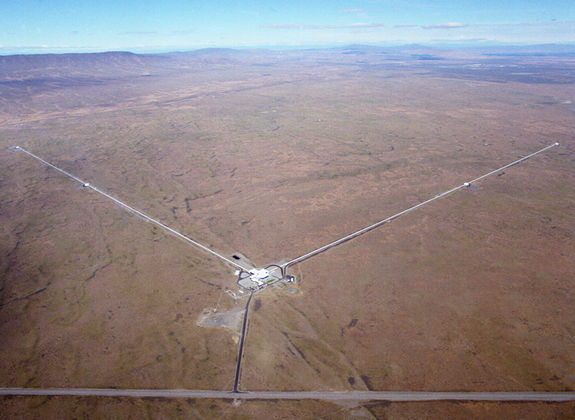
ligo detector

I’ll end with some relevant things to look at. Above is part of the LIGO detector (photo from NASA’s website). Here’s a link to the LISA detector that everyone hopes will […] Click to continue reading this post

That Ain’t Workin’

Remember the Tune “Money for Nothing”, by Dire Straits? It was a big hit in the 80s. (Remember those?) Well, Warren of the new blog A Strange Universe wrote a rather brilliant physics version of it, to be sung to the same tune. The “stringer” is the object of the ridicule of the song’s character. The original post is here, where he’ll tell you his thoughts on the song. I can’t resist (I hope he forgives me) posting the entire thing here, rather than an extract, which would break up its impact. (Original song’s lyrics are here, by the way, for comparison.)

So here it is: […] Click to continue reading this post

Masterclass, II

Don’t forget to catch the latest installment of Joe Polchinski’s rather thorough deconstruction of the nonsense, obfuscation, selective memory, and other confusions that constitute the bulk of Lee Smolin’s attack on string theory.

All the points I’ve had the energy to raise have been made here on Asymptotia […] Click to continue reading this post

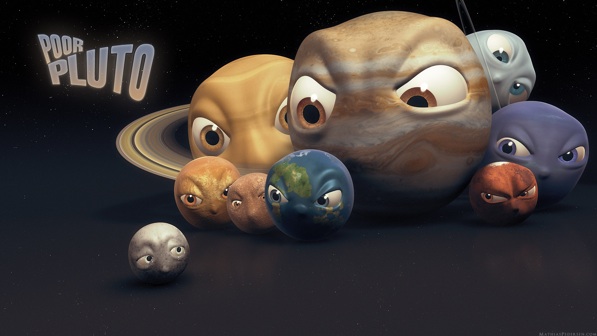
Poor Pluto!

Remember our discussions of Pluto’s demotion/reclassification? (Lots of link reminders at bottom of post.) Well, here’s a sad (and amusing) image* created by artist Mathias Pedersen:

poor pluto mathias pedersen


You can see a high resolution version of this image here. Don’t forget to look at more of of the graphic art of Mathias Pedersen**.

Poor Pluto indeed!

(Take some time to appreciate how good a job he’s done on colours and other features of the […] Click to continue reading this post

NASA’s Wrong Stuff?

Have a listen to Greg Easterbrook (of Wired) in conversation with NPR’s Steve Inskeep on Morning Edition. The issue is whether NASA’s focus on setting up a manned base on the moon, and then heading for Mars, is really the right focus for a huge (multiple billions of dollars) expenditure, given other scientific priorities. The link is here. See also his Wired piece here, entitled “How NASA Screwed Up (And Four Ways to Fix It)”.

That was yesterday. Today, also on NPR’s Morning Edition, I heard NASA’s chief administrator Michael Griffin attempts to defend the policy. There’s a link to audio here, and be sure to listen to the audio (the transcript offered there is only partial, for a start). I find it revealing. He seemed to have a great deal of difficulty answering certain key questions, such as “Do you think it is the best use of money or not?”. “Are there priorities that you have had to cut…?” His answers on climate change and global […] Click to continue reading this post

Griffith Observatory: Entertainment, Education, or Both?

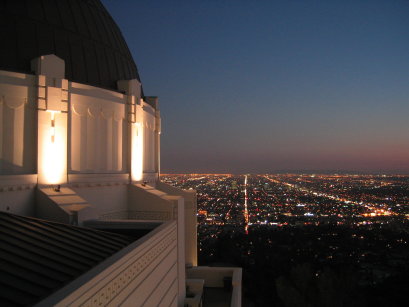
partial view of and from griffith observatory at night, by c.v. johnsonYou may recall a post I did some time ago about a worrying development at Griffith Observatory, just before it reopened after the splendid three year refurbishment. (See here for my long post -with pictures- of my visit to the facility around the time of its reopening.) Various reports said that they’d decided to hire actors (not trained in the subject of astronomy) to largely replace the lecturers (trained in the subject of astronomy) for the new planetarium show. This seemed a very disturbing turn of events, and so I did the blog post about it.

Well, I’d put the issue out of my mind until a few weeks ago when Jerry Weil, one of the show’s creators, showed up in the comments section (I love Google) and made his case for why the new show was just fine. Among the things he said in his comments were:

With the new structure of the shows, there is no time for a Q&A period, so there is no need for the lecturers to have any knowledge of astronomy. It is important to keep the show exciting and entertaining, but the star of the show should be the visuals.

Now, I have not seen the show, and so cannot comment in detail on its contents, or the setting, but I am -to say the least- very worried about such a statement. So I asked him to unpack the statement a bit more, thinking that I may have misunderstood. His clarification:

As far as the role of the lecturers, I was certainly one of the people who originally thought it was an unnecessary burden to have live lecturers when a canned narration would work just as well. After seeing the show, I have to say that having someone there live really adds to the excitement of the show. It makes it “feel” more interactive, and it certainly keeps your attention knowing there is a live human there speaking. However, since it is all scripted and there is no Q&A, it is not necessary for the lecturers to have any knowledge of astronomy. I am also an actor myself (in fact I had coincidentally worked with the actor/lecturer at the show I saw), and I have certainly played many roles in areas where I had no prior knowledge. In this situation it’s more important to have people who can convey the excitement and wonder of the Universe than to have a deep understanding of the subject matter.

Not wanting to repeat my often-made point that education and entertainment need not be thought of as mutually exculsive, I made a mental note to see the show and revisit this issue if I thought I could contribute further.

Remarkably, a few days later I was at a party at a neighbour’s house (Cinco De Mayo), and it was a great opportunity to meet some more neighbours. Among those were […] Click to continue reading this post

Parthenogenesis, II

bonnethead sharkRemember Flora? The Komodo dragon? I blogged about her here and here. She produced offspring using parthenogenesis while in captivity last year. Well, there was a news story earlier this week about a bonnethead shark in in the Henry Doorly Zoo in Nebraska giving birth to a pup. (Interestingly, zoo-keepers and news reporters seemed uninterested in giving our subject shark a name, as happened for the reptile.)

It was a puzzle for a while as to how she did it (as I learned in a BBC article):

At the time, some theorised that a male tiger shark kept at the zoo could have been the father – but the institution’s three bonnethead females had none of the bite marks that are usually inflicted on their gender during shark sex.

Some even suggested that one of the females could have had sex in the wild and stored the sperm in her body – but the three-year period in captivity made this explanation highly unlikely.

But eventually DNA tests resolved the issue:
[…] Click to continue reading this post

A Fair Bit of Fun with Science

Yesterday was a full day indeed. The main event? The California State Science Fair. The venue? The California Science Center (just across the road from USC). Here’s a picture of it in case you’ve never been:

california science center
(Click for larger view.) California Science Center (with one of my personal emergency escape crafts cleverly disguised somewhere in the picture – all scientists have emergency escape craft, by the way – along with our plans to take over the world, our lab coat, and so forth…)

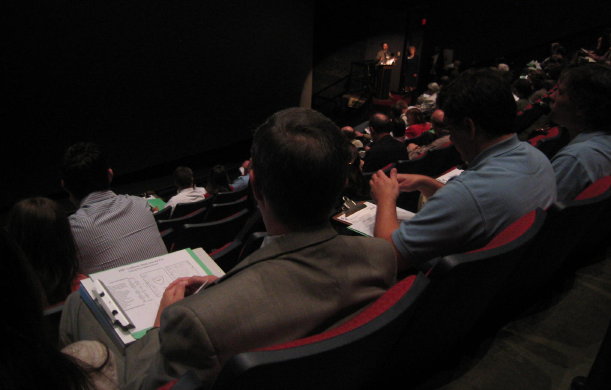
science fair briefing of judgingThe time? 7:00am. Yes, we start early, as there is a lot to do for the long morning. The judges all gather in the IMAX theatre for a briefing about the ins and outs of the organization this year, the times at which various things will happen, and a reminder about some of the finer points of judging.

At 8:00am we broke up into groups of judges who will judge various sections. Mine was Applied Mechanics and Structures – Senior. Here, we decided on our collective strategy concerning how we’ll go around the various displays, making sure at least five judges (there were ten of us in total) see each project once in the first round of interviews. We’ll compare notes during the break at 11:00am, agree which ones we should all have seen – in order to focus on deciding which ones get which prizes or honourable mentions. I forgot to take a picture of our group of judges sitting around the table chatting. Most of the judges in my group were people from the aerospace industry, I gathered. About three or four people were new to the whole thing, and so some of us explained a bit about the things that we ought to be looking out for in the judging. This also (given the section were were to judge, and given the makeup of the judging panel – many coming from an industry where the place where the science and engineering are quite thoroughly – and necessarily – mixed together) leads to discussion about making sure to distinguish between a great science project and a great engineering project. It’s also good to be aware, when making comparisons, of the vast differences in resources that some entrants have access to. These two things, to my mind, are very important (and we all agreed). A kid (especially one with access to lots of resources, for example) can dazzle an unwary judge with lots of fancy cool equipment and build something that is truly wonderful and admirable, but that does not necessarily mean that they would have done as much science as the next entrant who has done some very careful scientific experimentation with a innovative way of answering a clearly stated question, but in a less spectacular setting – perhaps mostly using more affordable household items.
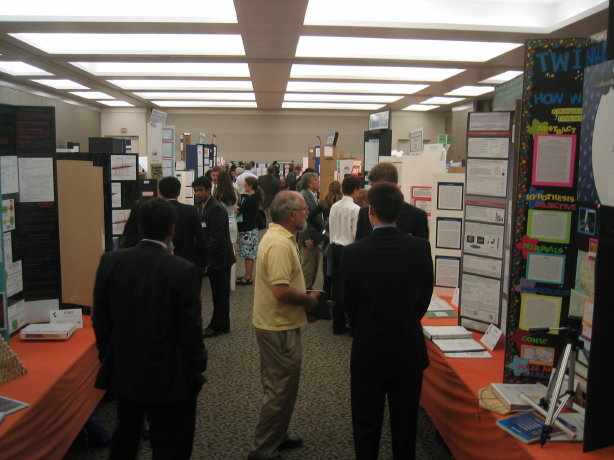
science fair students
(Click for larger view.) Overview shot of one of the sections, with poster displays.

Well, with that in mind, we all went off to meet the youngsters! See the project listings here. This is the best part, of course… talking with all those enthusiastic young people […] Click to continue reading this post

JPL the new Disneyland?

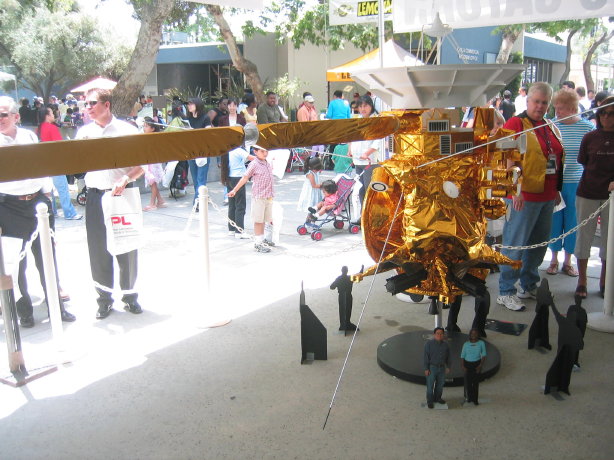
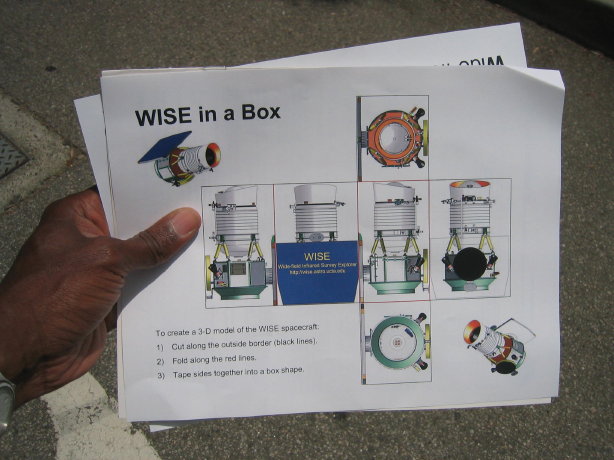
If you’re looking for a day (or half day) out today in the greater Los Angeles area, let me suggest a trip up to the Jet Propulsion Laboratories (JPL). (Details here.) Their open house (held today and yesterday) is rather fun…. you get to learn about some of the grand space missions of yesteryear (like the 1977 Voyager missions… both craft are still actively sending data from beyond the solar system now), or of the moment (like Cassini-Huygens, for example sending wonderful pictures of Saturn and Titan back for us to learn from and marvel at – see e.g. here), or to come soon (like WISE (an infra-red telescope which will help broaden and deepen our understanding of planetary systems, galaxies, and the universe at large), or Dawn (a mission to go and orbit and study two large asteroids).

JPL Open House

You can learn lots of things about the science these missions are teaching us about not only far away worlds, but about our own world. There are also missions which are studying earth directly (making observations about our atmosphere, oceans, and so forth), so even if you don’t care about space, there’s something for you.

JPL Open House

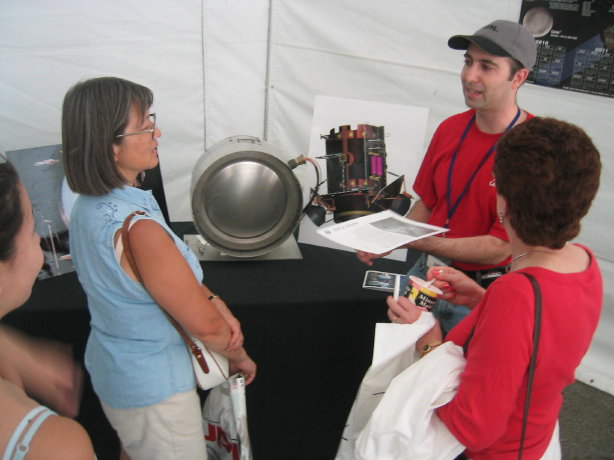
JPL Open HouseYou can visit special exhibits for each of the missions, talk to scientists and engineers, and even visit the large warehouses where the spacecraft are made, and where they are assembled. There are the control rooms to visit, JPL Open House a dome with giant robots (I’ve no idea about that one), an extra special exhibit about Mars exploration, and lots of stations with all sorts of entertainment for kids! They’ve done a great job providing a lot of material for everyone to take away, including packets of information for teachers to use in their classes too! […] Click to continue reading this post

Read a Gravity Essay Today

The Gravity Research Foundation announced its awards for the 2007 essay competition. (Hmm: I think we should have more technical science essays, in more categories, to inform each other about what the big questions and answers are…. and maybe even just for fun (because I’m in a silly mood) -and to make an important point about how vital it is to communicate what we’re up to to each other- have a swanky awards ceremony, with speeches, and music, and an MC, and everything. And of course it should be held somewhere in LA… Like the LA Times Book Awards. It could be held at the same time as (another fantasy): awards we give to our peers for the important task of writing essays, books and other efforts in the service of communicating science to the general public.)

But anyway, you can read all about the winners of this year’s awards here. Nicking a bit of text from the site, here are the top prizes: […] Click to continue reading this post

LHC Coverage

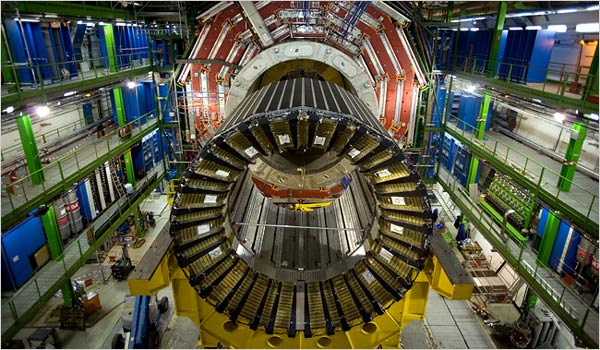
CMS at LHC NYTimes

One of the Large Hadron Collider’s detectors, the Compact Muon Solenoid (CMS).

As you gather a lot when there are discussions on the topic here and elsewhere, there’s a lot of excitement and anticipation among high energy physicists about a number of things. I would go as far as to say that we are already in a very rich experimental time for results pertaining to high energy physics (or, if you insist, “fundamental physics” issues (I have in mind, for example, all the wonderful cosmological and astrophysical data that continues to come in, with more to come), and it is set to possibly get much richer – maybe even a new Golden Age with a little bit of luck – when the Large Hadron Collider starts producing results. We are really going into the (relative) unknown with this experiment, and this will be a great time to be working in the field – with a little luck, as I keep repeating.

A number of substantial articles have recently appeared in the general media that give you a good sense of what is going on, more reasons (and more detail) for why there is […] Click to continue reading this post

Taking the Time to Work it out

Itzhak BarsOne of my colleagues here at USC, Itzhak Bars (picture right, by Don Milici), spends a lot of effort trying to understand aspects of time. In fact, in his way of approaching things, the fact that we see a single time dimension (all the others being space dimensions) would be a consequence of certain choices (“gauge choices”, in the more technical language) made, whereas in the underlying formulation, there’s be two times. Yes, two.

You hear about extra dimensions, and you think “string theory”, no doubt. No, this is nothing to do with string theory. He’s developed this idea independently of string theory for years, working first with quantum mechanics, and […] Click to continue reading this post