Quite a Lot On
 It was quite a busy week for me, and so all those moments I meant to stop and post thoughts and observations seemed to evaporate as I went from one thing to the next, with rather full days. I hit the ground running on Monday with several extra things on the calendar including being an external member of the committee for a thesis defense in the Chemistry department. Always useful and instructive to look in on what one’s colleagues are up to, and it was a rather nicely written thesis well defended.
The evening saw me at Bovard Auditorium to attend a pleasant visit by author Michael Ondaatje. My colleague from English and Comparative Literature, Hilary Schor, always super-enthusiastic about great authors, gave an introduction and then he came onto the stage and read a few extracts from his work before having a rather nice conversation with Hilary. Then the audience joined in with questions and comments of their own. While it was not full, it was a decent audience for this event, given its type, and I was happy to get the perfect seats I got. I had not done an RSVP, and came as a walk-in only to discover that some of the people on the door knew me and arranged for me to sit in the reserved seating for special guests. Only then did I remember that I’m on the committee that partly was responsible for this event […] Click to continue reading this post





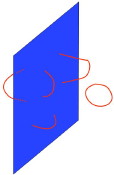 It was a fun week in the string theory class this week, as we got to some major landmarks that are always fun to teach. We’ve uncovered the extended objects called D-branes (see numerous previous posts for how useful and important these objects are in string theory research) in all their glory in the lectures before, and deduced lots of their properties, such as the form of the action that determines how a D-brane moving in spacetime responds to the various fields (including the geometry) created by the string theory. That’s all fun, but then the key thing to do next is to compute the mass of these dynamical objects, or the mass per unit volume – the tension. Computing it fully, with no hand-wavy factors. Your mass measures how strongly you interact with gravity. So you can measure it by studying the gravitational interaction between masses. (You do that when you step on a scale to measure your weight… well the scale does it by showing how much force it takes to stop you from falling through the floor toward the center of the earth…)