Archive for the 'academia' Category

All Hands on Deck

all hands on deck Well, it’s the middle of the Bleak Midwinter, and the first day of classes of the new semester. Mine start tomorrow. It is time to get myself back into the classroom-teaching frame of mind -although to be honest I don’t think the break was long enough for me to have got sufficiently far removed from it: 85% of the research tasks that I wanted to do during the break remain undone.

Anyway, I must sit and contemplate what I am going to talk about in the graduate course entitled “Selected Topics in Particle Physics”. It’s my lunch break, so I thought I’d chat to you for a bit.

Rumour has it that everyone is expecting some sort of string theory course, reasonably complementary to the one that my colleague Nick Warner taught here two years ago. I’ve no interest in just teaching the standard string theory topics - a good and motivated graduate student can just look them up in a book if motivated enough (if they can’t they’re in the wrong business) - and so I’d like to throw in some material that is not packaged together in the standard way, and give them an education that emphasizes powerful ideas and techniques that are relevant to more than just standard string theory research, but theoretical physics in general.

You see, this is one of the wonderful things about the topic that you don’t hear about much when people say things (and write books for a general audience) about how much it is supposedly taking over smart young minds and leading them astray: It is a fantastic framework for training good physicists for whatever new and useful ideas and physics will come along in the future, whether it is string theory or some other topic. The point is that string theory has developed in so many different ways, and Continue reading ‘All Hands on Deck’

Budgetary Blues

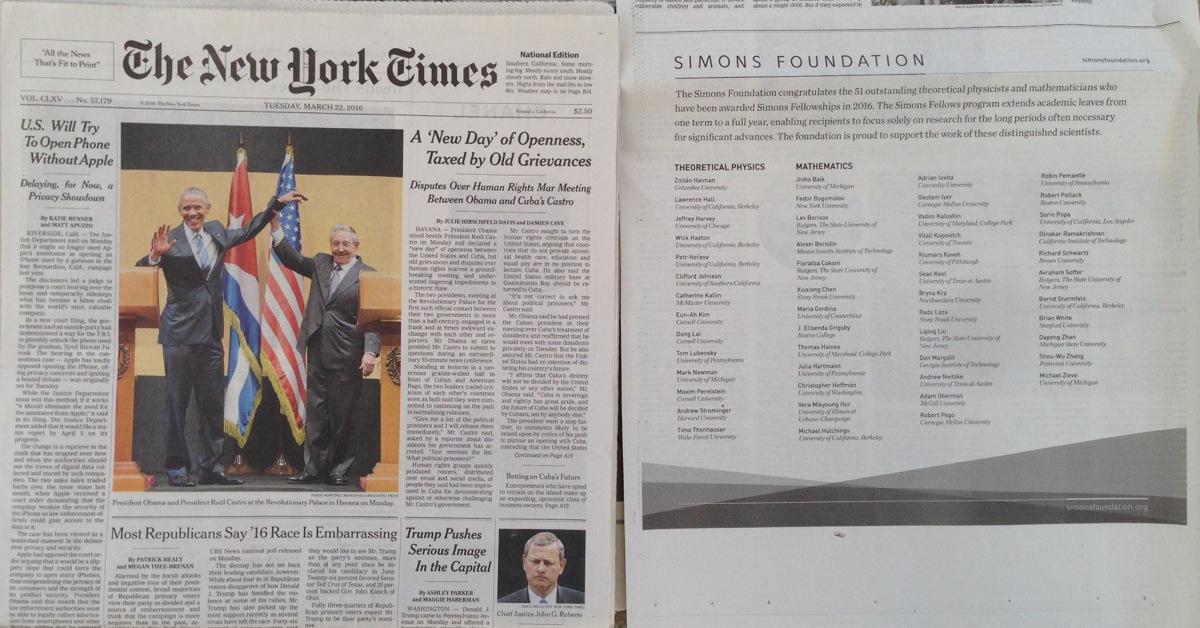
AAAS budget graphic for New York Times Yesterday there appeared a New York Times article by William J. Broad about the effects of the congressional budget delays on funding for scientific research. It’s not cheerful reading, but it is worth knowing about, especially since the forecast is not set to dramatically improve any time soon.

The article is here.

There’s not much to say here, since the comments I could make are obvious.

On the right is a look at the AAAS graphic that was used (click for larger) in the article. It does summarize things a bit, but you should of course learn about the details in the article.

-cvj

(Via Dynamics of Cats)

Research Blogging

Time to talk briefly about other uses of blogging. Some time ago I spoke about the idea of using blogging as a sharper tool for exchanging and even developing research ideas. The conversation about the suggestion degenerated into vapour, at some point, and having floated the idea and learned from the conversation, I left it alone. In public at least.

In private, I continued. The fact is that I have other blogs on the go. I’d like to tell you about one of them, since it might be a useful tool for you too. The way I use it is simple. I run my “lab” with it. It’s my virtual lab-space. I have about five students working with me, and a million and one projects, and not enough hours in the day. The students all are working on several projects with me, with each other, and alone…. but all under the umbrella of being part of my little “subgroup” of the larger high energy theory group here at USC. I want us all to have conversations, point at new papers, throw out ideas, show partial computations to each other (and definitely to me) for comment, share drafts of papers with each other, etc.

So far so standard. Normally, this is all done with emails back and forth, one on one conversations, etc. Sometimes those conversations can be supplemented by one or other person from the group (me, or anyone else) dropping in and setting the whole thing straight with a comment. Sure, you can do this with email in the “reply-to-all” mode, but….

A blog is the perfect tool for making this all work seamlessly. On the “cvjlab” blog Continue reading ‘Research Blogging’

Women in Science - What to Do Next?

Cornelia Dean has written a very interesting article for the New York Times about the things people are doing to change the current situation concerning the underrepresentation of Women in Science in academia. It continues on from the discussion we were having after the September release of the report by the National Academy of Science on the issue.

The key point under discussion? From the article:

Since the 1970s, women have surged into science and engineering classes in larger and larger numbers, even at top-tier institutions like the Massachusetts Institute of Technology, where half the undergraduate science majors and more than a third of the engineering students are women. Half of the nation’s medical students are women, and for decades the numbers have been rising similarly in disciplines like biology and mathematics.

However…

Yet studies show that women in science still routinely receive less research support than their male colleagues, and they have not reached the top academic ranks in numbers anything like their growing presence would suggest.

In fact, it is only in the social, behavioral or life sciences that the proportion of women full professors has risen into double digits - 15 percent or so. Something goes wrong. What is it?

at each step on the academic ladder, more women than men leave science and engineering.

The current article reports on a number of gatherings on various campuses - conferences organised to network, share, and brainstorm a bit on the issue. There are interviews with several people, and experiences and anecdotes are shared. Very much worth your time to read. Discussed are a wide range of topics, the most central being that it is still the case that women are judged by different standards than men. Even though often times it might seem to be something as simple as what to wear to a meeting - it makes a difference. These things all add up. Other things mentioned are the two-body problem, mentoring, letters of recommendation, children and motherhood, and negotiating skills, among others.

I’ll let you read the article, but do come back and let us know what you think. We’ve been through a lot of this discussion before, so one aspect I’d like to hear about is the following: What are you doing about the issue in your own sphere of influence? Are Continue reading ‘Women in Science - What to Do Next?’

Out West

Well, yesterday I handed in my grade sheets for my courses, so I’ve finished all undergraduate teaching duties for the calendar year! Time now to turn to all those things that have been piling up waiting to be done. Eventually, this will mean research, but in between there are various tasks, from writing letters of recommendation to reviewing grants, fellowship applications, and more.

Mostly, I just want to disappear for a while. Leave the planet for a bit and go walkabout, like I did last year’s holiday season. That might happen, but I have to be partly available for a little while for a number of duties. Either way, I need to get out of the old mode, and into the more contemplative one. In order to begin the resetting, I decided to hide away from campus entirely and in the afternoon visit one of my other offices… the beach.

I had some errands to run out in Santa Monica, such as picking up my boots from that great boot repair place (where I’d dropped them off to get stretched a bit… the miracle repair I told you about before had resulted in them a bit stiff and slightly tighter on the slopes, and so I thought I’d try a stretching of a few days), and so this fit well. I figured I’d just stay there until the evening.

I have a love-hate relationship with Santa Monica. It sometimes annoys me a lot, and seems to be a place that is so squeaky clean that all the flavour of real life has been drained out of it, to be replaced by mostly smugness…. but at other times, I’m very happy with it, since it has a number of gems that I like a lot.

If the truth be told, one of the main reasons that I like to go over there is the tarts. Continue reading ‘Out West’

How To Make It Stop?

Ok, I know that in a post a while ago I said:

I don’t know about you but I melt each of the (very few these days) times I receive a real letter, by post…

So you’d think I’d be delighted with this pile (it is more than three layers deep - and I’ll get at least this many again over the next month or so):

letters

Well, yes and no. What are they?

Continue reading ‘How To Make It Stop?’

Supporting the Alternatives

Many of us received a letter today from the Editorial office at SISSA about supporting not-for-profit journals like JHEP (Journal of High Energy Physics) and some of its siblings. Why? Simply put, the other journals seem to be less about the science and more about the money. We discussed this a lot in my field back way back when JHEP was starting out, and several physicists switched to JHEP -pointedly turning their backs on Nuclear Physics B for example- as a group. Basically, you do the research, submit it to a journal, and they sell it back to you and your institution at extortionate prices. Better, they get you to contribute to doing their job by doing all the typesetting, reviewing of other mugs’ papers, etc. In fact, most of their work involves just raking in the money, as far as I can tell… So people moved to a model which was more about distributing refereed work for people to read, making heavy use of cost-savings involved in using electronic communication and distribution. Below I reproduce the letter I received from Marc Henneaux and Hector Rubenstein about this matter*. I’ll be interested to hear your opinion.

One thing I am concerned about is the relative weight of physics vs other fields - how much of a difference will this make to science publishing at large? What else can we do to change things? Take some areas of Biology for example. Elsevier (who publish Nuclear physics B, for example) probably makes a huge amount more money out of them than physics, if you take into account the large number of colour figures, etc, (and the associated page rate) that go into a typical publication. Might it be that progress by Elsevier (and other publishers) in reforming their economic model to be a lot more fair might be less speedy until we get the Biologists (and other fields) to support their own versions of the alternatives? Biology journals run for the sake of the subect and not the money? Perhaps this process already has begun? I do not know. Does anyone? Last time I talked about this to a prominent biologist, they seemed to be under the impression that online distribution of published work (particularly online pre-print distribution like hep-th that I know is slightly different but not unrelated) was akin to hanging out in internet chat rooms, and said so explicitly…. but this was before Nature and others started doing their major online work, so perhaps attitudes have changed…. Thoughts?

Anyway, here is the letter:

Continue reading ‘Supporting the Alternatives’

Grin and Bear It

illustration by Deanna StaffoWell, it is midnight and I am only on page 12 of the notes I am writing to present as a talk in the Southern California String Seminar tomorrow at 9:15am. Don’t try this at home - prepare talks early, ok?

Where is the seminar being held? UCLA! What University am I from? USC! What event happens tomorrow besides my (hopefully not too terrible) talk? The big USC vs UCLA head to head in College Football. If USC wins, they go to the championship game, apparently. Yay.

So the usual articles about the cross town rivalry between the two institutions have shown up this week in print and on National radio and TV. There are two amusing (and interesting) ones that I looked at - one in LA Weekly (about academic performance, faculty recruitment, student acheivement, and much more - illustration above from it, by Deanna Staffo), and one in the LA Times (mostly about nightlife). Have a look. There are dozens of others -just type USC into the LA Times search engine for example. You learn things about both universities as well from those two, so it is not without some point. For example, our young ones clearly go to cooler bars, for a start, as you can see from the pictures in the LA Times article.

(Strange that the articles do not mention the cooperation and general fun had when their high energy physics groups get together to discuss topics in string theory and other physics. Very odd omission indeed.)

I would say a lot more about the articles, but time is not on my side, so I will instead leave you with a blog post I wrote (“Drag the Bear”) on December 2nd last year, upon encountering something strange on campus:

Continue reading ‘Grin and Bear It’

My Powerpoint Advice

Chad is giving more “Powerpoint technique” tips over on his blog.

I’d like to give a few tips of my own:

  1. Learn to give a good 55 minute chalkboard (or whiteboard) talk first. Only then learn about how to give a talk with a computera.
  2. Powerpoint?! Don’t use Powerpoint, for goodness sake! Use Keynoteb!!

-cvj

[aRegardless of program you are using to project the talk. And am I the only one who Continue reading ‘My Powerpoint Advice’

We’re Not Doomed

video gamerUSC has launched a Bachelor’s degree in video games. I know what you’re thinking. Stop it! No, civilisation is not doomed. (Image on right grabbed from Chip Chick). In fact, this could be rather wonderful, as it will create the opportunity to develop the potential of this medium in so many wonderful ways. It will not be about kids sitting there blowing up stuff and shooting up people. Why do I say this?

I remind you that in 1929 USC founded the first film school (at least in the USA)…. I imagine that people turned up their noses at this. Film is now recognized as a major art form, and a powerful tool for education and expression, with USC continuing to lead the pack in educating artists, visionaries and technicians in that area, feeding the local Industry and well beyond.

Doing a degree in film or movie-making (or “The Cinematic Arts”, as we are supposed Continue reading ‘We’re Not Doomed’

More Uncertainty

walt disney concert hallYou may recall the very successful event called “Uncertainty”, back at the end of August. I blogged about it here and here, among other places.

Well it is time for the second one in the series. Recall that it is part of the Provost’s Visions and Voices series, which has been running since August, with a huge program of events of all sorts.

Here are some words about the event:
Continue reading ‘More Uncertainty’

The 2006 Nobel Prizes: Who, What and Why!

Not long after the colloquium on the Fields Medal work, we had a joint presentation by three colloquium speakers on the topics of the three science prizes awarded from the good folks in Stockholm this year. This was another very popular Monday talk, with people from various other departments joining us, given the topics being discussed. The speakers talked about the science of the prizes, and also reflected upon how it drives or interfaces with future research, perhaps their own research program.

First up was Lin Chen, of Chemistry and Molecular and Computational Biology. He told us about the Chemistry prize, awarded to Roger Kornberg, “for his studies of the molecular basis of eukaryotic transcription”.

lin chen

Starting out by reminding us about the basic chain of relationships within organisms concerning the movement of genetic information, (the “Central Dogma”) he explained Continue reading ‘The 2006 Nobel Prizes: Who, What and Why!’

A Man Out Standing In His Field

Two of our colloquia this semester were concerned with work very much in the public eye this year. The first was from Francis Bonahan of the Mathematics Department here at USC.

F bonahan colloquium

He talked about the work that won the Fields medal - the proof, by Grigori Perelman, of the Poincaré conjecture. Or better, I should say the work toward the proof, since the citation does not explicitly mention the conjecture, but his larger body of work. (MathWorld link, Wikipedia link.) In fact, Francis spoke about a lot more than just the Poincaré conjecture.

F bonahan colloquium

He talked about the larger setting in which that work fits, something mathematicians call the “geometrization conjecture”, which Mathematicians care a lot more about. Perelman’s work does more than just prove the Poincaré, it addresses the whole (3-)ball of wax, so to speak. He told us quite a bit about that in the talk, spending most Continue reading ‘A Man Out Standing In His Field’

Inside the Academics Studio

Well, do you know the show on Bravo, “Inside the Actors Studio”? The host interviews an actor of some sort -pick your favourite- and you get an in-depth conversation about their life, work, motivations, loves, hates, passions, etc. Not in the service of frivolity, but in pursuit of an understanding and further appreciation of the craft of acting itself. A lot of people like the show for those reasons.

Imagine the same thing, but with an academic in the hot seat. This is what happens tomorrow, hence the title of this post. I will be the interviewer, and my new colleague cosmologist/astrophysicist Elena Pierpaoli will be the interviewee. It will be in front of a live audience.

No, it won’t be on Bravo, or any other tv channel, as far as I know. It is a local USC event, part of a series, and a jolly good idea I must say. It got me thinking:- What academic in history would I like to have sit in my interview chair, and if I only had one question, what would it be? Off the top of my head (and stretching the definition of the word “academic” a bit, I’d like very much to have Galileo, Leonardo da Vinci, Beethoven, Dirac… oh and several more… But what would I ask them? Don’t know yet…. need to think about it.

Here is blurb about it. And yes, I’ve already been teased by my students and a colleague about being described as a “super string theorist” in the advertising.

I may well wear a cape to the event.

-cvj

Memories, Physics, and Celebration

It’s a pleasantly foggy morning here on the USC campus. It is 7:00am now (at least at start of writing), and it will all burn off in a few hours, I imagine, to reveal the sunny sky waiting for us. But right now it reminds me of the Cambridge morning of a couple of weeks ago. A foggy Saturday morning in fact. I took that photo of the spider web I used on Halloween with that mist in the background.

That Saturday of celebration of Andrew’s work (The Andrew Chamblin Memorial Conference) at Cambridge was a remarkable experience. (See here for my first post on Andrew, with tributes.) I was exhausted through a good deal of it, since I had eight hour jetlag, but I’m so glad I went, and that I could contribute a talk. I met many old friends and colleagues, drawn mostly from the UK and European side of Andrew’s collection of friends, collaborators, and admirers in the field.

andrew chamblin memorial conferenceThere were talks by former collaborators of Andrew’s: Gary Gibbons, myself, Roberto Emparan, Robert Caldwell, Raphael Bousso, and Stephen Hawking (who also guided some of Andrew’s thesis work). Gary, in “Discrete Symmetries and Gravity”, talked about Andrew’s early Oxford and Cambridge work on various discrete symmetries in physics, particularly those of a geometrical origin. He’d played with various ideas in this context, including some applications to problems in cosmology and other areas of physics. Gary described some of this Continue reading ‘Memories, Physics, and Celebration’

Hang In There, Rob Knop!

Hang in there, Rob! Keep up the good fight for a better climate for, (and representation of) women in your department, and in departments everywhere.

-cvj

Panel Matters

Coffee break.

Day two of the panel work. Locked in a room again, looking at proposals. Yesterday we deliberated over who passed to the next stage, and who did not - a painful process at times. Today there’s a final part of the process to be performed. We are writing feedback to each applicant to give a little guidance on their proposals for the future. This is an important service to perform, as you can imagine by simply putting yourself in the shoes of the person applying for the grant. In a room full of international people, all with some pride in their wordsmithing abilities, jointly crafting sentences that reflect the salient points of the panel’s deliberations is often an amusing task. Last time I did this (earlier this year) I learned a good algorithm for getting right the use of “that” vs “which” - useful when writing with eight hour jetlag. I probably should have known it before. In addition, I’ve learned several arcane uses of hyphens, “however”, and other modifiers, but I’m sure I’ll forget those.

The coffee is a bit weak. Not a good thing.

Well, better carry on.

-cvj

Magic Ring

guinness circle

It was a long day on the Job. From 8:15am to 6:15pm, we were stuck in one room for more or less the entire time. Now…. a quick guinness on the way back from dinner. Conversation about the private vs public forms of university, funding in science in general, dark energy and dark matter, Borat…. all the big topics of the day.

-cvj

Those Self-Fulfilling Prophecies

You may recall that we were recently discussing stereotypes as a result of an earlier post. Particularly, I was talking about the effects those sterotypes can produce as a result of modifying the expectations of others, making it hard for some people to be taken seriously, and resulting in them having to go that extra mile (or several) as a result.

Well, I’d like to point your attention to a recent study about the direct effects of those stereotypes on the stereotyped. Quoting from an article by AP science writer Randolph E. Schmid:

[Steven J.] Heine and doctoral student Ilan Dar-Nimrod wanted to see how people are affected by stereotypes about themselves. They divided more than 220 women into four groups and administered math and reading comprehension tests between 2003 and 2006. Their results are reported in Friday’s issue of the journal Science.

What they actually did was to provide the different groups with different images and reading materials before they did the tests. They seem to have found significant differences in the results that suggest that having a negative stereotype of yourself in mind actually makes things worse. In other words:

It’s a process psychologists call a stereotype threat, Heine explained. “If a member of a group for which there is a negative stereotype is in a position to test the stereotype, they are likely to choke under the pressure.”

So reminding them of the stereotype affects them.

Here’s what they found:

Continue reading ‘Those Self-Fulfilling Prophecies’

New Colleagues

Ah! The joy of new colleagues! I have somehow forgotten to tell you one piece of the great news that we had here at USC Physics and Astronomy recently. We got three new faculty, and one of them is here in action (I’ll tell you about the others later), telling us about the physics behind the 2006 Physics Nobel Prize. This is Cosmologist/Astrophysicist Elena Pierpaoli:

elena pierpaoli

She’s one of those people who works closely on (among other things) the data from Continue reading ‘New Colleagues’

Manifold Yau

calabi-yau sliceWell, here’s yet another discussion of Yau to gobble up. It is a New York Times article by Dennis Overbye on Yau, his life and work*. I’ve no idea why this was written, or what the timing was. I’d like to believe that it was just because it is a good subject -because it is- and that it is worthwhile to do an article about a Mathematician of considerable stature in the field, and about the ins and outs of the world of Mathematics -because it is. But I can’t help but wonder if this would have seen the light of day if there was not the big argument going on about the New Yorker article and Yau’s displeasure with its contents. (Image on the right -click for larger- was taken from this site. It is a slice of a Calabi-Yau manifold. There’s more in the article about Yau’s work on those.)

Well, I don’t care what the reason is. I love to see articles of this type written about this Continue reading ‘Manifold Yau’

Irrational Memories

Back when I was young enough to care to try to list such things, I had a favourite number. Really, really faourite. I lived and breathed that number for a while. Today’s session in the freshman seminar “The Art and Science of Seeing and the Seeing and Science of Art”, about which I have blogged here and here, was all about it. Rather than do chapter and verse about it (don’t get me started!), I will instead leave you with the image that I ended with…

penrose tiling

… and let you tell me and other readers - if you like - what you think the number is, what it means to you, and perhaps share whatever you like (or hate) about it.

-cvj

Yau Fights Back?

Well… yikes! Remember my article on the New Yorker piece on the Fields Medal, the Poincare Conjecture, and the mathematicians Perelman and Yau? Remember that I said:

I cannot comment upon whether the hero of the story (Grigory Perelman) is as heroic as painted, or whether the villian of the piece (Shing-Tung Yau) is really as villainous. The anecdotes that are used to do the painting may well be able to be supplemented by other anecdotes that tell another story, as is sometimes the case. I simply don’t know.

Well, it seems that Yau is quite sure that it is not going to stop there. There was a letter sent to the New Yorker and the authors of the article (apparently) on his behalf by legal counsel. It is discussed and can be found on a web page under Yau’s name. The page is in the form of a press release, and I quote:
Continue reading ‘Yau Fights Back?’

On The Potential of Women Scientists and Engineers in Academia

Today, the National Academies released their long awaited report on the potential of women scientists and engineers in academia. The title is “Beyond Bias and Barriers: Fulfilling the Potential of Women in Academic Science and Engineering”, and it can be obtained here. This is a hugely important topic, and they seem to have done quite an extensive amount of work on this. Here are some quotes from the press release, and then I’ll make some comments of my own at the end:

“Women are capable of contributing more to the nation’s science and engineering research enterprise, but bias and outmoded practices governing academic success impede their progress almost every step of the way,” said Donna E. Shalala, president of the University of Miami, former secretary of the U.S. Department of Health and Human Services, and chair of the committee that wrote the report. “Fundamental changes in the culture and opportunities at America’s research universities are urgently needed. The United States should enhance its talent pool by making the most of its entire population.”

Much the same can be said (and has been said in, e.g., my earlier blog posts on CV) about the largely untapped talent pool of minorities in general, of course. Continue reading ‘On The Potential of Women Scientists and Engineers in Academia’

USC has the best GPA

Well, although we can hold our own on the academic standards side of things, in this case I mean Gay Point Average. I saw in the New York Times today*, in an article by Stephanie Rosenbloom, that USC and UPenn both scored the highest possible score (20 out of 20) for their “campuses policies, programs and practices affecting lesbians, gays, bisexuals, and trangender people”. This was in the Advocate College Guide for LGBT students. This is just great!

Please read the article, which is very interesting indeed, discussing several campuses throughout the USA. I’ll simply end with the closing paragraph, which sums up the response to the “why” question that might be forming in some minds. It quotes Kevin Jennings, the executive director of the Gay, Lesbian and Straight Education Network:

“When people feel included they can focus on learning,” Mr. Jennings of the education network said. “When they feel isolated and marginalized they can’t. And what LGBT students want is what everyone else wants when they go to college: They want to feel like they belong.”

-cvj

(*Thanks Caolionn!)

A University of Wonderful Things

I’ve come to realise that there are all sorts of really interesting people on the USC campus, involved in fascinating work and interesting projects of one sort or another. This is of course true for any university. However, I am still finding pleasant surprises and connections quite regularly. The last major such discovery for me was in the early Summer, when I found out that the excellent writer Aimee Bender (e.g. “The Girl in the Flammable Skirt”), whose work I knew about in a different context, is on the faculty here. (I mentioned this and described her contribution to one of the Categorically Not! events in this post.)

Now I’ve noticed that the hugely popular blog Boing Boing Cory Doctorow is here for the year as the Canada-U.S. Fulbright Visiting Research Chair, which will be co-hosted by the Viterbi School’s Integrated Media Systems Center and the USC Center on Public Diplomacy. Obviously I don’t read Boing Boing regularly enough or I would have noticed the increased flux of USC events and other things mentioned there in the last few weeks. Silly me.

Anyway, it’s nice to have another little blog carry the load of telling you a bit about what goes on at USC. So I can relax a little, right?

Here is an article about it on the Viterbi School’s site, from which I quote:

In his new role, announced this week by the Canadian Fulbright Commission, Doctorow will collaborate with USC faculty and students and deliver guest lectures to the wider community.

and further:

“We are excited by this opportunity to work with such a visionary as Cory Doctorow as we continue our research on experiential media for education, journalism and entertainment, ” said Adam Clayton Powell III, director of the Integrated Media Systems Center, an NSF-funded Engineering Research Center within the Viterbi School of Engineering.

Here’s an April post announcing it from Cory himself. There he mentions his connection with Bob Stein’s Voyager company. Who’s Bob, you ask? He and his work was another pleasant discovery I made last year, in the context of academic blogging. He’s Director of research at the Institute for the Future of the Book, at the Annenberg Center for Communication, and also part of the Interactive Media Division. I blogged about meeting him, and the bloggers meeting here and here. It’s a really small world after all.

So, beyond the exciting Visions and Voices events I told you about, there’ll be even more interesting events and talks on campus as a result, no doubt. Here’s one already. Excellent. If only I had more hours in the day…

-cvj

The Stampede

So this semester, at the request/suggestion of the people who bring USC freshmen the Freshman Seminars, KC Cole and I started a new course. Turned out we were brought in to replace another professor who was originally billed to do what looks to be an Art appreciation course. Looked good. The title was “The Art of Seeing and the Seeing of Art”. For whatever reason, that professor was no longer doing it, and relatively late in the day we were asked if we wanted to do a seminar, and it would be one of two freshman seminars that meets from 2:00-3:50 (or so) each Wednesday afternoon and deliberately engages with the events of the Visions and Voices programme. (See earlier blog post about that programme.)

Well, of course KC and I thought that we’d have fun with this, by mixing art and science and… everything else together. So we changed the title to “The Art and Science of Seeing, and the Seeing and Science of Art”. Heh.

The first meeting of the course, we had nine students registered, and five or six showed up. Yay! (These seminars are designed to enable freshmen to engage with all sorts of extra material, learn to take part in wide ranging discussions with their peers and a professor or two in a non-confrontational environment, and enrich their first year -some titles (more here): “You Can’t Go Home Again: Now What?”, “Bioterrorism and Emerging Diseases: Their Impact on Society”, “Beer and Belly Rings: Facts and Fictions About Today’’s Youth”, “The Art of the Comic Book: Graphic Narratives from Maus to Sin City” (Blast! Why can’t I do that one?!)- are capped at 18 students in order to maintain intimacy of the discussions and discourse, etc….. lovely idea).

Then we handed out the syllabus. The word “science” was spotted. Faces fell. We Continue reading ‘The Stampede’

Reminder of Uncertainty

This is a reminder of today’s event here at the USC campus. I’ve no idea what is going to happen. Uncertain, I suppose I should say. That’s the fun of it…. we’ll just see what serendipity brings.

To kick off the events, I’m going to show that lovely clip from one of my favourite Coen brothers movies, “The Man Who Wasn’t There”, where the fancy lawyer from out of town, Freddie Riedenschneider, (played wonderfully by Tony Shalhoub) all of a sudden does this long speech about the Uncertainty Principle. I couldn’t believe it when I first saw it…. - it is rather overstated by the end of the scene, but as a piece of drama, it is excellent. Have you seen it? If not, get it. It’s an excellent movie all around.

Anyway, for more information on the event, see earlier post here. See poster below (large pdf here). Come back here for more discussion, or just give your impressions of the event!

uncertainty at USC poster

-cvj

D-Branes in Paperback!

Look what arrived the other day!

paperback d-branes

More later….

[Update: There was never meant to be a paperback. They told me this. The reason Continue reading ‘D-Branes in Paperback!’

Uncertainty

Below (nearer the end of this post) is the description of the “Uncertainty” event (Thursday 31st August, 7:00pm, USC’s Annenberg auditorium; much more here) part of USC’s Visions and Voices program I told you about in the previous post.

These are, as I said, events that build upon the Categorically Not! series held at Santa Monica arts studios on Sundays, and about which I have blogged extensively on Cosmic Variance (see some recent descriptions here and here). The old Categorically Not! series will not stop. The Santa Monica series will continue, but there will be some gaps to accommodate the USC events. We hope that the regular Santa Monica crowd will make the short trip across the city to USC on those nights. For more information on all Categorically Not! - type events, visit the Categorically Not! website.

We will start on the USC campus -in the Visions and Voices program- with Uncertainty, and we will do this theme twice this semester. We did this theme before, actually (we had K.C. Cole, Jonathan Kirsch, and Julia Sweeney) and it was very successful. We were planning to redo this first event with the same presenters, but at the time of planning, Julia (who did extracts from her monologue/show “Letting Go of God” (which you must see if it comes to a theatre anywhere near you)) was thinking of leaving LA for a bit -nooooo!- to go away for a year to New York to do her show there. So we modified things and added a different component - from actress Chloe Webb instead (which will no doubt also be thought-provoking, entertaining, and funny …see below). (I’ve since heard from Julia that her plans have changed and she’ll be staying in LA -hurrah!- and so I’m already thinking of some ways of collaborating with her on arts-meets-science related projects in the near future, which I’ll probably tell you about - as soon as there is something to tell.)

Why redo the theme? Why twice? What other themes will we do there? Have a read of the Science and Serendipity blurb at this link to get an idea of what we had in mind. An extract:

Science, Serendipity and the Search for Truth puts science on stage in an informal series of conversations and performances alongside music, theater, journalism, religion, film, dance and other disciplines to see what serendipitous connections might bubble up. The informality of the presentations and discussions will encourage intellectual risk-taking–both on the part of the presenters and the audience. People will feel free to “play” with ideas in any way they like–falling on their faces if need be, rather than bending over backwards to please some arbitrary convention. Nothing will be rigged, staged, hyped or in any way polished and sanitized or overly practiced. Because of this, we have reason to believe that real discoveries can be made.

“Uncertainty” is just an excellent theme for this, and we’ll use it this Fall semester. “Point of View” is also an excellent theme, and we’ll use that in the Spring Semester. We did that latter theme before too. We’ll get a chance to revisit both with performances and presentations similar to the ones done before, and then we and the participants will look at themes all over again with a fresh set of performances and presentations, having had time to discuss everything over the intervening weeks (maybe on this blog if you’re game?). It should be fun and instructive, I hope you agree.

Here is the blurb for the first Uncertainty event:
Continue reading ‘Uncertainty’

Visions and Voices

This year, there’s going to be even more to do on the USC campus to broaden your mind, and several events which link USC with off campus venues such as theatres, museums, and performing arts centers. The (then) new Provost, Max Nikias, announced his “Arts and Humanities Initiative” in his installation speech last year, where he reminded us of USC’s core values and then said:

These core values represent USC at its very best. They form its foundation and drive every aspect of President Sample’s creative vision for our future. And so we must pointedly ask: how can the university incorporate the rigorous exploration of these values into each student’s experience at USC, regardless of discipline? I believe we should turn to the arts and humanities. These disciplines fully capture the values of the university and provide students with an outstanding opportunity to examine their own relationship to these values on a truly personal level. The arts and humanities bring these values to life- illuminating their complexities and nuances…

and that this series is intended to:

affirm what is most essential and most enduring within the human spirit.

He then invited faculty to write letters of intent (and later, proposals) describing programs that they might want to see (and help make) happen on campus. In collaboration with other colleagues, I put in three. Actually, as I type, I recall that I blogged about this last year in my “Three Proposals of Marriage” post.

Tara McPherson, KC, and cvjWell, one of them was selected! When a campus news story was being prepared to announce it, somehow the Annenberg School’s K.C. Cole, the Cinema-Television School’s Tara McPherson (who chaired the selection committee) and myself were chosen to be the poster children of the event. This explains the purpose of the photo shoot, about which I blogged some time ago at this link. We had some fun with it, you might recall. (Official photo they used is to the right; contrast, if you will, with the one I showed back then.)

You can find a lot about the events from the news story that Diane Krieger wrote, linked here. Here are all the events (not all the descriptions are totally accurate, including the one of our event):
Continue reading ‘Visions and Voices’

The Blurb

Well, I dashed off a lecture summary to be printed out in time for the public lecture on Thursday:

Title: Strings Everywhere?

Hold it right there. What is the meaning of the title? I’m riffing on two things, one physical and the other sociological. The first, vastly more important theme is the fact that strings are powerful tools that represent one of the major steps in modern “technologies” (like quantum field theory) that are useful in several areas of theoretical physics, and -I suspect- may well become useful in several other areas as the field matures. I have in mind the idea of an “effective theory”: that there are physical phenomena that are not as easily (or in some cases -not at all-) described by standard particle-like theories (quantum field theories, relativistic or otherwise) as they are by string theories. Stringy techniques -quantum mechanics of extended objects- have and (I suspect) will continue to show up in diverse places in physics, and not just particle physics where it began. I hope to give some indication of this in the talk. One of my primary examples will be the contrast between electromagnetism and the strong interactions, I imagine. There are phenomena like quark confinement that are rather hard to describe using standard QFT, but seem to be extremely natural in a string theory framework…

The second, which to my mind is a storm in a teacup, is the issue of strings showing up all over the press, and increasingly (because the press -editors, some writers, and publishers- love a controversy and a David-vs-Goliath fairlytale, sadly sometimes at the expense of painting an accurate picture; see e.g., here) in a negative light as being some useless juggernaut-come-cult. I’ll talk about that a bit too…

Anyway, here is the blurb I dashed off for the background to the lecture:

Continue reading ‘The Blurb’

Hard To Avoid

Well, I have to face up to it. There’s been this embarrassing thing all around town here in Aspen that I have not told you about, but I have to get it done this week. Everywhere you go around town -and I mean everywhere- there are little piles or pinboards of free flyers telling you what things there are to do in Aspen this Summer, along with other information about bus routes, timetables, etc. So you’ll see things for the Summer Films, the Theatre series, the Music Festival, the Music School, the talks going on at the Aspen Institute, and…. the Summer Public Physics Lectures at the Aspen Center for Physics. I’m pleased that the latter gets such wide distribution, since…. well you know how I feel about getting more Science out to the Public. But here’s the embarrassing bit:

flyer at large

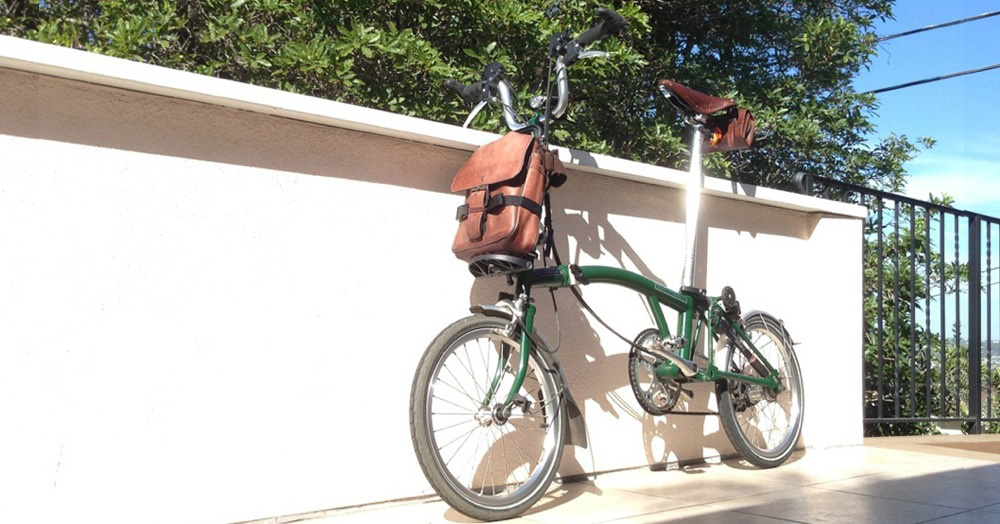
closeup of flyerI’m giving one of the Public lectures this Summer, and they decided to use an image of me as the cover of the flyer! So everywhere I go, there I am smiling back at me, holding up some strings. (Closeup on right, if you click.) It is actually quite an honour to be chosen to give such a talk, and more so that they wanted to use my photo for the series this year. Of course they got my agreement before using the photo, but it is still a shock to see it all over the town, but a bit embarrassing when asked about it by my colleagues! (I admit that am very pleased -given my passions in this area- to be alongside useful information about public transport. I like that a lot somehow….Perhaps I could have supplied them with a picture of me with the Brompton.)

The image they used, which is by the excellent photographer Phil Channing, has haunted me for years since it pops up to the front page of the USC website at least once a day -as part of a thing they do where they feature their faculty on the front page- which is always a shock when I need to go there for something. I have to explain to people from time to time that I am not always on the site and that I am not the face of USC. (You know, like Susan Sarandon and Halle Berry for Revlon, or Whoever-it-is-now for Maybelline, or Scarlett Johansson and Penelope Cruz for L’Oreal… although if USC wanted to pay me their level of salary to do so, I’d be pleased with that… I could do the theoretical physicist’s equivalent of a supermodel swoop of the hair (write a long equation with brightly coloured chalk maybe) and say, in an annoying way, “Because I’m worth it”.) To be fair, the photo does a good job, since it gets people asking questions about what that thing is I’m holding up, and why.

(The backstory there is that the USC people in charge of the website project asked some of us to come to a photo shoot, and Continue reading ‘Hard To Avoid’