In class tomorrow I’ll introduce one of my favourite equations:
[tex]
\frac{d^2x^\sigma}{d\tau^2}+\Gamma^\sigma_{\rho\nu}\frac{dx^\rho}{d\tau}\frac{dx^\nu}{d\tau}= 0\ .
[/tex]
… Wait – Where did everyone go?!
Come back! I’m not expecting you to know what it means, I just wanted to talk a bit with it sort of … nearby. If you consider yourself a bit intimidated by mathematics, be assured that it won’t bite. (No more than a piece of sheet music lying nearby will harm someone who has not learned to read music.)
It turns out that it is pretty geometry! In the equation, we’ve the object
[tex]
\Gamma^{\sigma}_{\rho\nu}\equiv\frac12 g^{\sigma\mu}\Biggl(\frac{\partial g_{\mu\nu}}{\partial x^\rho}+\frac{\partial g_{\mu\rho}}{\partial x^\nu}-\frac{\partial g_{\rho\nu}}{\partial x^\mu}\Biggr)\ ,
[/tex]
called the “Christoffel symbols”. The set of objects [tex]g_{\mu\nu}[/tex] (the “metric”) actually encode the properties of the space you wish to study (like the plane, or the sphere), and the equation at the top tells you what are the “straight lines” in that space. Well, in the plane (like your desktop) they are straight lines, while in other spaces they are the analogue of straight lines – if you want to go from one point to another point somewhere else in the space and desire to travel along the shortest path to do so, you want to follow such a line. It is called a “geodesic”. The equation is commonly called the geodesic equation.
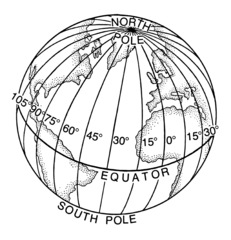 You know such lines, intuitively, in a non-trivial example. Next time you look at a globe (wait, does anyone but me look at maps and globes any more? I love them!), you’ll probably see examples of those lines drawn in. They are the “great circles”, the lines of longitude, and the equator. (Image used with permission.)
I just made a class worksheet that guides one through a bit of playing with this equation to get the class excited about Click to continue reading this post →

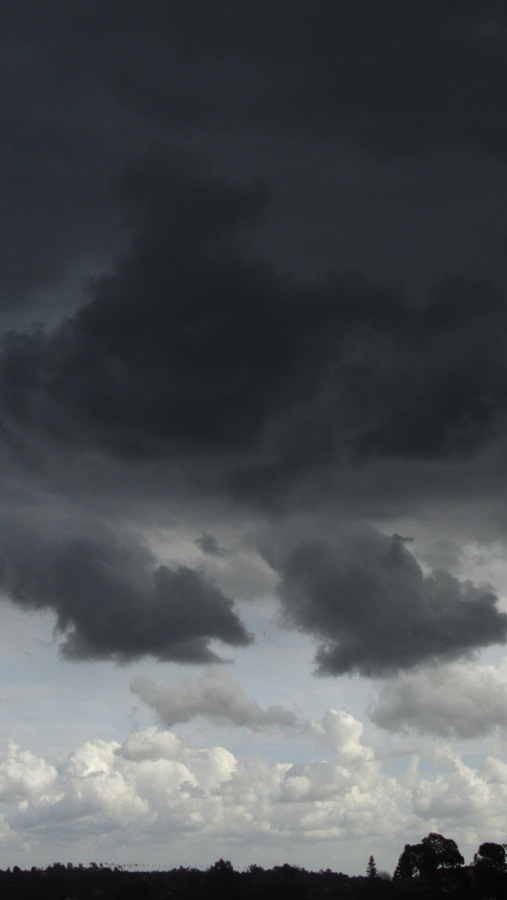
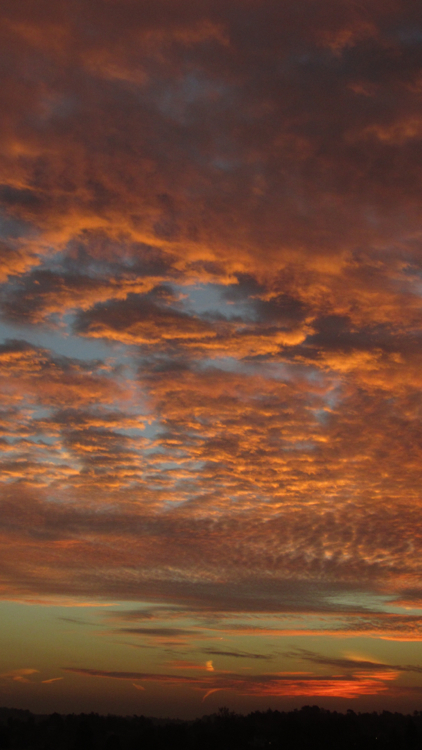
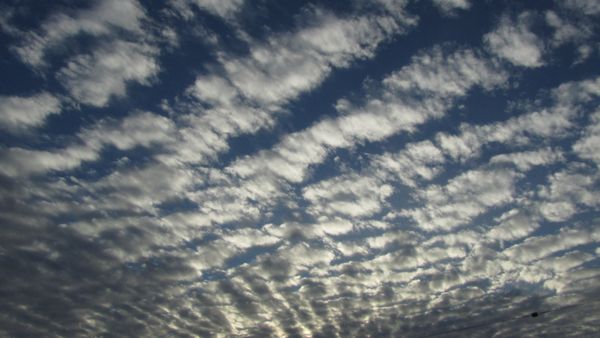 temperature, perhaps some layering of different bodies of air, and so forth, resulted in this and I’d love to know more. What factors set the roughly regular size of the structures, their pretty uniform distance apart, etc? (These are typical physicist’s questions, in case you’re Click to continue reading this post

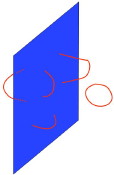 So I am here to help celebrate Joe’s work on the occasion of his 60th (hard to believe that number, frankly), and it will be good to see all the people who show up, and of course it’ll be excellent to see Joe. Part of my help in the celebrations is to organize and run a panel about D-branes, which will be on at 11:00 tomorrow. I’ll be reflecting a bit on the good old days when D-branes really broke, and turned out to be the key tool of the Revolution that took place in the field. In lectures and writings from that time and long after I used to refer to them as the Heroes of the Revolution, and in honor of that and of Joe I have named this session D-Branes, Tools of the Revolutionary, or something like that. Joe helped bring about the revolution, and his tools were D-branes, you see.


.png)