
News from the Front XIX: A-Masing de Sitter

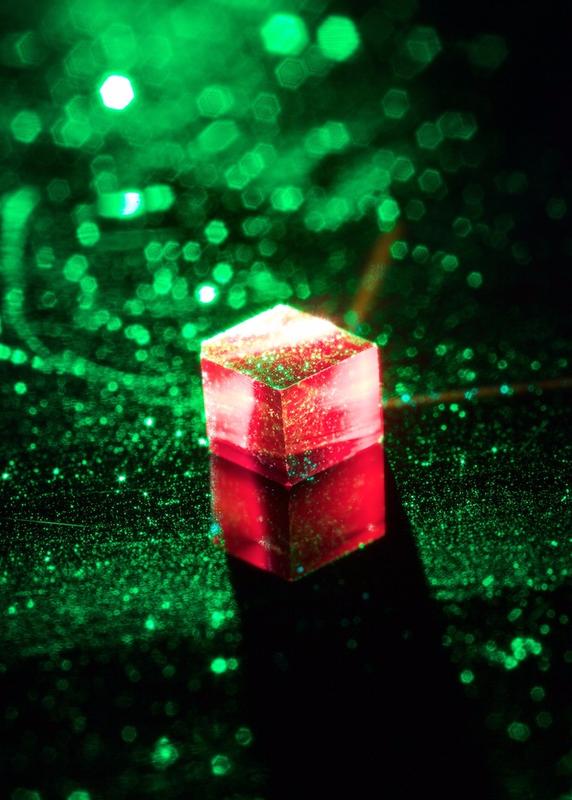
[caption id="attachment_19335" align="alignright" width="215"] Diamond maser. Image from Jonathan Breeze, Imperial College[/caption]This is part 2 of a chat about some recent thoughts and results I had about de Sitter black holes, reported in this arxiv preprint. Part 1 is here, so maybe best to read that first.
Now let us turn to de Sitter black holes. I mean here any black hole for which the asymptotic spacetime is de Sitter spacetime, which is to say it has positive cosmological constant. This is of course also interesting since one of the most natural (to some minds) possible explanations for the accelerating expansion of our universe is a cosmological constant, so maybe all black holes in our universe are de Sitter black holes in some sense. This is also interesting because you often read here about explorations of physics involving negative cosmological constant, so this is a big change!

One of the things people find puzzling about applying the standard black hole thermodynamics is that there are two places where the standard techniques tell you there should be a temperature associated with them. There’s the black hole horizon itself, and there’s also the cosmological horizon. These each have temperature, and they are not necessarily the same. For the Schwarzschild-de Sitter black hole, for example, (so, no spins or charges… just a mass with an horizon associated with it, like in flat space), the black hole’s temperature is always larger than that of the cosmological horizon. In fact, it runs from very large (where the black hole is small) all the way (as the black hole grows) to zero, where the two horizons coincide.

You might wonder, as many have, how to make sense of the two temperatures. This cannot, for a start, be an equilibrium thermodynamics system. Should there be dynamics where the two temperatures try to equalise? Is there heat flow from one horizon to another, perhaps? Maybe there’s some missing ingredient needed to make sense of this – do we have any right to be writing down temperatures (an equilibrium thermodynamics concept, really) when the system is not in equilibrium? (Actually, you could ask that about Schwarzschild in flat space – you compute the temperature and then discover that it depends upon the mass in such a way that the system wants to move to a different temperature. But I digress.)

The point of my recent work is that it is entirely within the realm of physics we have to hand to make sense of this. The simple system described in the previous post – the three level maser – has certain key interconnected features that seem relevant:

  • admits two distinct temperatures and
  • a maximum energy, and
  • a natural instability (population inversion) and a channel for doing work – the maser output.

My point is that these features are all present for de Sitter black holes too, starting with the two temperatures. But you won’t see the rest by staring at just the Schwarzschild case, you need to add rotation, or charge (or both). As we shall see, the ability to reduce angular momentum, or to reduce charge, will be the work channel. I’ll come back to the maximum […] Click to continue reading this post

News from the Front, XVI: Toward Quantum Heat Engines

(The following post is a bit more technical than usual. But non-experts may still find parts helpful.)

A couple of years ago I stumbled on an entire field that I had not encountered before: the study of Quantum Heat Engines. This sounds like an odd juxtaposition of terms since, as I say in the intro to my recent paper:

The thermodynamics of heat engines, refrigerators, and heat pumps is often thought to be firmly the domain of large classical systems, or put more carefully, systems that have a very large number of degrees of freedom such that thermal effects dominate over quantum effects. Nevertheless, there is thriving field devoted to the study—both experimental and theoretical—of the thermodynamics of machines that use small quantum systems as the working substance.

It is a fascinating field, with a lot of activity going on that connects to fields like quantum information, device physics, open quantum systems, condensed matter, etc.

Anyway, I stumbled on it because, as you may know, I’ve been thinking (in my 21st-meets-18th century way) about heat engines a lot over the last five years since I showed how to make them from (quantum) black holes, when embedded in extended gravitational thermodynamics. I’ve written it all down in blog posts before, so go look if interested (here and here).

In particular, it was when working on a project I wrote about here that I stumbled on quantum heat engines, and got thinking about their power and efficiency. It was while working on that project that I had a very happy thought: Could I show that holographic heat engines (the kind I make using black holes) -at least a class of them- are actually, in some regime, quantum heat engines? That would be potentially super-useful and, of course, super-fun.

The blunt headline statement is that they are, obviously, because every stage […] Click to continue reading this post

Event!

Well, I’m off to get six hours of sleep before the big announcement tomorrow! The Event Horizon Telescope teams are talking about an announcement of “groundbreaking” results tomorrow at 13:00 CEST. Given that they set out to “image” the event horizon of a black hole, this suggests (suggests) that they … Click to continue reading this post
Mindscape Interview!

And then two come along at once… Following on yesterday, another of the longer interviews I’ve done recently has appeared. This one was for Sean Carroll’s excellent Mindscape podcast. This interview/chat is all about string theory, including some of the core ideas, its history, what that “quantum gravity” thing is anyway, and why it isn’t actually a theory of (just) strings. Here’s a direct link to the audio, and here’s a link to the page about it on Sean’s blog.

The whole Mindscape podcast has had some fantastic conversations, by the way, so do check it out on iTunes or your favourite podcast supplier!

I hope you enjoy it!!

-cvj Click to continue reading this post

Futuristic Podcast Interview

For your listening pleasure: I’ve been asked to do a number of longer interviews recently. One of these was for the “Futuristic Podcast of Mark Gerlach”, who interviews all sorts of people from the arts (normally) over to the sciences (well, he hopes to do more of that starting with me). Go and check out his show on iTunes. The particular episode with me can be found as episode 31. We talk about a lot of things, from how people get into science (including my take on the nature vs nurture discussion), through the changes in how people get information about science to the development of string theory, to black holes and quantum entanglement – and a host of things in between. We even talked about The Dialogues, you’ll be happy to hear. I hope you enjoy listening!

(The picture? Not immediately relevant, except for the fact that I did cycle to the place the recording took place. I mostly put it there because I was fixing my bike not long ago and it is good to have a photo in a post. That is all.)

-cvj Click to continue reading this post

Science Friday Book Club Wrap!

Don’t forget, today live on Science Friday we (that’s SciFri presenter Ira Flatow, producer Christie Taylor, Astrophysicist Priyamvada Natarajan, and myself) will be talking about Hawking’s “A Brief History of Time” once more, and also discussing some of the physics discoveries that have happened since he wrote that book. We’ll be taking (I think) caller’s questions too! Also we’ve made recommendations for further reading to learn more about the topics discussed in Hawking’s book.

Join us!

-cvj

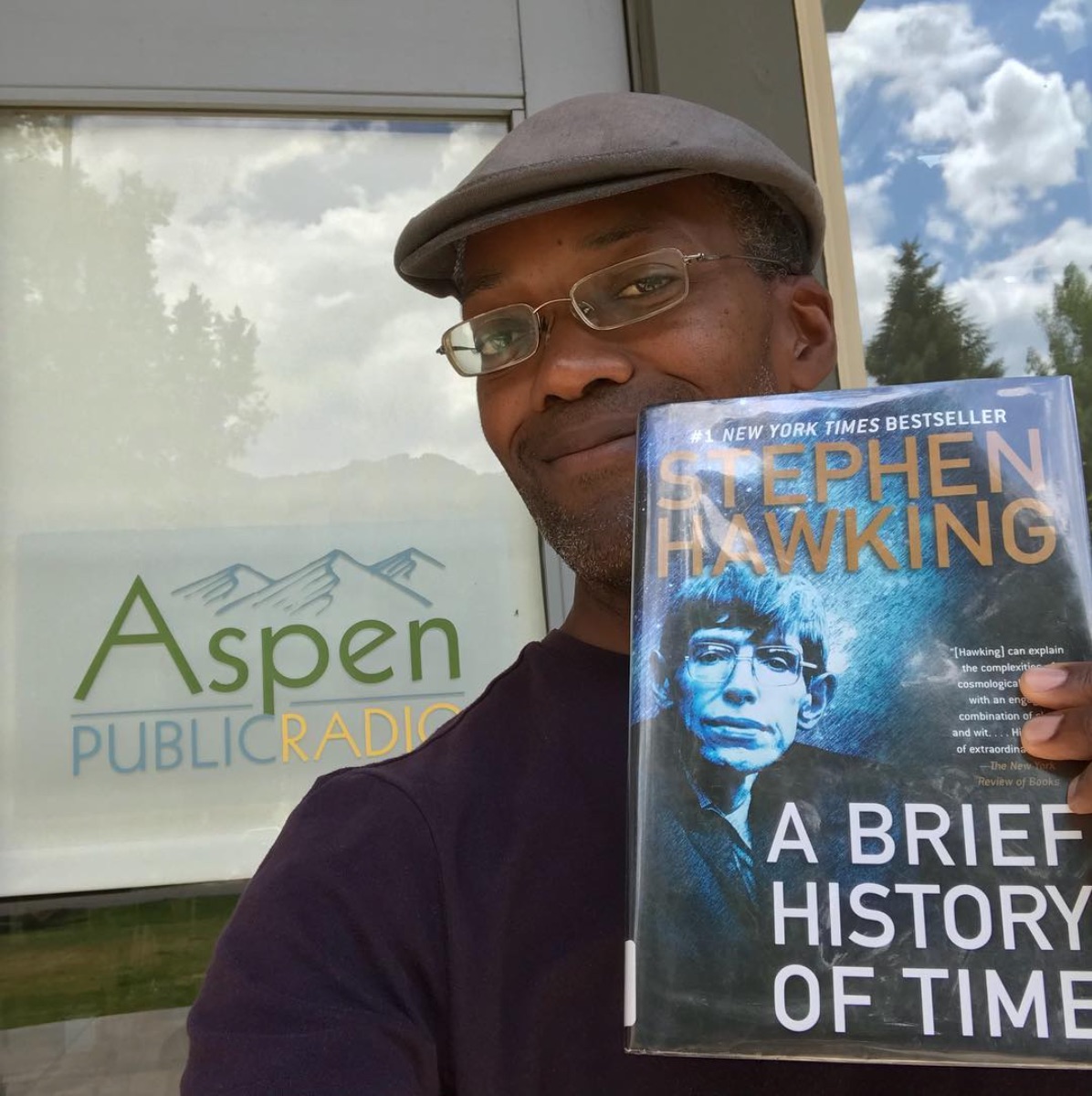
(P.S. The picture above was one I took when we recorded for the launch of the book club, back in July. I used the studios at Aspen Public Radio.) Click to continue reading this post

News from the Front, XV: Nicely Entangled

This is one of my more technical posts about research activity. It is not written with wide readability in mind, but you may still get a lot out of it since the first part especially talks about about research life.

Some years ago (you’ll perhaps recall), I came up with an interesting construction that I called a “Holographic Heat Engine”. Basically, it arises as a natural concept when you work in what I call “extended” gravitational thermodynamics where you allow the spacetime heat_enginecosmological constant to be dynamical. It is natural to associate the cosmological constant with a dynamical pressure (in the usual way it appears as a pressure in Einstein’s equations) and if you work it though it turns out that there’s a natural conjugate quantity playing the role of volume, etc. Black hole thermodynamics (that you get when you turn on quantum effects, giving entropy and temperature) then get enhanced to include pressure and volume, something that was not present for most of the history of the subject. It was all worked out nicely in a paper by Kastor et. al. in 2009. So…anyway, once you have black holes in that setup it seemed to me (when I encountered this extended framework in 2014) that it would be wilful neglect to not define heat engines: closed cycles in the p-V plane that take in heat, output heat, and do mechanical work. So I defined them. See three old posts of mine, here, here, and here, and there are others if you search.

Well, one of the things that has been a major quest of mine since 2014 is to see if I can make sense of the extended thermodynamics for quantum field theory, and then go further and translate the heat engines and their properties into field theory terms. This seemed possible to me all the way back then since for positive pressure, the cosmological constant is negative, and when you have gravity with negative cosmological constant you’ve got duality to strongly coupled field theories. So those heat engines must be some kind of special tour in the field theories. the efficiency of an engine must mean something about the tour. Moreover, since the efficiency of the engine is bounded by the Carnot efficiency, it seems we have a naturally defined dimensionless number that has a fundamental bound… Alarm bells ringing! – Opportunity knocking to learn something new and powerful! Maybe even important!

So I chipped away at this for some time, over years, doing various projects that […] Click to continue reading this post

Frank Buckley Interviews…

Turns out that Frank Buckley, the news anchor at KTLA 5, is not just a really great guy (evident from his manner on TV), but also a really excellent interviewer with a sharp curiosity that gives me hope that great journalism is still alive, well, and in good hands. I showed up at the station expecting to just have a pleasant chat around the book and be done with it, but I walked into the room and he’d done all his research and was sitting with extensive notes and so forth about lots of physics ideas he’d read in the book that he wanted to talk about! So we have a blast talking about the physics of our universe and the world around us in some in-depth detail. It was fantastic, and just the kind f conversation I hope that the book celebrates and inspires people to have!

Check out our interview here (embed below), and be sure to tune in to his […] Click to continue reading this post
London Event Tomorrow!

Perhaps you were intrigued by the review of The Dialogues, my non-fiction graphic novel about science, in Saturday’s Spectator? Well, I’ll be talking about the book tomorrow (Thursday) at the bookshop Libreria in London at 7:00 pm. Maybe see you there! #thedialoguesbook

-cvj Click to continue reading this post
Talk Nerdy!

I was on the Talk Nerdy podcast recently, talking with host Cara Santa Maria about all sorts of things. It was a fun conversation ranging over many topics in science, including some of the latest discoveries in astronomy using gravitational waves in concert with traditional telescopes to learn new things about our universe. And yes, my book The Dialogues was discussed too! A link to the podcast is here. You can find Talk Nerdy on many of your favourite podcast platforms. Why not subscribe? The whole show is full of great conversations!

-cvj Click to continue reading this post
Two Events!


(Image above courtesy of Cellar Door Books in Riverside, CA.)

Happy Thanksgiving! This coming week, there’ll be two events that might be of interest to people either in the Los Angeles area, or the New York area.

The first is an event (Tues. 28th Nov., 7pm, Co-sponsored by LARB and Chevalier’s Books) centered around my new book, the Dialogues. It is the first such LA event, starting with a chat with writer and delightful conversationalist […] Click to continue reading this post

QFT Book Review

9780199699322This month’s issue of Physics Today has a review that I wrote of the book “Quantum Field Theory for the Gifted Amateur”, by Tom Lancaster and Stephen J. Blundell. I took the opportunity to give a broader view (albeit brief, given the word limit) of the landscape of books on that subject and how it has changed a lot, in a way that I think reflects some excellent changes in formal theory brought about by (at least in part) research into the many topics pulled together under the broad umbrella of string theory. As you might know from reading here and elsewhere, I’ve long been pushing for the increased application of the ideas and techniques of string theory to other areas of physics, and it has become quite the thing these days, I’m happy to see. Such research has resulted in the blurring of the […] Click to continue reading this post

News from the Front, XIII: Simplicity

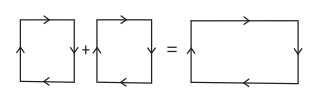
adding_cyclesOk, I promised to explain the staircase I put up on Monday. I noticed something rather nice recently, and reported it (actually, two things) in a recent paper, here. It concerns those things I called “Holographic Heat Engines” which I introduced in a paper two years ago, and which I described in some detail in a previous post. You can go to that post in order to learn the details – there’s no point repeating it all again – but in short the context is an extension of gravitational thermodynamics where the cosmological constant is dynamical, therefore supplying a meaning to the pressure and the volume variables (p,V) that are normally missing in black hole thermodynamics… Once you have those, it seems obvious that you can start considering processes that do mechanical work (from the pdV term in the first law) and within a short while the idea of heat engines in which the black hole is the working substance comes along. Positive pressure corresponds to negative cosmological constant and so the term “holographic heat engines” is explained. (At least to those who know about holographic dualities.)

So you have a (p,V) plane, some heat flows, and an equation of state determined by the species of (asymptotically AdS) black hole you are working with. It’s like discovering a whole new family of fluids for which I know the equation of state (often exactly) and now I get to work out the properties of the heat engines I can define with them. That’s what this is.

Now, I suspect that this whole business is an answer waiting for a question. I can’t tell you what the question is. One place to look might be in the space of field theories that have such black holes as their holographic dual, but I’m the first to admit that […] Click to continue reading this post

It Came from Elsewhere…

Reggie_Austin_and_cvj_interviewThis just in. Marvel has posted a video of a chat I did with Agent Carter’s Reggie Austin (Dr. Jason Wilkes) about some of the science I dreamed up to underpin some of the things in the show. In particular, we talk about his intangibility and how it connects to other properties of the Zero Matter that we’d already established in earlier episodes. You can see it embedded below […] Click to continue reading this post