Weinberg on BCS

For some reason I don’t understand, I occasionally get a copy of some random (as far as I can tell) issue the International Journal of Modern Physics A in the post. It just arrives. The people at World Scientific are presumably hoping I’ll get hooked by it and take out a personal subscription or something. Not sure. Well, it has not happened yet (just as it did not with the unsolicited regular arrivals of Angeleno a while back). But you never know.

Anyway, before putting the one that arrived recently on to my shelf (I can’t easily throw things like that away… it’s a problem, I know) I glanced through the contents to see if there were clues as to why this one was sent to me. I found no obvious ones, but the very first article caught my eye. It was a rather good essay by Steven Weinberg (1979 Nobel Prize in Physics) on BCS (J Bardeen, L N Cooper and J R Schrieffer – No, nothing to do with College Football’s BCS.) theory of superconductivity and the importance of the idea of spontaneously broken symmetry in condensed matter physics and then in particle physics (see last year’s Physics Nobel, by the way). I thought I’d point it out to you, since it is rather nicely written and very instructive (whether or not you’re already familiar with the phenomenon/idea).

He begins with some overstatement, however. He expounds upon the difference between particle physicists and condensed matter physicists and although it is amusingly written in parts (I assume intentionally) he really over-eggs the pudding, in my opinion. Look at this: […] Click to continue reading this post

The Chronophage

I’m back home in Los Angeles now, after four days in Cambridge (UK) trying to pay attention to several interesting talks and meetings while being eight hours out of sync with my sleep. It has been interesting, but it is good to be back and getting on with the business of starting the new semester. I gave my first class of the season yesterday (upper division electromagnetism), and it looks to be a good group of students. I expect we’ll have fun! Additionally, two research meetings with graduate students meant for a nicely balanced first day back.

It’s (of course) 5:18am, and so while I sit here, wide awake, I’ll tell you about something I saw earlier in the week. chronophage_corpus_clockWhile wandering around for a bit in Cambridge on Monday, I stumbled across the Corpus Clock and the Chronophage. It’d been mentioned to me about half an hour before by a friend, and I made a mental note to ask about it, but did not realize I’d stumble upon it so easily. Did you hear about it last year? I must confess that all the fuss about it totally passed me by. There’s been a lot of silly stuff said about it, including the usual sensational things about time and so forth, but at the core, the whole thing is quite marvellous. I’ve an old-fashioned streak to me, as you know by now, and so that it is essentially a traditional mechanical clock (despite the presence of LEDs to show the time – they are not controlled electronically, but are on all the time and the mechanical works moves slits to make them appear to go on and off) appeals to me immensely. The whole effect of using modern technology to […] Click to continue reading this post

Galileoscopes and More

This year is not all about Darwin. There’s even more fun to be had. It is the International Year of Astronomy. It is 400 years since Galileo Galilei looked at the night sky using a telescope, and this is regarded by some as the birth of modern astronomy. There’ll be lots of celebratory events and discussions taking place under this banner, and of course it is a wonderful opportunity to highlight and kindle interest in Astronomy, so keep your eye out for lots of such events. The theme is “The Universe: Yours To Discover”, which I think is rather good, don’t you? See the official website of IYA2009 for more information. Here’s a BBC World service piece about it, in the form of an interview with Astronomer Royal, Sir Martin Rees. (That same page has an audio visit to the Vatican’s Observatory, Castel Gandolfo (a facility previously mentioned on the blog here), which might be of interest.)

I wonder whether you’ve heard of the Galileoscope. It is one of the “cornerstone […] Click to continue reading this post

Complex

So where am I and what am I doing? I’m in chilly Cambridge. The one in the UK. It is super cold over here. When we landed in Heathrow at lunchtime yesterday it was below freezing, and the thick cloud of the London sky was right down to the tops of the airport terminals. Everybody seemed to be talking about how cold it was. My wandering in central London for a few hours dragging my suitcase (before heading to Kings Cross and the train to Cambridge) was quite a bit uncomfortable – at least until I realized that a key mission should be to find on Oxford Street a branch of Marks and Spencer’s (now called M&S it seems… interestingly across the street from an H&M, and not so far from where the doomed C&A store used to be…) and buy some long thermal underwear. A bit elderly, perhaps, but very snug and warm against the icy winds and snow flurries, so I don’t care. (Yes, that probably falls under the category of “oversharing”, one of the words of the year 2008….)

icam board of governers meeting

One of the various governance boards I managed to accept to be on last year (despite trying hard to try to say “no” more last year) was that of ICAM, the Institute for Complex Adaptive Matter. For the first time in ICAM’s ten year history, its […] Click to continue reading this post

Darwin in the Air

You’ll begin to notice a lot of discussion of Charles Darwin soon. Why? It is his 200th anniversary, and also 150 years since his Origin of Species was published, and so many people and organizations will be celebrating those landmarks. I did a couple of posts last year on Darwin that are worth a look, one about Darwin’s presentation of the evolution idea to the Linnean Society (150th anniversary of that last year) and the other about the wonderful Darwin Online project. See here and here.

Earlier this week I noticed that BBC Radio 4’s excellent series In Our Time (which I’ve mentioned a number of times here and will again) did a four part special documentary on Darwin. I’ve not listened to it yet, but I’ve a feeling it’ll be good. (I’ll be dropping all four parts onto my phone for listening to in those idle moments on some travel I’m about to embark upon.)

Snipping some of the synopses: […] Click to continue reading this post

Thermodynamics and Gravity

ads_ballI noticed that Robert Helling shared some thoughts about thermodynamics and gravity today on his blog. He is understandably confused about several aspects of the issue, especially when applied to cosmological issues. (What is the entropy of our universe? Does the Second Law really apply? Does equilibrium thermodynamics even apply here?)

I’ve nothing remarkable to add to the discussion at this time except to note that a blanket statement that thermodynamics and gravity don’t seem to go together (which I don’t think he’s strongly saying) is not one I’d make, since we have a major class of working counterexamples.

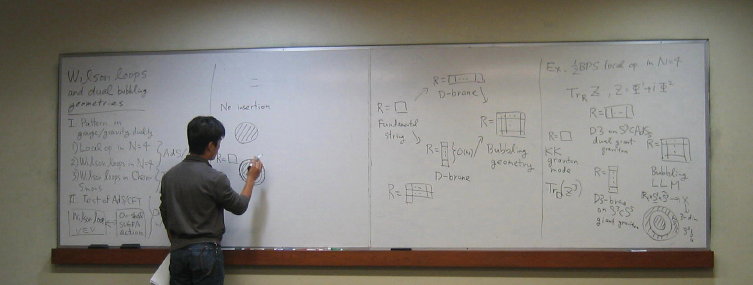
The context is the gauge/gravity duals I’ve talked about here a lot, starting with AdS/CFT and beyond. There we know that the gravitational systems are essentially able to display the more garden variety thermodynamics by being immersed in the (regulating-box-like) anti-De Sitter type backgrounds. Then we see that black holes […] Click to continue reading this post

Red, Yellow, Blue, Green…

red yellow green blue…among other colours.

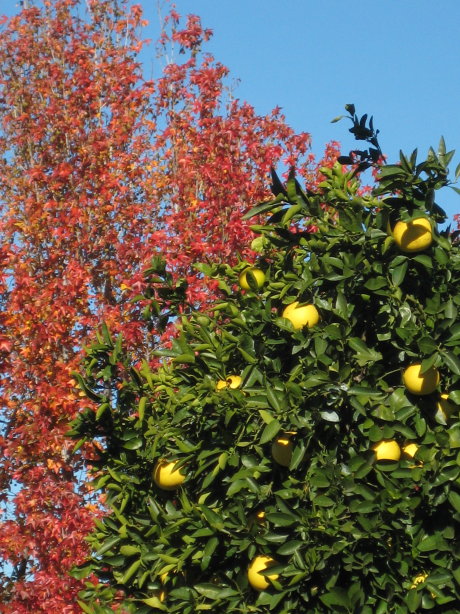
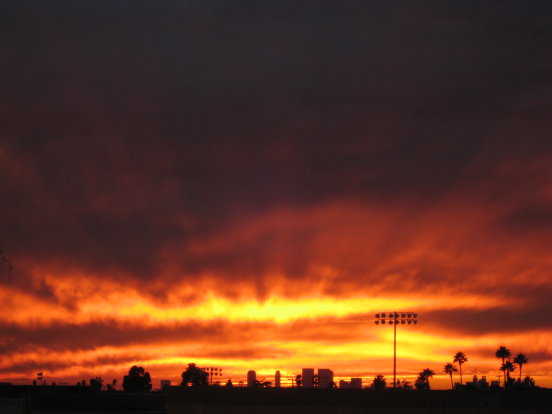
View of the day from the garden. (Winter. Number x in a limited series of y.) (Click for larger view.) The rains have gone for a while. The sun is back, with clear blue skies to close out the year.

I’m trying to rest. Well, I’m working on various projects at home, mostly. Colours are on my mind a bit in one of these projects, actually. Later today I’m going to be down in the (only slightly mad-scientist) workshop making a portable screen on which to project films.

Projecting onto the wall is good, but I want to make a silver-grey screen with a dark border that will really pop the colours out. Some of this is about not projecting onto […] Click to continue reading this post

Summer Reading: Falling For Science

(Yes, I know it is not Summer (here), but I love the idea of Summer reading lists so much that I will continue to discuss some books under this series title, whatever the time of year.)

I just heard a piece by Robert Krulwich on NPR about the book “Falling for Science: Objects in Mind”, which is a collection of essays with an introduction by Sherry Turkle, who’s a social sciences professor at MIT. Krulwich says:

“…written by senior scientists (artificial intelligence pioneer Seymour Papert, MIT president and neuroanatomist Susan Hockfield, and architect Moshe Safdie, for example) and by students who passed through her classes at MIT over the past 25 years. They were all asked the same question: “Was there an object you met during childhood or adolescence that had an influence on your path into science?”

And after a tidal wave of Legos (7 different essays), computer games and broken radios, I found a few wonderful surprises. One MIT student reported how she couldn’t stop braiding her My Little Pony’s tail, weaving the hairs into endlessly repeating patterns (a clue, perhaps, to her fascination with mathematics)….[…]”

He goes on to interview software designer Joseph Calzaretta about his childhood encounter with stop signs. It’s a really nice story. The whole radio piece is here, with audio and transcript. (There’s another version here with the excellent “Eggs in a Basket” story emphasized instead.)

This is actually an issue that fascinates me, and I don’t think that the question should be quite as narrow as above – focusing only on people who went into science. I think that -especially as children- we are all scientists, exploring the world around us, […] Click to continue reading this post

Remembering Uncertainty

Gosh, look what I found on YouTube, quite by accident. It is video of the first Uncertainty event I did with science writer KC Cole way back in 2006, and was one of the first Visions and Voices events at USC.

It has as features (about 20 minutes each) Jonathan Kirsch on Monotheism (and how it actually isn’t, really), some opening thoughts by moderator KC Cole, her interview […] Click to continue reading this post

Another Physicist in the House

With more refreshing words about what he thinks science is, and the role science can play in shaping society and steering the country forward, Barack Obama announced several key science posts today. One of them is a physicist by the way. (“Excellent…”, cvj rubs hands together with a gleam in his eye, “…all going according to plan.”)

Here’s a YouTube video of the announcement:

From an AFP piece by Maxim Kniazkov:
[…] Click to continue reading this post

Teachers Rock!

Listening live (over a late breakfast coffee) to the press conference led by President Elect Obama announcing the Secretary of Education. Arne Duncan is the nominee. This is an underrated post in terms of how high profile it is compared to the other cabinet posts… but of course it’s super-important. So it is wonderful to hear the lovely speech from the pres-to-be (and also the one from the vice-pres-to-be). Just really great. It is especially good to hear recognition of the fact that the core of […] Click to continue reading this post

Fat Moon!

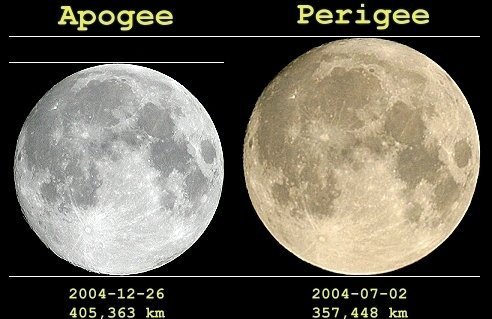
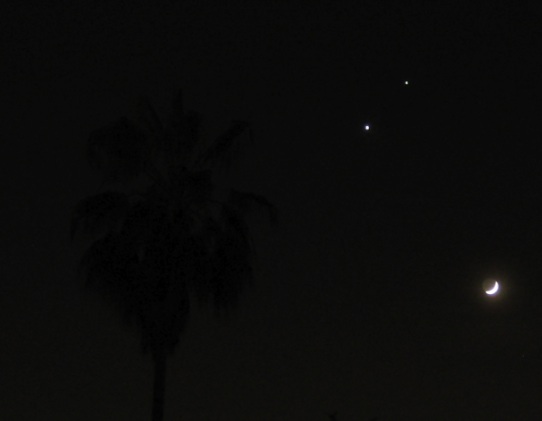
Tonight, have a look at the full moon. It’ll be significantly bigger than any of the others you’ve seen this year since the moon is at perigee (as close as it can be in its elliptical orbit). This is not a slight difference that only those deeply into astronomy care about. The moon will be, as the NASA site on this* notes:

…14% bigger and 30% brighter than lesser full Moons we’ve seen earlier in 2008.

Anthony Ayiomamitis\' 2004 apogee perigee comparison

(Anthony Ayiomamitis’ 2004 apogee/perigee comparison.)

Go out and have a look at it at shortly after 4:30pm today when it rises. When the moon is near the horizon, it looks bigger anyway – combine that with the fact that it […] Click to continue reading this post

Physics Nobel Prize Winner in the Cabinet

I just learned this* – Steve Chu (Nobel Prize for Physics in 1997 – see here) has been nominated as Energy Secretary in the new Obama administration. I find that sort of interesting and exciting. An actual Physicist in charge of energy. And at this crucial time. Story here (for example).

-cvj

*Thanks Jeff! Click to continue reading this post

Gervais and Merchant on Mayo

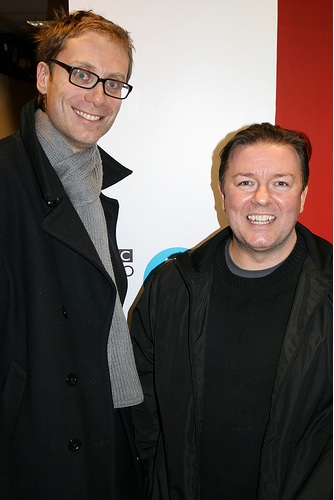
ricky gervais and stephen merchant on mayoRicky Gervais and Stephen Merchant were on Daily Mayo for half an hour yesterday. It was a good bit of fun unscripted chatter that’s worth a listen. They were really there to plug the new boxed set of the TV show Extras (which if you have not seen you should put high on your list of viewing priorities – it is quite brilliant), but of course they were also there to mess around a bit.
They asked for a higher standard of question to be emailed in by the viewers, and so I wondered whether anyone would send in some science ones – maybe some physics ones. Sure enough there were. […] Click to continue reading this post