Search Results for 'fractal'

Edible Fractals, and the Snowflake

In celebration and anticipation of the unveiling of the Mosely Snowflake Sponge fractal on the USC campus later today, I’m reposting an old post about an edible fractal that I did back in February 2008. They say they will be serving fractal-themed food in the reception, and so I wonder if this is one of the foods that might feature? Don’t forget to come to the event! Recall that I (jokingly) speculated that when this fractal is completed the universe will end, as its purpose will have been served? Well, it seems that this has not come to pass, so… whew.

For other fractal-related posts, click here. You might also enjoy the lovely fractal-related film, Yaddda Yadda Yada, that won a prize in the competition last year.

-cvj

_________________________________________________________________________
romanesque cauliflower

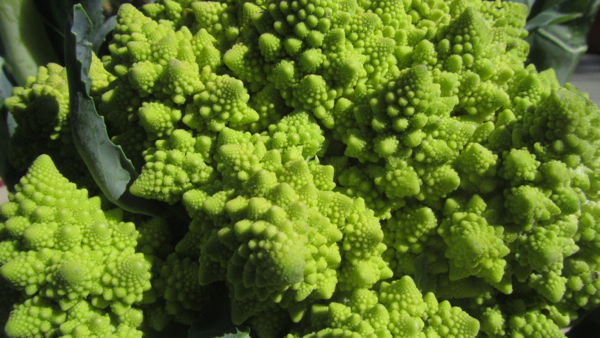
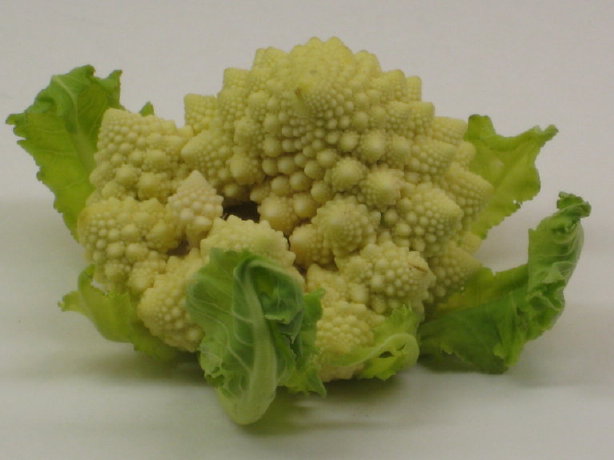
A small Romanesque Cauliflower. (Click for larger view.)

Imagine my delight when I spotted this lovely piece of edible mathematics in the Hollywood Farmer’s Market this morning. The stall has several of them of many sizes (this was a very little one) and of several colours. Wonderful. If you don’t know what I mean when I talk about the mathematics, or use the term fractal, look it up. There are several things of note, among which are the wonderful spiral structures that you can see (Fibonacci spirals) all over, and which in various ways, encode the infinite sequence of numbers 1, 1, 2, 3, 5, 8, 13, 21, 34, 55, 89, 144, 233…. (you get the next one by adding the previous two) called the Fibonacci sequence. Ratios of successive members of the sequence, (e.g., 5/8, 8/13, 144/233, etc) approximate what I’ve already mentioned in an earlier post is definitely my favourite number (if I Continue reading ‘Edible Fractals, and the Snowflake’

Along the Way

It has been a busy semester so far, but not a bad one at all. There are some exciting things I ought to update you on, but now is not the time as I need a different frame of mind to pull my thoughts together on those topics. We’ve got through Green functions in the graduate electromagnetism class, which meant that we’ve been playing with the retarded potentials and doing one or two fun things with them by way of examples. The group of students I have in class is really fun to work with, and they seem to like the class worksheets that I bring them to try out from time to time. They allow me to get the students into the habit of working on a specific example where they can see how to set up a coordinate system, interpret the general expressions we’ve derived in the context of a specific example, and solve it through to the end, interpreting their results, etc. It eats up a chunk of the (1 hour 50 minute) class time, but it is well worth it, since I think that they potentially learn a great deal Continue reading ‘Along the Way’

Fractal in Progress…

So last week we had a visit from Kelly Stelle (he’s part of the high energy theory group at Imperial College) who gave us an excellent talk about aspects of supergravity. His work connects to the fascinating ongoing story about finiteness, and the new techniques being used to do the multiloop computations (see a recent Scientific American cover story about some of that – it is misleadingly packaged by the magazine, as usual (preview here), but the article itself, focusing on the computational issues, is nice).

After his talk, I gave him a tour of the campus, and as we passed through the Doheny Library to view the lovely interior, we stopped by the ongoing construction of the Mosely Snowflake Sponge fractal that I told you about here.

They’re making a lot of progress.

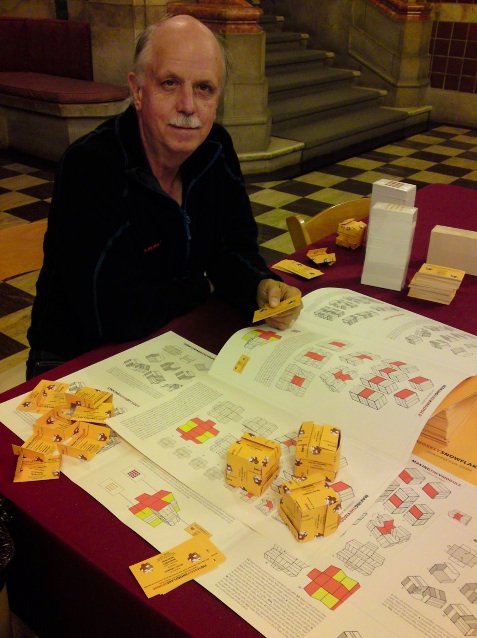
We spent a few minutes folding some business cards to contribute some component cubes to the construction, and I took a snap (see photo on left) of Kelly at work. We made two or three cubes each…

Here’s a shot of one of the completed modules Continue reading ‘Fractal in Progress…’

A Snowflake on Campus

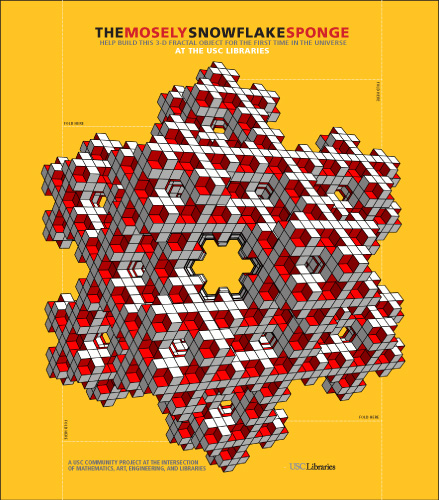
Ever heard of the Mosely Snowflake Sponge? There is one being constructed on campus here at USC right now! (The image on the left is the poster for the event.) The fractal was discovered by engineer Jeannine Mosely, and she did a similar construction (of a different fractal, the Menger Sponge) some years ago out of folded business cards (see here for some great images!), and the same thing is being done here. You can learn more about the project here. Margaret Wertheim, of the Institute for Figuring, is running this project, with the help of Tyson Gaskill. Everyone is invited to join in. You can just show up and fold a few cubes as you pass by. I took a picture and made encouraging remarks on this visit. (My defense is that I’d just given an hour and a half presentation, it was getting late into the night, and I was tired.)

There’s Margaret and Tyson working on constructing it, alongside a colleague of theirs Continue reading ‘A Snowflake on Campus’

Gold and Neutrinos!

Here are two of the top prize winners in the competition (see earlier posts for the others, and for the full list).

The 2nd Prize and 3rd Prize winners are below! Consider watching them in full HD.

(Sadly, the 1st Prize winner, Time, (by Kevin Le and Edward Saavedra) uses copyrighted music and they are waiting to sort out permission before it can be shown publicly by the USC Science Films competition, so I can’t show it on the sciencefilmsusc YouTube channel (where all the winners are hosted) until then…)

Enjoy!

-cvj

Dance and Fractals!

Here are the two films that won honorable mentions in the Science Film Competition. Consider watching them in full HD.

I’ll release the others tomorrow…

Enjoy!

-cvj

A Zoological Fractal

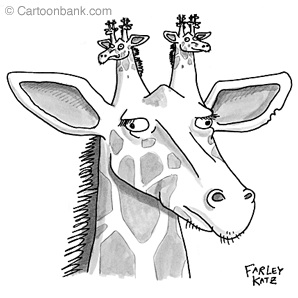
farley katz cartoon of a fractal giraffeWhen I saw this back in August, I laughed in delight. I think it is a rather clever idea, well executed. (It’s by Farley Katz, and was in the New Yorker, Aug 11th ’08. (Link is to cartoon bank where you can get it.))

Actually, it reminded me of the delicious fractal I photographed for you and that we discussed here not long ago. That one was real, this one imagined, but nevertheless rather good.

-cvj

A Delicious Fractal

romanesque cauliflower

A small Romanesque Cauliflower. (Click for larger view.)

Imagine my delight when I spotted this lovely piece of edible mathematics in the Hollywood Farmer’s Market this morning. The stall has several of them of many sizes (this was a very little one) and of several colours. Wonderful. If you don’t know what I mean when I talk about the mathematics, or use the term fractal, look it up. There are several things of note, among which are the wonderful spiral structures that you can Continue reading ‘A Delicious Fractal’

Go Figure!

hyperbolic crochetSo I think maybe I died and went to cvj heaven. Let me explain. I mentioned to you a while ago the freshman seminar entitled “The Art and Science of Seeing and the Seeing and Science of Art”, for which there was an enrollment snafu. Well, it is continuing, and on Wednesday afternoons, I sit under the trees with two students for an hour and a half (KC Cole pulled out, since it would be a ridiculous professor-student ratio otherwise) and talk about a huge spectrum of things that fall into this category, as well as some of the things that come up in the Visions and Voices series.

Last week and this week, we discussed -with illustrations- two pretty obvious topics that come up first in people minds when the words “Science” and “Art” are in the same sentence. Those two topics are Fractals, and Escher. Quite obvious as “science-meets-art” topics go (and tiresomely so sometimes) but nontheless I believe it would be neglectful of us not to explore some of the interesting and wonderful themes, images, and techniques that those topics touch upon. Escher last week, Fractals this week. It was a lot of fun. I will tell you a bit about it later, in view of the lack of time (I had a breakthrough in a little computation that I really should get back to before I have to prepare a class).

Anyway, I come away from these sessions thinking how great it is to let oneself broaden the canvas upon which one can jot down one’s reflections upon and reactions (emotional, intellectual, otherwise) to when one looks at a piece of art. The broadening I refer to means simply to include science. Either directly or indirectly. This is the tack we’ve been taking in this seminar, and so far I think we’ve been having a lot of fun and learning a lot. I’ve been reflecting on how wonderful it would be if more people, in the context of art appreciation, would allow themselves the latitude to do this. Sadly, ignorance of what science is about, and the fear of science, topics that I talk about a lot on this blog, maintain huge barriers between art and science in most people’s minds, and so there is a whole dimension of appreciation that goes unlocked as a result (not just in the obvious context of Escher, etc, but in appreciating any art form). It was especially sad to see six freshmen disappear from the enrollment on the class principally because the word “science” was inserted into the title of what they thought would be an art appreciation seminar. Well, it is still an art appreciation seminar, but those who are coming are learning to look at art, and the world around them, with new eyes, and maybe seeing a broader and/or deeper spectrum.

So I go into “What if…” mode for a while on my ride back to my office and feel a little sad that even bright young people who are on campus to learn new things are selecting themselves out of such opportunities to engage with their world because of the word “science”. Sigh.

So imagine my delight last night (having finished a seminar on fractals earlier that day, pointing out several examples of “fractal geometry” in art and nature) when and architect friend of mine* emailed me a link to an institute, right here in LA, that seems to be right on the same track I’m talking about!

It is the Institute for Figuring, (founded by science writer Margaret Wertheim) right Continue reading ‘Go Figure!’