Not Improbable

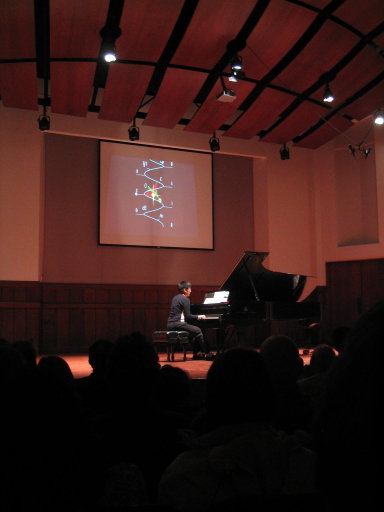
elaine chewOn Wednesday night, accompanied by Tameem, a student of mine, I wandered across campus to attend the “Mathematics in Music” event. I blogged about it earlier. I don’t really want to talk about the event itself in this post. It was a nice enough recital of three pieces. I don’t know why, but the promised “mathematics” was disappointingly virtually non-existent. I’m not exaggerating, I’m afraid.

Keep in mind that it may simply just be my misunderstanding of the intent of the event, but there’s simply next to nothing to report in the way of what was said about mathematical aspects of music. There were plenty of opportunities, but (almost) none were taken. I got out my notebook and pen, all excited at what the presenters might say at various points… and the mathematics never showed up. There were a few extremely elementary remarks about tonal ratios in chords, about scales, keys, and time, and that was it, more or less. This was a bit of a shame, since I suspect that Elaine Chew could have talked at length and with some authority on the matter (given the projects she’s involved in – see e.g. here), but mathematics was almost completely missing in the event – despite the title. I imagine there were what seemed like good reasons for this. I was not party to decisions made behind the scenes, so cannot comment further.

More interestingly on that front was what took place in the minutes leading up to the delayed start of the event. First, although it was a free event, they pointed us to the box office where an attendant printed us two tickets from the computer so that we can show them to someone at the door who wasn’t really looking anyway. Fine. We got into the recital hall, but rather than sitting at the obvious available seats, I suggested that we move to the other side of the room where one can get a better view of the piano keyboard. I’m less than happy when I can’t see what a musician is doing, you see, so I always try to sit with the pianist’s view of the piano. So we did that, and found two seats. While we chatted and looked around us at the growing assembly, I spotted a friend and colleague of mine, the composer Veronika Krausas. She was in the company of someone who she introduced as Brian Head, who is a composer, performer (guitar) and music theorist (a “triple threat”, Veronika joked), also in USC’s Thornton school of music. They were looking for seats and there was one on either side of the two we were sitting in, and so they joined us and we chatted some more.

When the event start was about ten or fifteen minutes late -they were trying to get the reassuringly large crown all seated, they announced- Veronika idly looked at her ticket, pointed out that they were numbered, and wondered if we should have been Click to continue reading this post


De-Gaussing

I accidentally used the term “de-gauss” (or perhaps “degauss”) in conversation the other day, referring to something I had to do for my well-being. I was asked for an explanation. Thought I’d explain what I meant to you too:

One of many effective ways to de-gauss: Get the best gin ever (Hendricks’), a decent tonic water, the very tastiest of lemons (it’s from the tree in the garden), a glass, some ice*

gin and tonic

…and a really comfy chair. Hey, it’s been a long and busy day.

-cvj

P.S. Oh. There’s some other use of the word involving getting rid of trapped built up magnetic fields, etc., etc. You can google that.

(*Yeah, I know it’s not a great snapshot, but you get the idea.)

I Love It Every Time

I love teaching undergraduate electromagnetism. It has such an elegance, logic, and completeness about it. It introduces such a host of powerful techniques and ideas to the student, taking them across the threshold into maturity in their physics studies: Once you’ve done electromagnetism, you don’t usually think about large chunks of Physics in quite the same way ever again.

Today saw me give one of my favourite lectures, in any subject. It’s always a thrill. Summarize all that has gone before in their studies of electromagnetism – Gauss’ Law for the electric field produced by charges, the statement of the absence of magnetic monopoles (the Law with No Name), Faraday’s Law for the electric field produced by changing magnetic fields (induction:- another really fun set of lectures there), and Ampère’s Law for the magnetic fields produced by a current density. Write them all down next to each other and stare at them. Realize that they are not internally consistent, in general, as Maxwell did (he was motivated slightly differently, but in an essentially equivalent way). The culprit is Ampère, and the problem is fixed by Maxwell’s realization of the existence of the displacement current term. Ah… symmetry. Changing electric fields produce magnetic fields. All is well. Do some nice examples to show how it all works in concrete terms.

The resulting beautiful and consistent set of equations sent a shiver down my spine when I first saw and appreciated them as an undergraduate. They still send a shiver down my spine, and I hope your spine shivers too. Maxwell’s equations:


[tex]
\begin{eqnarray}
\nabla\cdot \mathbf{E}\, &=&\,\frac{\rho}{\epsilon_0} \ ;\nonumber \\
\nabla\cdot \mathbf{B}\, &=&\, 0 \ ;\nonumber \\
\nabla\times\mathbf{E}\, &=&\, -\frac{\partial \mathbf{B}}{\partial t}\ ;\nonumber \\
\nabla\times\mathbf{B}\, &=&\, \mu_0\mathbf{J} +\mu_0\epsilon_0 \frac{\partial \mathbf{E}}{\partial t}\ .\nonumber
\end{eqnarray}
[/tex]

After the shiver, a lovely warm feeling. From here to light, radiation, Relativity, and beyond…

Every time, I especially love giving this lecture. It never gets old.

-cvj

Tell-Tale Tail

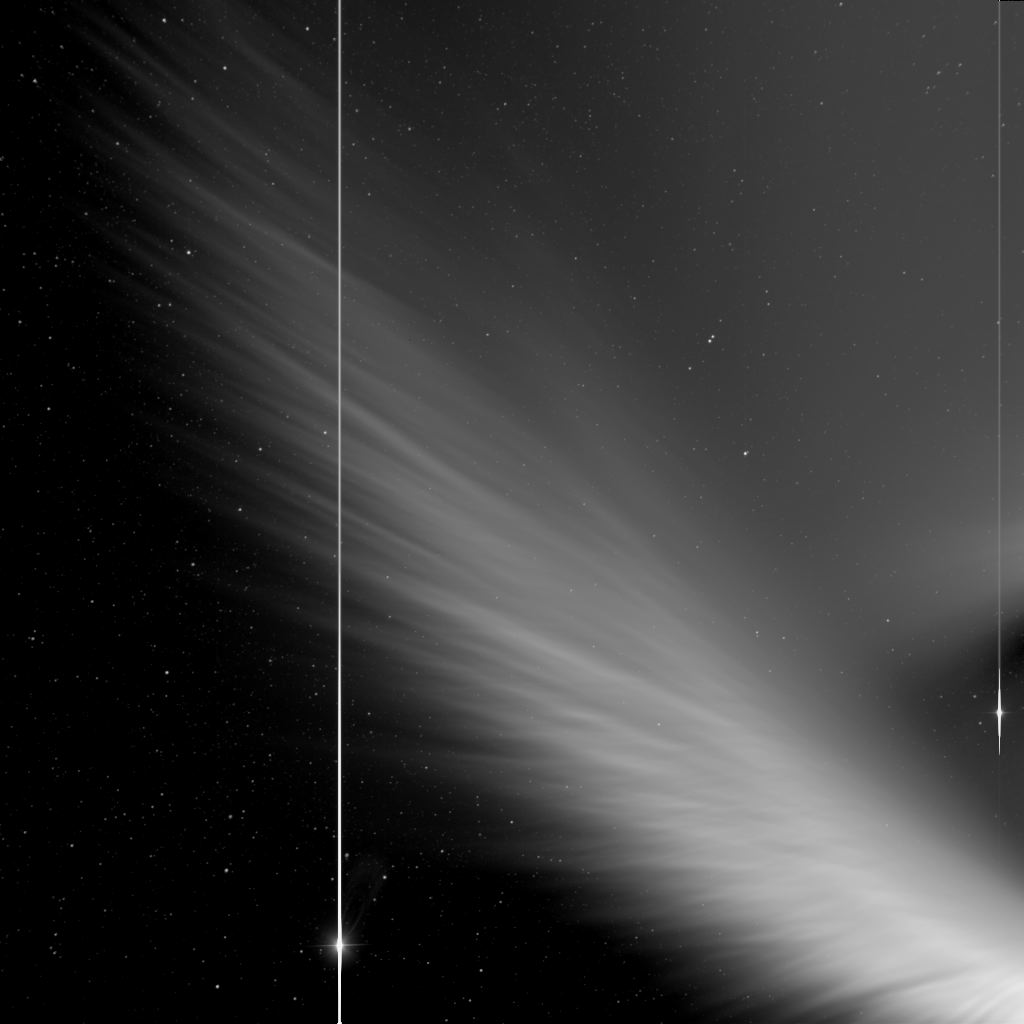
The Solar and Heliospheric Observatory (SOHO), a spacecraft that studies the sun, has been taking rather spectacular photos of comet McNaught. See here, for example. But the recent news that’s been exciting everyone are the comet pictures from the newer twin-spacecraft Solar Terrestrial Relations Observatories (STEREO), such as this one of the comet’s tail (the sharp lines are artifacts due to bright objects in the background):STEREO/SECCHI comet McNaught image

Click the image for a larger version. They put together a number of images to make a rather impressive movie of the comet, with a great deal of detail in a sort of fly Click to continue reading this post
The Proud Parent

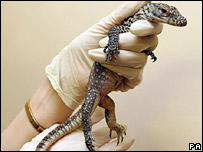
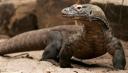
Flora komodo babyThe BBC1 are calling her the proud “mum and dad”. I’m talking about Flora, who is the parent of five baby Komodo dragons so far. Read the story at the link above. flora the komodo dragon You’ll recall my earlier post about her, back when she featured in the “virgin birth” story leading up to the Christmas period. Just to remind you, she is one of the first Komodo dragons known to Click to continue reading this post
I’d Like To Go South Please… Now.

I’m watching my email for an invitation to fly suddenly to the Southern Hemisphere. Perhaps the Latin American Summer School (being held in Argentina this year) needs an emergency strings lecturer? I’ll be happy to reprise my lectures from the one I taught at in Mexico city in 2000…

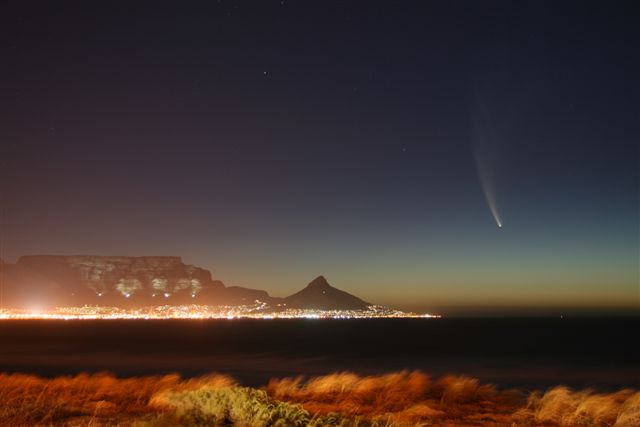
Why do I want to go South with such urgency? This is largely because Comet McNaught continues to put on a wonderful show in the Southern Hemisphere. Amara Graps has kindly put several links for us to look at in the comment stream of my Look Up Down South post. Have a look here, here, here, here, and here. I did, and I found this lovely shot (by Mary Fanner – click for larger) of the comet over the beautiful city of Cape Town, which I miss a lot from the days when I helped run the ASTI science education program in 2004:

comet over  cape town by Mary Fanner

There are several more to be found on the various sites Amara linked to, some that Click to continue reading this post
Unexpectedly On YouTube

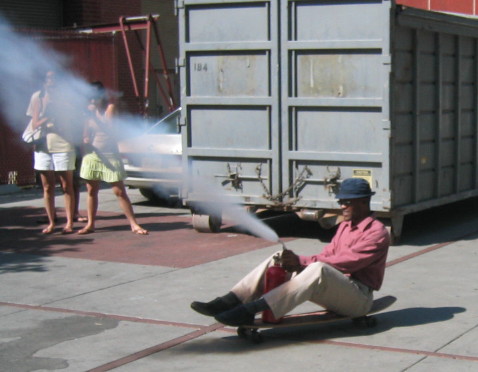
third law jet demoI don’t know why this possibility did not occur to me before. So let me give you a heads up if you do demos in your lectures. In Physics 100 (which I taught last semester) and in Astro 100 especially, we do a lot of demos to demonstrate various physics concepts. I did a post on the Newton’s third law jet propulsion demo some time ago (linked photo right). My colleague Ed Rhodes did this same demo in his Astro 100 class.

He received an email from one of the students in the class recently saying “Congratulations, you’ve been YouTubed…”.

Apparently, one of the students in the class used his or her mobile phone camera to Click to continue reading this post
Vaporstream or no Vaporstream?

Want to have a confidential email conversation about a sensitive issue? There’s not really been such a thing so far, really. Better to pick up the phone and talk in person. Or meet at random near that noisy fountain in the park. But wouldn’t it be nice to be able to send an email and not worry about it being forwarded on, saved – or “reply-all”-ed to the entire organization? I just heard a piece on NPR about a company that claims to offer this service. It acts as the place where you can send and pickup these mails. Once they are read, they are gone. Self-destructed. All very Mission Impossible

The service is called Vaporstream, and you can hear more about it in the NPR story, by going to the NPR site. I can’t give you a link to the clip directly as it does not seem to be on their site anywhere, so perhaps you will just have to listen to the whole program. (All Things Considered- The Monday 22nd Jan show, toward the last half hour or so.)

Interestingly, it seems that there’s only 8 posts tagged with it on Technorati. It’s been a long time since I saw something with so few entries there! I wonder how long that will last?

I wonder if Vaporstream will catch on and we’ll all be using it regularly in a short time. Will it be one of those things, like YouTube and Google, where we’ll all be wondering what life was like before them?

I find myself confused by why this elementary possibility is not a problem: While Click to continue reading this post
What Inspired You?

It’s always interesting to hear from others about what set them on the path they’re on, no matter what career path that is. I just read Chanda’s guest post on the matter over at Backreaction. Chanda is a theoretical physicist in training, and so from my point of view it is interesting to hear about her choices since I chose the same career myself.

Since I’m also keen that talented women and people of colour can learn that they can choose to do science careers, and hope that it continues to become increasingly likely that they make their way in such careers with the same opportunities as everyone else, it was also interesting -and encouraging- to read her thoughts (since she is in both categories). Have a look at her post yourself, and also her post on Cosmic Variance about some of those issues.

Whether or not you read it, don’t hesitate to share with us your own recollections. What Click to continue reading this post

Mathematics and Music

On Wednesday there’ll be an evening event about Mathematics and Music here at USC. If you are nearby and can make it, consider going along. It’s free! It is part of the Visions and Voices programme I’ve talked about before. The presenter/performer will be Elaine Chew, whose research is at the intersection of engineering and music. Read more about the event here. You can find out more about Professor Chew from her website here.

Enjoy!

-cvj

Light Cone

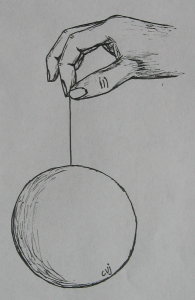
bulb on a stringSo imagine that you’re standing at some spot, holding a big round bulb that can shine in all directions. At a particular time, you switch on the bulb and it shines out brightly. Who has a chance to see the light from your bulb? Let’s not worry about things like buildings, cars, etc., getting in the way of the light, but just imagine it can shine free in all directions. You’ll realize that there is a whole ball of light expanding away from the bulb – light going away from you in all directions. (The edge of that ball describes what is called a sphere, a two-sphere to be precise, denoted [tex]S^2[/tex] in the trade.) The sphere expands at the speed of light. You might imagine that eventually every point in space around you would be reached by your expanding sphere (let’s stay local and not worry about the expanding universe and so forth), and you’d be right. But when? When does it get to some particular point that you might care about? As soon as it takes the light the time it takes to get there, of course. It can’t get there any sooner than that.
Let me put it another way. Your sending out the light is a particular “event”. It took Click to continue reading this post