News From The Front, VIII: One Down…

work_snap…more to go. I’ve finished one of the papers I’ve been writing (this one co-authored with my student, Tameem) after delaying on it for months. I’m not sure how things got quite this backed up in terms of things I have to do, but they have. I meant to start on a new, long project last week, and all my efforts these days have been toward clearing away all those things I want to get done and dusted before focusing on that. It is taking time, but gradually the clearing is happening. Two more manuscripts to complete.

This paper reports on the continuation of the work we’ve been doing over the years in understanding the physics of various model systems in an applied magnetic field. This is in the context of holographic models of important strongly coupled phenomena that are of considerable interest in lots of fields of physics (particle physics, nuclear physics, condensed matter physics, atomic physics). (Since I don’t want to explain holography and so forth every time I talk about it, see a post I did about some of that here, and related posts in the list at the bottom of this one, if not sure what I’m talking about.) (Hmmmm, I see from my SPIRES listing that I’ve got seven papers mentioning magnetic field explicitly in the title in the last three years, and three or four more of the rest are occupied in large part with the issue too. No, really, I’m not obsessed.)

The issue here is the study of structures that suggest themselves as earmarks of Fermi surfaces in strongly coupled systems. It has been a goal for a long time in the context of gauge/gravity duals to understand what the signals of a Fermi surface would be. Would it be some geometrical object in the dual gravity theory, perhaps? Access to a computationally tractable description of such an object would be rather […] Click to continue reading this post
Peer Review Reactions

hitler_peer_reviewAh yes. I’ll admit it: Except for the moustache and a few other details, the scene is eerily familiar… 😉 (The embed for the video is below.)
Does anyone know who originally started this brilliant series? For those who don’t know it is a 4 minute clip from the 2004 film Der Undergang that several people have periodically re-subtitled with words that have Hitler reacting to an event of some sort. (Warning: Many of them are full of language some might find a bit strong, so watch out!!)

Here it is*: […] Click to continue reading this post

Wham!

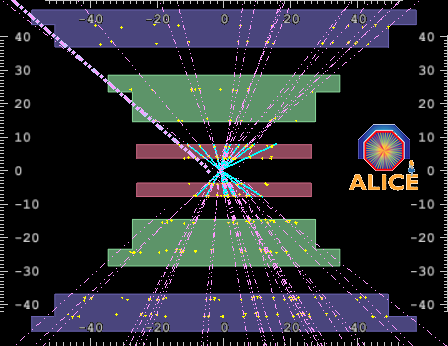
aliceWell, a very gentle sort of wham. Yesterday the Large Hadron Collider at CERN had its first collisions of protons! It is a warm start, making sure everything is working before ramping up the energies to regimes where we hope to see new physics, but it is a very exciting milestone nonetheless*. Recall that a few days back they hit the landmark of getting the machine to circulate beams again for the first time. (If you’ve forgotten what all of this is for, please search the blog for “LHC” and/or look in the related posts list at the bottom of this one.) Above right is a visual reconstruction of some of the collision data seen at the ALICE detector, and you can see more of this sort of data at CERN’s website (from where I got this graphic).

From the press release: […] Click to continue reading this post

There Goes the Weekend

viscosity_scatterI’ve no idea why I do this to myself. I was just about managing things schedule-wise and aiming to make sure I have some fun on the weekend when the following thing happened. I went to Monday’s departmental colloquium and before it, ran into Moh, our organizer this year. I’d been trying to see if there was still room to schedule a speaker I’d thought of inviting, and he mentioned that the dates we’d earlier discussed had all been filled. Then he mentioned that he was desperately trying to find a speaker for next Monday, and was thinking that he’d have to simply cancel it that week.

This was at 4:05pm. Now watch how rapidly I move to ruin a perfectly good schedule […] Click to continue reading this post

More Book Fun!

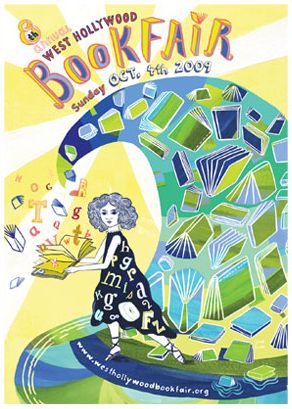
bookfair_homeMark your calendar for Sunday! The West Hollywood Book Fair is on from 10 am to 6:00 pm that day, and there’s so much to see and do with readings, panels, discussions, authors, special celebrity guests, food, exhibitions, writing workshops, discount book offers, signings, swag (no doubt), and so forth. I’ve not been before, but as you know from reading here I’m a big fan of cities going gaga over books for a while, being a regular visitor to the LA Times Book Festival when it comes in the Spring. The calendar of events and much more about the event can be found at the website here.

Here’s another thing. Despite the fact there was no mention of a spankingly splendid […] Click to continue reading this post

Len Adleman: Quantum Mechanics and Mathematical Logic

Today I’m pleased to announce that we have a guest post from a very distinguished colleague of mine, Len Adleman. Len is best known as the “A” in RSA and the inventor of DNA-computing. He is a Turing Award laureate. However, he considers himself “a rank amateur” (his words!) as a physicist. len_adleman He’s one of my colleagues on whom I can always rely for a fun and interesting conversation, even if it is just for a fleeting moment during a chance encounter in an elevator. The other day he told me he’d been thinking a lot about quantum mechanics, and it seemed like it would be fun to share his thoughts with others here on the blog. So join in using the comment form if you’ve some thoughts of your own in response.

Here’s Len.

-cvj

_________________________________________________________________________________

For a long time, physicists have struggled with perplexing “meta-questions” (my phrase): Does God play dice with the universe? Does a theory of everything exist? Do parallel universes exist? As the physics community is acutely aware, these are extremely difficult questions and one may despair of ever finding meaningful answers. The mathematical community has had its own meta-questions that are no less daunting: What is “truth”? Do infinitesimals exist? Is there a single set of axioms from which all of mathematics can be derived? In what many consider to be on the short list of great intellectual achievements, Frege, Russell, Tarski, Turing, Godel, and other logicians were able to clear away the fog and sort these questions out. The framework they created, mathematical logic, has put a foundation under mathematics, provided great insights and profound results. After many years of consideration, I have come to believe that mathematical logic, suitably extended and modified (perhaps to include complexity theoretic ideas), has the potential to provide the same benefits to physics. In the following remarks, I will explore this possibility.

But, be warned: I am not a physicist and these ideas are embryonic. At best they indicate a possible direction; a fully functional theoretical framework, if possible at all, would be the work of lifetimes.

For most of my academic life, my primary topic of research (and affection) has been […] Click to continue reading this post

Thursday was Monopole Day

Here’s an odd coincidence. Thursday, just for fun, I declared it Monopole Day in my facebook status. It was largely because I was prepping a class on Dirac’s ideas about magnetic monopoles (roughly: point sources of magnetic fields analogous to point sources of electric fields), why it seems (from looking at Maxwell’s equations – the defining equations of electricity and magnetism) that Nature might very much like the idea of them (using a symmetry argument – roughly: electric and magnetic fields can turn into each other so if there’s one kind of point source, isn’t it strange that there’s not the other?) but chose to hide them away…

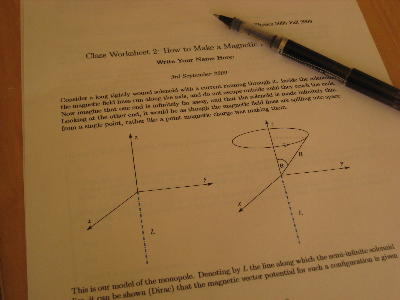
monopole_workIt’s a favourite topic of mine (and many physicists – it is one of the first grown-up tastes of modern ways of thinking about physics that you get as an advanced undergraduate, actually), and so I was excited to lecture about it (as I am every year… I find en excuse to bring monopoles into every course I teach… almost). I even handed out one of my class worksheets, which was all about how to build a monopole (on paper – you take a semi-infinite solenoid (a “Dirac String”) and let the magnetic flux lines spill out […] Click to continue reading this post

Kiss and Tell

I make it a rule to never do that. It’s bad form. Best to be avoided.

Seriously, though, over on the Intersection, Sheril wants your kiss and tell photos. What she’s really looking for is…. well, here are her words:

Have you ever taken a picture of bears nuzzling in the field or kissing fish? How about a provocative pair of human subjects? (With their permission!) Are you interested in having an image credited to you in a science book debuting next Fall? If you’re a photographer with intriguing pictures of kissing and cuddling [no higher than PG-13 content please], email me before September 14 at srkirshenbaum@yahoo.com.

So go and send her some of your material if you have what she’s looking for! If not, consider making some new material. It’s for science.

-cvj Click to continue reading this post

Scenes from Work

cvj_at_workThe College of Letters, Arts, and Sciences here at USC has built a new website, and gone quite far in including extra media, and links and portals on YouTube, Facebook and so on. One of the things they did was have a filmmaker make lots of videos. Lots. Things about faculty, research, teaching, learning, etc. All very exciting. Have a look, here, if interested. Mira Zimet, who makes the films, gave me a call and asked me if I’d like to contribute, and I agreed. I chatted on and on for about 45 minutes to an hour and she cut two short films out of it. The shorter one is on the site and has me saying some general things about research, teaching, science, and USC. Mira made the second because she thought it might be a nice extra video for the College’s YouTube portal. It has me talking a bit more about what string theory is and does, […] Click to continue reading this post

Witten Interview

Here’s an interview that I missed when it first came out back in April. It is with Edward Witten, the single most influential person in my area of theoretical physics for quite some time now. This is for no other reason than his off-scale abilities in every key area of theoretical physics. He was my mentor back in the early ’90s, and the […] Click to continue reading this post

News From The Front, VII: What is Fundamental, Anyway?

One of the words I dislike most in my field – or more accurately, a common usage thereof – is “fundamental”. This is because it is usually used as a weapon, very often by people in my area of physics (largely concerned with particle physics, high energy physics, origins questions and so forth), to dismiss the work of others as somehow uninteresting or irrelevant. image by I don’t like this. Never have. Not only is it often allied to a great deal of arrogance and misplaced swagger, it is often just plain short-sighted, since you never know where good ideas and techniques will come from. A glance at the history of physics shows just how much cross-pollination there is between fields in terms of ideas and techniques. You never know for sure where valuable insights into certain kinds of problems may come from.

Fundamental physics is a term I used to hear used a lot to refer to particle physics (also called high energy physics a lot more these days). This was especially true some years back when I was an undergraduate in the UK, and it persisted in graduate school too, and is still in use today, although I think it is declining a bit in favour of less loaded terms. Somehow, a lot of particle physics is regarded as being all about the “what is everything made of at the very smallest scales” sort of question, first discussing atoms, and then atoms being made of electrons surrounding a nucleus, and the nucleus being made of protons and neutrons, and those in turn being made of quarks, and so on, in this was arriving at a list of “fundamental” particles. There’s the parallel discussion about the “fundamental” forces (e.g., electromagnetism and the nuclear forces) being described in terms of exchanges of particles like photons, gluons, and W and Z particles and so forth. There’s no real harm in the use of the term fundamental in this context, but this is about where the word gets elevated beyond its usefulness and starts becoming a hurdle to progress, and then a barrier. Somehow, “fundamental”, meaning “building block” gets turned, oddly, into “most important”. The issue of what the smallest building blocks are gets elevated to the most important quest, when it is in reality only a component of the story. It is rather like saying that the most important things about the Taj Mahal are the beautiful stones, tiles, and other components from which it is constructed.

Perspectives have evolved a bit since my salad days, with the rise of wider […] Click to continue reading this post

Best Abstract of the Year So Far?

…At least in my field, as submitted to the ArXiv. Just saw “Remarks on the world-sheet saga” by Bert Schroer. The abstract (and the paper) is full of excellently derisive turns of phrase that are hilarious to read! Example from the abstract:

Attention is given to how such misleading metaphors originate and how their support is maintained by quantum mechanical analogies to models which for good reasons never existed before in particle physics physics and whose only purpose is to uphold the string metaphor. The correct localization is inconsistent with the idea of world-sheets and the string-theoretical interpretation of T-duality.

He’s not actually trying to make the reader laugh, I think, but is attempting to make some serious physics points in there, apparently suggesting alternative lines of […] Click to continue reading this post

Just Great!

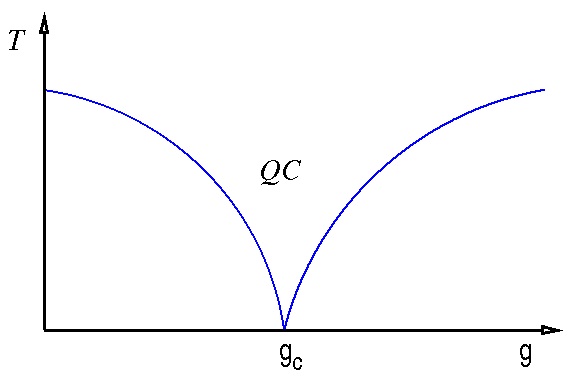
quantum_criticalI’ve no idea why I’m writing a blog post about this, since I can’t really explain any of the details in a way that won’t sound tediously technical. I’m just pleased since I had a sort of perfect workshop moment for a couple of hours after the weekly picnic at the Center today. I’d been talking a bit last week with Lincoln Carr, an excellent condensed matter theorist at the Colorado School of Mines, and had also been talking with Allan Adams, another excellent physicist, from MIT. Allan and I seem to be on the same page as theorists and so I really enjoy talking with him. We work on string theory, but are not fussy about where the physics that it can be applied to might come from. As long as it is good physics. We both seem to love the idea that there’s so much rich physics, that might be accessible with string theory,[…] Click to continue reading this post

Haunting while Working

Well, there are two Aspen cafes that are probably a bit sick of me. The last couple of days saw me frequenting one or other of them while I worked on a number of things, primarily finishing writing a paper. I’ve focused on little else but finishing it up so that I can get on with other things, such as my various other projects, and also to allow me to pay attention to the interesting talks coming up in the workshop […] Click to continue reading this post