ALICE Publishes!

Jacques Distler pointed out that ALICE has just published their first paper, only a little over a week after the beginning of the heavy ion phase of the LHC at CERN! Moreover, they are way ahead in energy of the previous heavy ion collision experiment (RHIC) and have verified “elliptic flow” (the main sign that the quark-gluon plasma behaves like a strongly coupled fluid, the big experimental surprise of some years back, with properties of a type that can be nicely captured using string theory models). Have a look at Jacques’ post here, and go directly to the paper of ALICE here.

Hurrah!

Please see my post from last week (“Experimental Excitement” was the apt title) about why I’m excited about all this!

-cvj Click to continue reading this post

Experimental Excitement!

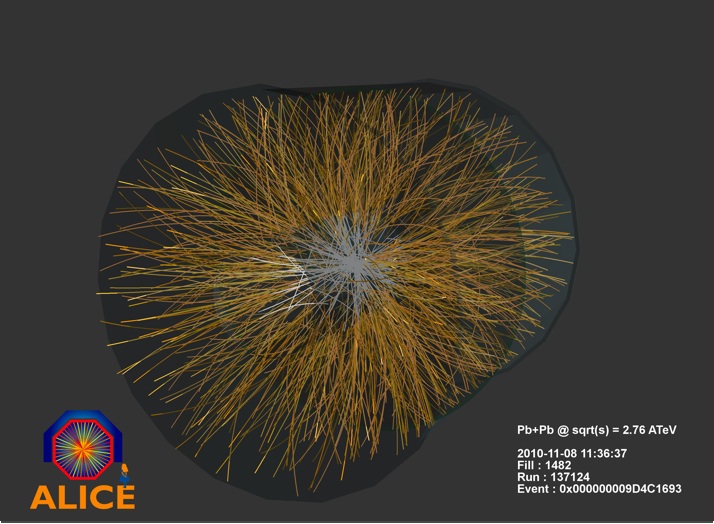
alice_frist_run_dataWell, this week is a big week, in some ways. The Large Hadron Collider has gone into a new phase! For a while, the experiment has turned aside from the task of searching for the origin of mass (the Higgs Particle, or whatever it is that mediates the generation of the masses of elementary particles – see earlier posts, and features like this, etc) and is turning to heavy ion collisions. Rather than studying processes in which only a few particles at a time are interacting at super-duper-uber-high energies, the experiment will instead collide together the nuclei of lead atoms, so that you get lots of particles colliding together and creating a messy “soup” of high energy stuff all together. The goal is to understand the constituent nuclear particles (quarks and gluons) working collectively at high temperature (and low to moderate density), instead of focusing on issues concerning individual fundamental particles. Today (starting late yesterday, actually) is an exciting day because it marks the first step on the journey to probe deeper into this physics. The ALICE experiment has started looking at these collisions. See top right for some screen-shots of the mess of particle tracks that are left after the soup flies apart. The trick is to analyze all these tracks from millions of such collisions to work out the properties of the soup.

As you perhaps know from reading this blog, while of course I’m interested in the behaviour of fundamental particles and the origin of mass, and so on and so forth, I’m very interested in this nuclear issue too. Some of the most interesting work that […] Click to continue reading this post

Southern California Strings Seminar

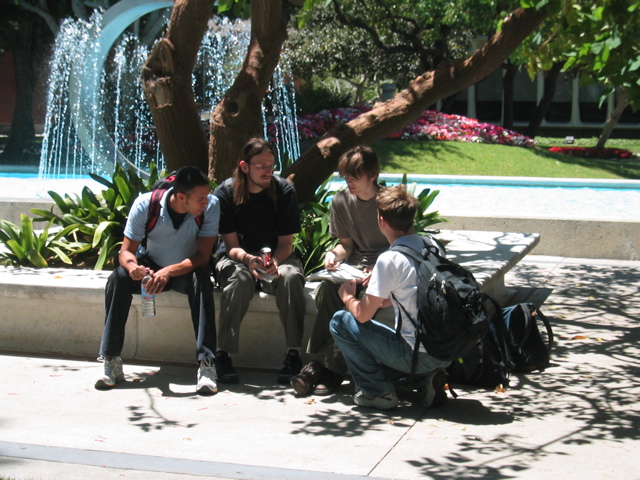
scss_studentsOh! I almost forgot to remind local readers that the next Southern California Strings Seminar is happening this week. Friday and Saturday. It will be at UCLA, and there’s a great line up of speakers. As I’ve said here before, graduate students are especially encouraged to come…

…since special effort is made to make sure that each talk begins with a pedagogical portion to help non-experts in that subfield navigate and see the motivation.

The speakers and talks are:[…] Click to continue reading this post

Too Little, Too Much, or Just Right?

Charles Day on the Physics Today blog asks an interesting question: Why has physics today’s news coverage of string theory been so sparse? I must admit that I had not noticed what the level of coverage is, and so the matter had not sprung to mind, but it is an interesting one. He looks back at the number of major articles written about the subject in recent years (he was a feature editor, and so shepherded some of them through), and concludes that the numbers are low, and he may well be right, but I am not sure I know what the best measure is.

How do we measure the appropriate coverage level? Is it by the number of people working in a sub-field as a percentage of the overall field of physics? If it were possible to break things down that way (I’m happy to see that we have come to a point in the field where I’ve no idea how to define what a “string theorist” is, per se, any more than I know what a “field theorist” is. There are simply people working in various fields who use both as tools to make progress) I wonder what fields would end up appearing under or over covered?

Perhaps a large part of it it is the issue of how many articles on the topic can be written that are of general enough interest, and finding the people who are both able and willing to write. This is a tricky issue, and depends on a combination of the topic in hand and the knowledge and writing skill of the author. There are two extremes that would be a factor here. On the one hand, you have the obvious difficulty of a non-expert journalist either not being able to see the general relevance or value of new results in such a specialist field, or if having seen it, not being able to explain it […] Click to continue reading this post

I Know What You Did Last Summer

That was the unmentioned title of yesterday’s group meeting. We try to do this every year, and so one of the first meetings of the year is us sitting together, eating our lunches, chatting about ideas. We basically catch up, and chat about things we learned about from Summer travels, perhaps from conferences, schools or workshops. We also mention what we’ve been up to in terms of projects worked on, work in progress, etc. I find the latter especially useful from the standpoint of student development, since it is often the first time that a student gets to tell a wider audience (but in a safe environment) a little about what they are doing, often their first projects. Even a few minutes summarizing what you have been doing can be daunting at the early stages of your research career, so this is a good place to start.

Talking about things that we’ve learned are going on in the larger community (or […] Click to continue reading this post

Time Travel a Click Away

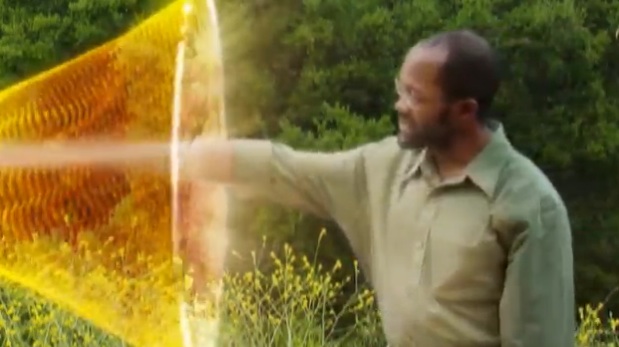
cvj_with_wormholeI just noticed that last week’s episode of The Universe on Time Travel, which I told you about here and here, is available online on their website. Click here to learn more about the ins and outs of it, and I show you how to make one too! Kind of.

It is a difficult subject to explain, and one that must be tempting to […] Click to continue reading this post

Witten at Your Fingertips

l-333-194-98891247-3696-41e6-97c7-386cb6dbeef9.jpegI just noticed, via this article at the Guardian, that not only has Edward Witten been awarded the Institute for Physics’ Isaac Newton medal, but his lecture at the ceremony has been posted online for all to see! See the link below. It is not often that you get an opportunity to see Witten, one of today’s giants in theoretical physics, on the public stage, to the extent that most people outside the field have not heard of him at all. The public view of who is driving forward and massively contributing to the field is rather skewed as a result of the number of appearances and grand pronouncements (often on subjects they’d be better shutting the hell up about!) from certain other renown theoretical physicists. So here’s an opportunity to hear from one of the true masters of the field.

When you speak to sensible people in the subject, whatever their own work is about and whether they like some of the things he works on or not (such as string theory), they will quite readily concur that he has done a huge amount for the field, driving forth many powerful ideas, sharpening the way we think about certain kinds of problems, conceiving of new ideas, and overall strongly influencing much of the basic manner in which practitioners think about the physics they are doing. Often, even if he is not the originator of a particular […] Click to continue reading this post

Happy Higgs Hunting

lhcb_z_bosonIn case you were wondering, things are moving steadily along in the search for the Higgs boson, and in the general ramping up to study entirely new frontiers of particle physics. I noticed a couple of interesting articles today that give you a nice sample. The first, by Dick Ahlstrom in the Irish Times, and is about the announced “rediscovery” of the W and Z bosons at the Large Hadron Collider, by a team working at the LHCb experiment. (I personally think that the term “rediscovery” is somewhat misleading since it makes it seem like the community forgot where they (the key signatures of the unity of the electromagnetic and weak nuclear forces at high energy) were since their discovery in the early 80s, but let me not quibble too much.) The point is that experimental teams are refining their searching techniques while sifting through all the new data being produced in the collisions at the LHC, and one thing you need to do before you begin to look for new things (like the Higgs) is to make sure you can find and recognize old things. Especially very important old things. […] Click to continue reading this post

Emerging Gravity

In the New York Times this week there’s an article* by Dennis Overbye on Erik Verlinde and his paper on the idea that gravity is not a force at all, but a consequence of thermodynamics. You can think of it as an extreme take on one of the directions a lot of the research (that I’ve mentioned a number of times has been going on in string theory) has been pointing, although I think it is safe to say that there’s a lot to be done on making the statement a concrete one that you can do physics with. I think it contains the germs of the right thing we’re all reaching for, but does not quite get there yet. We’re now quite routinely formulating some of the key physics of gravity entirely as physics of a completely non-gravitational dual theory – this is the content of what we call holography – and in particular the quantum physics of black holes in those settings get holographically mapped to the thermodynamics of the non-gravitational physics. This is the basis of the tools that we’ve been applying to studying aspects of phenomena showing up in various experimental systems in nuclear physics and cold atomic physics (and studies of phenomena relevant to various condensed matter systems are also being done). I’ve told you about a lot of this in various posts. (Some of them are listed below.) Running this the other way, the model non-gravitational systems (certain gauge theories at strong coupling and with large rank gauge groups) can be thought of as examples of how gravity (and space-time itself) is really an emergent phenomenon, appearing simply as […] Click to continue reading this post

Scenes from School

unam_astro_math_mexico_2Well, my work at the Quantum Gravity school over (see previous posts here, here and here), I hopped on a plane yesterday, in order to return to Los Angeles. It was an excellent time. I enjoyed being in Mexico again, and seeing a new part of it (see posts to come), and the school was well organized and very enjoyable. The students were very receptive overall, and I spent a huge amount of time chatting with them about physics between sessions, over lunch, and on the bus back and forth between the campus and the city (and on the excursion on Sunday for a while). A number of students seemed very interested in some of the quantum gravity phenomena that are possible to describe using string theory – surprised in most cases (since the background independence issue that keeps being waved about by some as a naive (in my view) and bluntly used principle seems to have served as a block to many) – and it was a pleasure to be able to open them up to new physical ideas. It worked pretty well because I gave them three lectures on the basics of string theory, and so could build on that material in the one to one discussions to explain more detail.

lunch_waiting_unam_mexicoDynamical changes of spacetime dimension is one thing that captured a lot of interest, as well as string theory’s various ways of showing in model examples how spacetime is an emergent, classical approximation to an underlying quantum description that does not have manifest spacetime geometry. The latter is something that all approaches to quantum gravity hope to realize in one way or another (since those sorts of ideas and fantasies about what quantum gravity should be appeared in the mid 20th Century), and exactly how it emerges in string theory is a beautiful story. Who knows, perhaps they will take these hints from string theory about how quantum gravity can work and develop them […] Click to continue reading this post

Minority Report

This is a quick update on the school. I’ve been trying to give the students some of the core concepts they need to help them understand what string theory is, how it works, and what you can do with it. Here’s the really odd thing about all this (and an explanation of the post title): While this is a school on Quantum Gravity, after talking with the students for a while one learns that in most cases the little they’ve heard about string theory is often essentially over 20 years out of date and almost always totally skewed to the negative, to the extent that many of them are under the impression that string theory has nothing to do with quantum gravity at all! It is totally bizarre, and I suspect it is largely a result of things that are said and passed around within their research community.. So there […] Click to continue reading this post

Arrival

(Anyone remember Mike Oldfield? I recall a lovely piece of music of his with the same title as this post and it has now been playing distantly in my head as I type…very pleasant.)

Well, I’m sitting at an outside table across from the main square with the cathedral and having a simple lunch. It is hot, and so I have a glass of cold pale beer in front of me, and everyone around me is speaking Spanish. This feels like it could be that I am back in Madrid, but in fact I am in Morelia, Mexico. (I can tell because, among other things, I’ve never been offered a shoe shine quite so many times in the space of 15 minutes…) It is quite a lovely place, as far as I’ve seen so far (I’ve not explored much yet). I’m resting after a very early morning travel schedule which saw a slight panic (er…long story) at LAX to catch my flight which left just before 1:00am. The seats were fixed to the bolt upright position the whole flight and so the two and a half hours I’d planned to snooze were not so […] Click to continue reading this post

Summer School Prep

So, it is that time of year.

I’ve got to give three introductory lectures on string theory in a Summer school somewhere in Mexico next week. So I must break away from intense work on The Project (which is going well, so maybe you will hear about it sometime soonish(ish)….) and focus on how to cram all the cream into three comprehensible and useful lectures. I hate overdoing the “it can be shown” line that ends up making the whole thing seem like magic (as is so often done), so this is always a challenge. Here’s how my preparation usually goes (and indeed it went this way this week): […] Click to continue reading this post

But is it Real? (Part One)

After my colloquium at UC Riverside some weeks back, I was asked an important question I’ve been asked before, and no doubt will be asked again. The same question may have occurred to you given things I’ve written here about the subject of my research concerning applications of string theory (particularly, ideas from quantum gravity) to understanding (relatively) recent experimentally measured phenomena. (The technique of “gauge/gravity dualities”: See also the special Physics Today May issue with articles on all of this. I wrote about that here. It tells you some of what we can and can’t do with the computational technology, and prospects for improvement, etc.)

So the question is “Is it real?”. This is particularly referring to the black hole in the discussion. Recall, one computes properties of new novel liquid phases of matter (that seem to be closely related to what shows up in the lab) by using a toolbox that involves the equations of gravity, in a higher dimensional spacetime, and much of the thermal nature of the system is controlled by a black hole solution of those equations. So people want to know if that black hole is real. A version of the conversation is like this: (Imagine I’ve already introduced the technique, the higher dimensional spacetime, and the black hole…)

[…] Click to continue reading this post

The Search For Perfection…

…is all very well, but to look for Heaven…is to live here in Hell*.

may 2010 physics today coverOne of the things I worked a lot on in earlier months this year (and late ones of last year) was the lead article in a cluster of articles that has appeared in the last few days in May’s special edition of Physics Today. They are sort of departmental-colloquium-level articles, so for a general physics audience, more or less. It’s about some of the things I’ve told you about here in the past, concerning exciting and interesting applications of string theory to various experiments in nuclear physics, as well as atomic and condensed matter physics (although we do not have an article on the latter in this cluster). I had a fun time working with Peter Steinberg on the article and remain grateful to him for getting us all together in the first place to talk about this topic way back in that AAAS symposium of 2009. It was there that Steven Blau of Physics Today got the idea to approach us all to do an article, which resulted in this special issue.

My article with Peter Steinberg, “What black holes teach about strongly coupled particles “, is here, and the pdf is freely downloadable (update: alternative link here). It is mostly about the theoretical aspects of the whole business and the relevance of the string theory […] Click to continue reading this post