Dawn’s On Its Way
7:34 am EDT – launch! Hurrah! (See earlier post for what this is about.) -cvj
7:34 am EDT – launch! Hurrah! (See earlier post for what this is about.) -cvj
How can I resist such topics – among everyone’s favourites, right? No, I’ll stay away from my own take on the subjects and move straight on to pointing you to two rather amusing pieces.
The first, which I found in a post of Sheril’s over on the Intersection, is a YouTube […] Click to continue reading this post
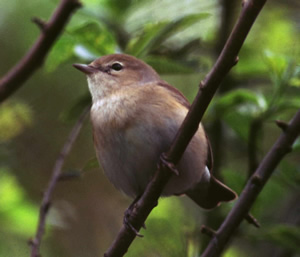 This is simply fascinating. I heard about it on NPR. While it is well known that birds are sensitive to the earth’s magnetic field, and use it to navigate, apparently it’s only been recently shown that this sensitivity is connected directly to the visual system (at least in some birds). The idea seems to be that the bird has evolved a mechanism for essentially seeing the magnetic field, presumably in the sense that magnetic information is encoded in the visual field and mapped to the brain along with the usual visual data. (Image: A garden warbler, photographed by Tommy Holden. I found it on the British Trust for Ornithology website, here.)
Have a listen to the NPR interview with Henrik Mouritsen (professor of neurosensory science at the University of Oldenberg in Germany – and among other things also a keen wildlife photographer, I learned from his website), and learn more about his […] Click to continue reading this post
Well, it is time for Round Two!
 Recall that (as mentioned in my post with the doom-laden title) the Dawn mission was postponed by several months due to unfavourable launch conditions. Recall also that the celestial window for launching Dawn will not come again for another seventeen years, if it does not launch over the next couple of weeks or so! This is a bit scary therefore.
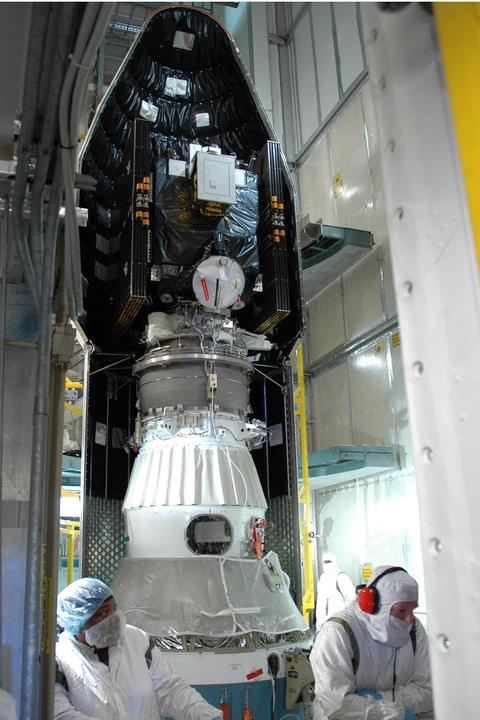
So the two week launch window is open, and Dawn is on the pad and ready to try to fly tomorrow, at around….. dawn. They’ve been preparing Dawn for this for a while now (you can see in the picture on the right some of the preparations – encasing it in the protective dressing for the rocket launch… I got this picture from this link and you can see more there), and from the press release of yesterday confirming that the mission is a “go”:
“If you live in the Bahamas this is one time you can tell your neighbor, with a straight face, that Dawn will rise in the west,” said Dawn Project Manager Keyur Patel of NASA’s Jet Propulsion Laboratory in Pasadena, Calif. “Weather permitting, we are go for launch Thursday morning – a little after dawn.”
Dawn’s Sept. 27 launch window is 7:20 to 7:49 a.m. Eastern Daylight Time (4:20 to 4:49 a.m. Pacific Daylight Time). At the moment of liftoff, the Delta II’s first-stage main engine along with six of its nine solid-fuel boosters will ….
They also talk a bit about the science (also see later, below this): […]
Click to continue reading this post
The MacArthur Fellowships were announced today. These are particularly great, as it’s awarded across so many different fields, and I always learn about interesting work going on by reading the synopses at the website. Congratulations to all recipients!! Before I point to the list, I’d like to make a plea that will, of course, go unheeded.
Please please, people of the media, stop calling them “genius grants”. Just stop. By way of explanation, I can’t quite put my finger on it, but the term just seems to strike the wrong tone about what these things should be about. It seems to me to push the recipients away as being “other” rather than encouraging us all to embrace the qualities that they are being encouraged to show by getting the fellowships. Ok, that’s the end of my plea.
Here’s a reminder of what the Fellowship is about (extract from their site): […] Click to continue reading this post
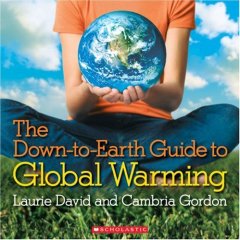 This looks/sounds like fun.
I heard about it on NPR (audio about it here). I suspect that it will be useful and informative not just for kids, but for us older ones as well. It is by Laurie David and Cambria Gordon. I’ve not read it, but from what I gather from the interview, it is certainly worth a look if you’re in the market for accessible information that someone you know (or a whole household) might like to have.
From the NPR site: […] Click to continue reading this post
Just thought I’d let you know that the blog of ScienceWoman (that I talked about in an earlier post) has now moved. Her blogging about her day to day experiences and thoughts as an early career woman scientist will be getting a whole lot more attention now that it is under the ScienceBlogs umbrella. Go and have a look at her new digs. She’s already started off nicely with a post asking readers to name their favourite woman scientist, with the resulting interesting contributions and discussions you’d expect in the comments. Go and add your two cents.
While I was over at ScienceBlogs (haven’t been in a long while) I spotted a rather […] Click to continue reading this post
Here’s my promised report/diary on yesterday’s adventures in film-making.
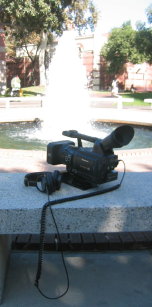 6:45am Got up a bit earlier than perhaps I should have, given that I got to sleep at 1:00am. Spent a while reading a ton of email, and sending some more. Will be away from my regular professoring duties for the whole day, and so wanted to make sure the fort was held. Prepared some appropriate TV clothing (pretty much what I wear normally anyway – simple solid colours), and so forth. Attempted to beautify myself just a tad (with the usual…inconclusive results). Shower and so forth. Coffee and oatmeal, sprinkled with NPR… Read a bit of stuff on dates of historical background on material I’ll be talking about. I often forget that sort of thing, and its never ever needed whenever I do remind myself of it, so after a few minutes I decided not to bother. The core physics ideas are more important, ultimately. Spent time looking for rain gear (the micro-brolly, basically), since supposedly there’s going to be a rainstorm later (hurrah! finally!). Ready to go.
8:45am Fifteen minutes later than I intended to (how did that happen?), I set off to walk to the Sunset/Vermont Red Line subway station. Waved to a neighbour, and we exchanged pleasantries about how nice a day it was.
8:47am Walked past surprised neighbour back toward home…. briskly.
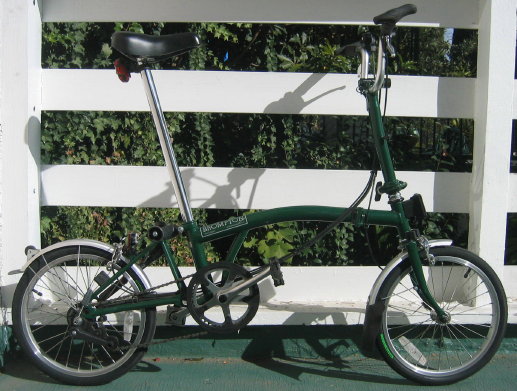
8:52am Riding the Brompton (the folding bike, for those of you not keeping up), I cycled off to the Sunset/Vermont station.
9:01am Arrive at said station on schedule (one minute late does not count in LA), and […] Click to continue reading this post
 Gosh, a thoughtfully-written general level (more or less) article on some of the general outcomes of string theory research! It’s written by Matthew Chalmers, and is in the Sept. ’07 edition of Physics World*. The article can be read online here, and downloadable pdf is here. The graphic on the right came with the article. I don’t fully understand what it is, but the title, like that of the article, is “stringscape”… Look, let’s not over-think this cvj – it’s a pretty decoration.
I’ve done a quick read of it (should re-read more carefully later on – it will no doubt have some emphases with which I disagree somewhat**) and I’d say it is very much worth reading. While not a perfect summary (what is?), compared to a lot that’s been out there, you’ll find it rather more informed, less sensational, (refreshingly unpoisoned by various prejudices, such as the presentations of Smolin and Woit – see numerous earlier discussions in the “More Scenes from the Storm in a Teacup” series of posts, and others), and unafraid to go to some length to unpack the issues somewhat carefully.
Very importantly, it contains numerous quotes from various respected researchers in […] Click to continue reading this post
 This is very interesting to me. I just heard a story (by Nancy Mullane) on NPR’s Weekend Edition about home schooling. (The link is here, and audio will be available at that page shortly). It focuses on the issue that African Americans are the fastest growing group of adopters among minorities in the US. I was also not aware that homeschooling is on a rapid rise.
This raises all sorts of questions for me. Very basic ones. How well does homeschooling work? Does the “product” – an educated person – perform well afterwards, once they’ve rejoined educational settings with the more traditional social environments (colleges and universities). Does the reduced level of social interaction during those homeschooling years have an adverse effect, or is it compensated for by social interaction that presumably takes place after school? Perhaps there are arguments that the reduction in social interaction even helps in some ways? I really don’t know much about this. Do you? I presume there’s all sorts of statistics on this, but I’d be curious to hear a bit of anecdotal discussion in the comments. Perhaps you were homeschooled? Have friends who were? Are homeschooling someone now? Are being homeschooled now? Tell us what you think!
I wonder about this since I’m curious as to whether this results in a different (better, […] Click to continue reading this post
Ok. So I want to make this post timely, but it means that it will begin to let a cat out of the bag. We’ll see how much I can save for a later post as I write1.
So, as I walked to the subway this morning (yes, they have one in LA), I went through my little checklist of things I take on self-assigned assignments of this sort.
Notebook for scribbling: Check
Pen for scribbling: Check
Camera: Check
Phone (now with decent back-up camera): Check
Spare battery for camera: Check
Decent excuse/reason for being spectacularly late: Check
Water: Check
Good footwear for endless walking back and forth: Check
By now you get it. I’m either doing one of my parade reports, or perhaps a street fair/party, museum exhibit, or some random science fair, object or installation or other. Yes, but which? Well, apparently I was going to the future:

The scene: The Los Angeles Convention Center. The event: The NextFest, brought to […] Click to continue reading this post
Well, I’m reporting on this as part of a longer blog post about an event I attended today at the Los Angeles Convention Center, but since it’ll take me a while to finish, and it will be buried in all the other stuff (including pictures and so forth), I’ll snip out a bit of what I’m saying there to inform you of this interesting development:
So what were some of the big ticket items, at least in terms of where all the regular press were? Well, the biggest was of course the X-prize. There was a long movie with lots of stuff about space, and dreams about our future in space, and animations and things of roving robots on planetary surfaces, and all that good stuff…. very nice, I thought, and began to wander off…. and then there was a round of applause from everyone and I came back as a voice announced “The Google Lunar X-Prize”, and various other people showed up on the stage (like one of the founders of Google – forgot his name, and later, good ol’ Buzz Aldrin, who seems to be required at these sorts of events). The Google co-founder guy began his speech by acknowledging all the Google engineers… and announcing that they’d just launched a new version of the moon. Applause. (I’m pretty sure that they mean Google Moon, by the way.)
 Drat.
Drat.
Well, maybe on the next flyby. Flyby page here. AP (via Yahoo) story by Alicia Chang here. Interesting extracts:
The international Cassini spacecraft went into safe mode this week after successfully passing over a Saturn moon that was the mysterious destination of a deep-space faring astronaut in Arthur C. Clarke’s novel “2001: A Space Odyssey.”
..and intriguingly: […] Click to continue reading this post
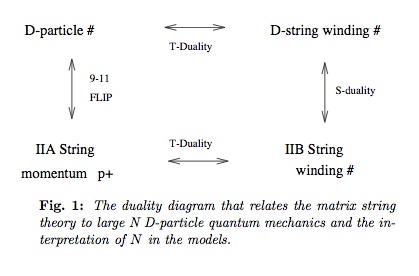 Ok, so here goes. A bit of physics linked to this all so significant date. There’s this term that people in string theory were using a lot in the middle to late 90’s, called the “9/11 flip”. I think maybe the Verlinde brothers, Erik and Herman, possibly in conjunction with Robbert Dijkgraaf, made the term popular but I am not sure about that and I welcome a correction. [Update, since there is some confusion: I’m talking about the term here, not the technique itself, which is older.]
(On right (click for larger) is a snapshot of one of the figures from their influential 1997 “Matrix String Theory” paper. You can see the use the term there, and it is in the paper’s text too, and soon everyone was using it in seminars and other papers to follow.)
The flip became particularly useful when people were discovering the wonders of “M-theory”, which is the catch-all term for whatever is the parent theory of string theory, something we are still trying to formulate. There are a number of narrower uses of the term, however – some more justified than others. For a while, everyone was thinking about the five ten-dimensional supersymmetric string theories (“type IIA”, “type IIB”, “type I”, and two types of “heterotic” theory) which, prior to the middle of 1995 (actually as early as late 1994 or early 1995) all seemed like totally distinct theories, and in the post middle-1995 era (after Witten’s remarkable talk at strings 1995 here at USC: paper here) were recognized to be all part of the same theory. The universe (at least the continually expanding string theory one) changed radically overnight.
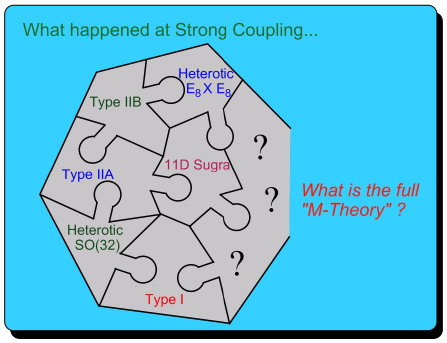
(One of my preferred ways of presenting the puzzle that is M-theory, and how the ten dimensional string theories fit in the puzzle. This is a slide from one of my general talks on the subject.)
The 9/11 flip is really simple, although when a setting is complicated enough, it can […] Click to continue reading this post
In case you missed this earlier this week, there was an intriguing detective science story that, if correct, has yielded remarkable news about the past of our planet, and of course, us. From an AP story by Richard Ingham (via Yahoo):
The extinction of the dinosaurs 65 million years ago can be traced to a collision between two monster rocks in the asteroid belt nearly 100 million years earlier, scientists report on Wednesday.
The smash drove a giant sliver of rock into Earth’s path, eventually causing the climate-changing impact that ended the reign of the dinosaurs and enabled the rise of mammals — including, eventually, us.
(Image above: Simulation images (AFP/HO/Don Davis) of the asteroid collision event, and the resulting extinction collision event on earth, and the collision with the moon.)
The scientists are William Bottke, David Vokrouhlicky and David Nesvorny, working at the Southwest Research Institute in Colorado. They traced the rock to a collision event that took place in the inner parts of the asteroid belt somewhere about between 140-190 million years ago, producing the family of fragments collectively called the Baptistinas, the largest being Baptistina 298. Over time, some of the fragments found […] Click to continue reading this post