
Custard
When looking for an excuse to have some custard, simply whip up an upside down cake built on a bit of fruit, spices, and whatnot you might have (here: apples cooked in butter, basking on caramel, with toasted walnuts, cinnamon…etc). –cvj
When looking for an excuse to have some custard, simply whip up an upside down cake built on a bit of fruit, spices, and whatnot you might have (here: apples cooked in butter, basking on caramel, with toasted walnuts, cinnamon…etc). –cvj
Updated with lots of new results! For your reading pleasure as 1912.03637 on the arXiv. (And still a swift read at 14 pages.) New results include a fascinating differential equation for spectral densities, and some lovely E=0 results. #physics #blackholes #gravity –cvj
Here’s a striking coincidence. Last Friday I was preparing to deliver a lecture on special relativity to my undergrad General Relativity class with this Hobbity thought experiment (that helps one discover Lorentz-Fitzgerald contraction), when I heard that Christopher Tolkien (the boy the Hobbit was originally written for) had died. (RIP. … Click to continue reading this post
(A somewhat more technical post follows.)
Continuing from part I: Well, I set the scene there, and so after that, a number of different ideas come together nicely. Let me list them:
[caption id="attachment_19442" align="alignright" width="250"] What “nearly” AdS_2 looks like via JT gravity. The boundary wiggles, but has fixed length 1/T.[/caption]
The basic Schwarzian computation mentioned above therefore gives the leading piece of the partition function, i.e., $latex g=0$, and so that’s why I put the subscript 0 on it at the outset. A big question then is what is the result for JT gravity computed on all those other topologies?!
(A somewhat more technical post follows.) Well, I think I promised to say a bit more about what I’ve been up to in that work that resulted in the paper I talked about in an earlier post. The title of my paper, “Non-perturbative JT gravity” has JT (Jackiw-Teitelbiom) gravity in … Click to continue reading this post
Well, you know the saying: When life hands you several apples, some blackberries, and a chunk of pastry left over from your last pie-making… you make another apple-blackberry pie, taking the opportunity to make it even better! (No? Never heard that saying? Huh.) -cvj
I realized recently that I’ve forgotten a great deal of my drawing skills, settling back into some clunky habits, due to zero practice. But I’m going to need them back for a project, and so will start teaching myself again. Above is a (digital) chalk doodle I did yesterday. –cvj
The two pies were a success! -cvj
And so it began… All this butter had to end up inside this little bit of flour/water mix. But in lots of tasty layers of deliciousness! (And I’ll do this four times, and so that’s my morning.) More later. I love puff pastry! –cvj
Oh, this? I’m very pleased with it. I’ll tell you more about what it is at a later point, but this is mostly for my own entertainment. It’s a sort of big brother to the spectral curve shown in the previous post. I’d been thinking about how to get this … Click to continue reading this post
Oh, this was a recent post I did on social media that I think ought to go here too. I will try to write a longer post about the physics behind this (in involves black holes, quantum gravity, string theory, quantum chaos, and a host of other things): Were you … Click to continue reading this post
It has been two weeks since it began, but I’m still pleased with the arrival of relatively chilly weather here in LA, because the heat, dust, grime, and smoke of the Summer and into the Fall (from fires, endless hot days, etc.,) was seemingly relentless, and really getting me down. … Click to continue reading this post
[caption id="attachment_19354" align="aligncenter" width="499"] Avengers cosplayers in the audience of my Friday panel.[/caption]It might surprise you to know just how much science gets into the mix at Comic-Con. This never makes it to the news of course – instead its all stories about people dressing up in costumes, and of course features about big movie and TV announcements. Somewhere inside this legendary pop culture maelstrom there’s something for nearly everyone, and that includes science. Which is as it should be. Here’s a look at two days I spent there. [I took some photos! (All except two here – You can click on any photo to enlarge it.]
Day 1 – Friday
I finalized my schedule rather late, and so wasn’t sure of my hotel needs until it was far too late to find two nights in a decent hotel within walking distance of the San Diego Convention Center — well, not for prices that would fit with a typical scientist’s budget. So, I’m staying in a motel that’s about 20 minutes away from the venue if I jump into a Lyft.
My first meeting is over brunch at the Broken Yolk at 10:30am, with my fellow panellists for the panel at noon, “Entertaining Science: The Real, Fake, and Sometimes Ridiculous Ways Science Is Used in Film and TV”. They are Donna J. Nelson, chemist and science advisor for the TV show Breaking Bad (she has a book about it), Rebecca Thompson, Physicist and author of a new book about the science of Game of Thrones, and our moderator Rick Loverd, the director of the Science and Entertainment Exchange, an organization set up by the National Academy of Sciences. I’m on the panel also as an author (I wrote and drew a non-fiction graphic novel about science called The Dialogues). My book isn’t connected to a TV show, but I’ve worked on many TV shows and movies as a science advisor, and so this rounds out the panel. All our books are from […] Click to continue reading this post
[caption id="attachment_19335" align="alignright" width="215"]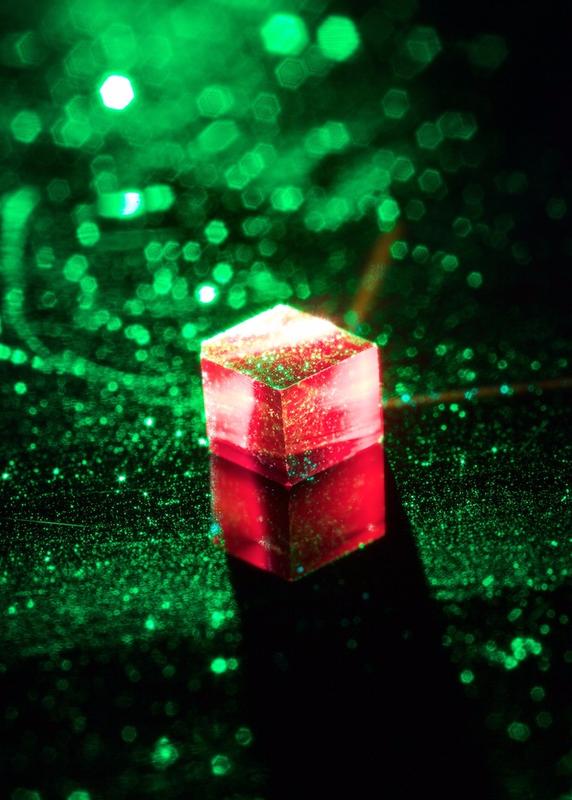 Diamond maser. Image from Jonathan Breeze, Imperial College[/caption]This is part 2 of a chat about some recent thoughts and results I had about de Sitter black holes, reported in this arxiv preprint. Part 1 is here, so maybe best to read that first.
Now let us turn to de Sitter black holes. I mean here any black hole for which the asymptotic spacetime is de Sitter spacetime, which is to say it has positive cosmological constant. This is of course also interesting since one of the most natural (to some minds) possible explanations for the accelerating expansion of our universe is a cosmological constant, so maybe all black holes in our universe are de Sitter black holes in some sense. This is also interesting because you often read here about explorations of physics involving negative cosmological constant, so this is a big change!
One of the things people find puzzling about applying the standard black hole thermodynamics is that there are two places where the standard techniques tell you there should be a temperature associated with them. There’s the black hole horizon itself, and there’s also the cosmological horizon. These each have temperature, and they are not necessarily the same. For the Schwarzschild-de Sitter black hole, for example, (so, no spins or charges… just a mass with an horizon associated with it, like in flat space), the black hole’s temperature is always larger than that of the cosmological horizon. In fact, it runs from very large (where the black hole is small) all the way (as the black hole grows) to zero, where the two horizons coincide.
You might wonder, as many have, how to make sense of the two temperatures. This cannot, for a start, be an equilibrium thermodynamics system. Should there be dynamics where the two temperatures try to equalise? Is there heat flow from one horizon to another, perhaps? Maybe there’s some missing ingredient needed to make sense of this – do we have any right to be writing down temperatures (an equilibrium thermodynamics concept, really) when the system is not in equilibrium? (Actually, you could ask that about Schwarzschild in flat space – you compute the temperature and then discover that it depends upon the mass in such a way that the system wants to move to a different temperature. But I digress.)
The point of my recent work is that it is entirely within the realm of physics we have to hand to make sense of this. The simple system described in the previous post – the three level maser – has certain key interconnected features that seem relevant:
My point is that these features are all present for de Sitter black holes too, starting with the two temperatures. But you won’t see the rest by staring at just the Schwarzschild case, you need to add rotation, or charge (or both). As we shall see, the ability to reduce angular momentum, or to reduce charge, will be the work channel. I’ll come back to the maximum […] Click to continue reading this post
[caption id="attachment_19313" align="alignright" width="250"] Hubble photo of jupiter’s aurorae.[/caption]Another title for this could be “Making sense of de Sitter black hole thermodynamics”, I suppose. What I’m going to tell you about is either a direct correspondence or a series of remarkable inspiring coincidences. Either way, I think you will come away agreeing that there is certainly something interesting afoot.
It is an idea I’d been tossing around in my head from time to time over years, but somehow did not put it all together, and then something else I was working on years later, that was seemingly irrelevant, helped me complete the puzzle, resulting in my new paper, which (you guessed it) I’m excited about.
It all began when I was thinking about heat engines, for black holes in anti-de Sitter, which you may recall me talking about in posts here, here, and here, for example. Those are reciprocating heat engines, taking the system through a cycle that -through various stages- takes in heat, does work, and exhausts some heat, then repeats and repeats. And repeats.
I’ve told you the story about my realisation that there’s this whole literature on quantum heat engines that I’d not known about, that I did not even know of a thing called a quantum heat engine, and my wondering whether my black hole heat engines could have a regime where they could be considered quantum heat engines, maybe enabling them to be useful tools in that arena…(resulting in the paper I described here)… and my delight in combining 18th Century physics with 21st Century physics in this interesting way.
All that began back in 2017. One thing I kept coming back to that really struck me as lovely is what can be regarded as the prototype quantum heat engine. It was recognized as such as far back as 1959!! It is a continuous heat engine, meaning that it does its heat intake and work and heat output all at the same time, as a continuous flow. It is, in fact a familiar system – the three-level maser! (a basic laser also uses the key elements).
A maser can be described as taking in energy as heat from an external source, and giving out energy in the form of heat and work. The work is the desired […] Click to continue reading this post