
Take Part in the Festival!
I’ve just returned from a rather wonderful two rainy days in Santa Barbara celebrating the work of Joe Polchinski. (See my previous post for more about this, including a few reflections.) It was a combination of high school reunion, group hug (with Joe in the center), and serious reflection about physics, now, back then, and to come. Now the great news is that pretty much everything was recorded on video, and so you can take part in it by settling down in front of your computer (or other device – those of you in the further (but pre-singularity) future can just instruct the appropriate plug-in from [Cyberdine systems ] [Tyrell Corporation] Google to stream directly to the vision centres of your brain) and view the various excellent talks and panel discussions here.
I had the honour of chairing (and contributing to) one of the panel discussions reflecting on D-branes (as I promised last post). The title was “D-Branes: Tools of the Revolution” and it went very well thanks to my three excellent panelists (Greg Moore, Andreas Karch and Samir Mathur) and many members of the gathered audience who contributed to the free-form discussion in the 15 minutes at the end. Have a look at that right along side the really interesting and lively discussion that Steve Shenker chaired at the end of the conference (which sadly I had to miss because I had to get back to LA through the rainstorm for another engagement). The idea there was to speculate a bit about the future of physics and thereby “Planning for Joe’s 90th Birthday“.
Enjoy.

 So I am here to help celebrate Joe’s work on the occasion of his 60th (hard to believe that number, frankly), and it will be good to see all the people who show up, and of course it’ll be excellent to see Joe. Part of my help in the celebrations is to organize and run a panel about D-branes, which will be on at 11:00 tomorrow. I’ll be reflecting a bit on the good old days when D-branes really broke, and turned out to be the key tool of the Revolution that took place in the field. In lectures and writings from that time and long after I used to refer to them as the Heroes of the Revolution, and in honor of that and of Joe I have named this session D-Branes, Tools of the Revolutionary, or something like that. Joe helped bring about the revolution, and his tools were D-branes, you see.

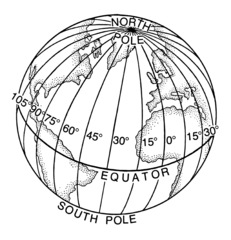 You know such lines, intuitively, in a non-trivial example. Next time you look at a globe (wait, does anyone but me look at maps and globes any more? I love them!), you’ll probably see examples of those lines drawn in. They are the “great circles”, the lines of longitude, and the equator. (Image used with

.png)