Archive for the 'science in the media' Category

Roz Chast On Physics

I learned from Often in Error that Roz Chast, whose work some of you may know from the New Yorker, had some physics-themed cartoons in the May edition of Symmetry Magazine (one of them the cover). Here they are (click for larger, then perhaps click again to zoom):

  roz chast on physics   roz chast on physics

I like the one on the left, I have to say. (A pseudoparticle called “poserino” is just Continue reading ‘Roz Chast On Physics’

Reality Calls

american inventor logoIn a bizarre twist, after a satisfying day of calculating I switched on the television, accidentally pressed a wrong number, and ended up on ABC just as a program called “American Inventor” was starting. I’m not really up on all these “reality” format shows, so I’ve no idea how long this has been in existence, but I must say that it was good to see a program in this format that was primarily about using one’s brain, inventiveness and engineering/construction skills! The format is a bit too gimmicky for my tastes (I’m not partial to all the fake drama and overwrought background music), but that’s probably because I don’t watch much of this sort of thing, so I probably won’t be a regular viewer. But again I must say it was good to see that such a show exists. Perhaps there are more that I don’t know about. It seems that I just saw the phase where they filter out all the silly ones (and goodness were some silly!) and pick the finalists from each city who get $50,000 worth of development money. They did LA and SF in this show, and apparently they’ll be doing the North East next. Questions you might be able to help me with: Do all these shows have a British judge on the panel to play a sort of mean guy? Is it a sort of requirement? The one other such show I’ve seen, American Idol, has that, and like a good theorist I am extrapolating wildly from two data points.

logo for design squadSeeing a reality show based on some intellectual skill actually reminds me. Even though I got a reminder from some of the people behind the show, I’m embarrassed to say that I completely forgot to tell you about the show on PBS for youngsters aged 9 - 12 called “Design Squad”. From the “about” part of their site:

Borrowing from the hugely popular reality competition format, DESIGN SQUAD is aimed at kids and people of all ages who like reality or how-to television. Its goal is to get viewers excited about engineering!

Over 13 episodes, eight high school contestants tackle engineering challenges for an actual client—from building a machine that makes pancakes to a “summer sled” for LL Bean. In the final episode, the top two scorers battle for the Grand Prize—a $10,000 college scholarship from the Intel® Foundation.

I think it has now concluded, but you can watch all 13 episodes online here. Did anyone see it? (I did not.) What did you think? You can get more involved with Design Squad by following up on this part of their website.

Design Squad was co-sponsored by the IEEE, which is excellent to see. So will the American Physical Society (and other science societies) be doing something similar, one wonders? It’s a potentially good way of getting people interested in participating in science - on prime time television. We could, for example, have members of the Continue reading ‘Reality Calls’

Hunting the Higgs is not a (D)Zero Sum Game

D0 data shotWriting in Slate magazine, James Owen Weatherall seems a little confused about how particle physics works. Based on a rumour that there’s a new and significant signal seen at the DZero detector at the Tevatron at Fermilab (Illinois), one of the article’s titles is “Why the rumored discovery of the Higgs Boson is bad news for particle physics”. Supposedly, the big new machine, the Large Hadron Collider (LHC - see more about it here, and what physicists are hoping for from it), about to switch on later this year, would have nothing to do, and would be a waste of billions of dollars. You can read about the original rumour here. (Above right: A random collision event I grabbed from the DZero experiment.)

Well, this is wrong for so many reasons. It is hard to know where to start with this. The major fallacy with the whole thing is that these machines are just somehow discovery devices (in the most naive sense) of some sort. You build it, switch it on, see what’s there, write the paper and the press release (not necessarily in that order) and then you’re done. Completely neglected is the notion of such an experiment as a device for Continue reading ‘Hunting the Higgs is not a (D)Zero Sum Game’

Masterclass, II

Don’t forget to catch the latest installment of Joe Polchinski’s rather thorough deconstruction of the nonsense, obfuscation, selective memory, and other confusions that constitute the bulk of Lee Smolin’s attack on string theory.

All the points I’ve had the energy to raise have been made here on Asymptotia Continue reading ‘Masterclass, II’

“Simple Physics”, by Sempé

Jean-Jacques Sempé does it again, with another great New Yorker cover. This time, his subject is- my people! (click for more detail):

sempe new yorker cover smallPretty interesting to see the choices of equations actually (mostly various quantum mechanics statements - Schrodinger’s equation, Heisenberg’s uncertainty principle, the definition of the Hamiltonian in question (there seems to be an external electromagnetic field?), then there’s a reminder of what happens in beta-decay of the neutron…and there’s the inevitable Einstein’s E=mc2 thrown in at random… and more…).

It’s great to see all this up there… although it is worth noting that a more typical blackboard would have (instead of definitions/statements known very well to the physicist) much more of a working computation in progress, probably.

Of course, if the physicist knew that he or she was to be on a New Yorker cover, perhaps they would have Continue reading ‘“Simple Physics”, by Sempé’

LHC Coverage

CMS at LHC NYTimes

One of the Large Hadron Collider’s detectors, the Compact Muon Solenoid (CMS).

As you gather a lot when there are discussions on the topic here and elsewhere, there’s a lot of excitement and anticipation among high energy physicists about a number of things. I would go as far as to say that we are already in a very rich experimental time for results pertaining to high energy physics (or, if you insist, “fundamental physics” issues (I have in mind, for example, all the wonderful cosmological and astrophysical data that continues to come in, with more to come), and it is set to possibly get much richer - maybe even a new Golden Age with a little bit of luck - when the Large Hadron Collider starts producing results. We are really going into the (relative) unknown with this experiment, and this will be a great time to be working in the field - with a little luck, as I keep repeating.

A number of substantial articles have recently appeared in the general media that give you a good sense of what is going on, more reasons (and more detail) for why there is Continue reading ‘LHC Coverage’

Chocolaty Book Fun

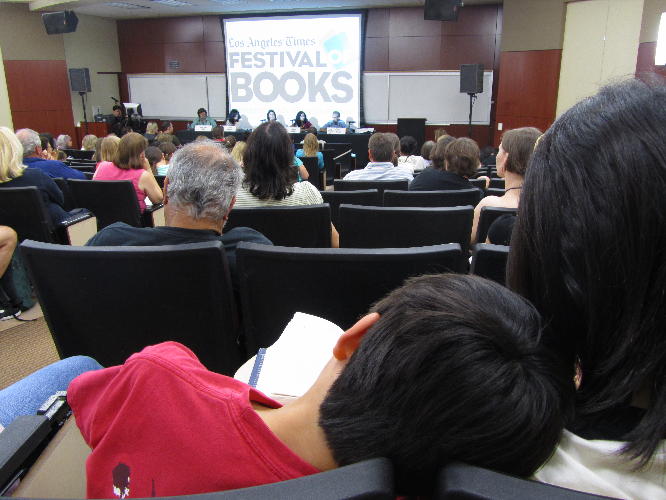
Ah yes, it is that time of year again. The LA Times book festival is on, starting today, and it was kicked off with the swanky Book Awards festival last night, followed by a reception. This all takes place on the UCLA campus, in Westwood. You might recall that I went last year and reported on it. (If in town, go to the LA Times website for more information and find your way over there either today or tomorrow!)

So I went to the Awards show again because:

  1. I enjoyed it last year,
  2. I like “book people”,
  3. I like the idea that in the city where there’s a swanky Awards ceremony for everything else, they have one for books,
  4. I like the unashamed delight that everyone takes in the value of the word on the page… there were some very nice speeches from the master of ceremonies (Jim Lehrer this year) and the various presenters in each category (all authors themselves) about the various aspects of this (all the way from history to Children’s books, to Science…)
  5. I wanted to see if they would have chocolate fountains again. They did.
  6. I wanted to see if they had old typewriters embedded inside ice sculptures again. They did.
  7. I can never be mistaken for an actual author at the reception too many times,
  8. I like dressing up, from time to time. (Never let it be said that I am not honest with you on this blog.)

  book prizes   book prizes

(Above: MC for the night, PBS Newshour host Jim Lehrer, and the LA Times’ Kenneth Turan, on the set/stage. I really like the work of both of these guys…)

Spent most of the evening after the ceremony at the reception talking with LA Times (or related) people and their spouses. This was not my intention, but it was a happy occurrence, as they were all really interesting people - two science writers (Rosie Mestel and Alan Zarembo, who I’d not met before and who were just great to talk to) and also some more general columnists, such as (novellist and essayist) Meghan Daum, and others whose names escape me now. K C Cole, my friend and USC colleague - and ex-LA Times science writer - was there for good conversation, as was Tom Siegfried. So it was just excellent to stand around and munch on the excellent food, drink the wine, and talk (and yes, sometimes gripe) a bit about science coverage and science writing. Briefly chatted with poet and author Michael Datcher (remember him from the point of view event?) and his wife as well, who told me about an upcoming event I’ll be mentioning later, I hope.

Rosie and I turned out to have some interesting points of commonality, which was a pleasant surprise, and so we talked about not just science and science-writing, but England, gardening, and the East/West divide in Los Angeles.

book prizes

(Above: Available light (sorry) shot of Alan Zarembo dipping a bit of pineapple into the chocolate fountain. Meghan Daum and Rosie Mestel look on.)

Some friends and colleagues from USC were there in an official capacity as well, such Continue reading ‘Chocolaty Book Fun’

When Worlds Collide, III

Well, the cat’s out of the bag. Since Tuesday, in fact. What am I talking about? I’m going to get so beaten up in the playground for this…

casino royaleWell, I did a post a while ago about a trip I did to New York to take part in a day long shoot for a magazine, all dressed up in my tuxedo on a “Casino Royale” themed set. You can read about it in full here. What was the point? Reaching out. More science in the public domain, and on the lips of the regular person on the street. The usual things you know (from my writing here and elsewhere) that I’m passionate about. The readership of the magazine in question is not commonly exposed to images of scientists. The world of science and practicing scientists hardly intersects with the world of R&B, hip-hop, sports, fashion, the primary foci of this magazine and many others. I see no reason why not, but those who work in the media that control most of the images we see think otherwise.

Except for some creative people at King magazine. King magazine is a men’s magazine aimed primarily at young African Americans. (See a Wikipedia summary here, and the magazine website here. Warning! This is a men’s magazine aimed at a very specific demographic/readership, and while it does not warrant being on those shelves in the store that are behind the black glass, it is decorated from cover to interior in a manner that is… shall we say “somewhat differently” from the magazines I usually point to, such as SEED, National Geographic, or Scientific American! Ok?)

Every year, King magazine does a feature shoot of a group of people making interesting noises in their respective fields, people that you’ve either heard from (if you’re into those fields, and sometimes even not) or that they expect you’ll hear from soon. It’s all glossy and fun and so forth, and they decided (to my lasting surprise) to call me and ask if I’d take part. Hence the New York trip. The magazine is out on the stands now (June edition), and you can go and look at it.

I took the liberty of making some scans of the pictures for you (I hope the magazine’s staff don’t mind!), since I’d teased you so much in the last post with some of the shots I took, but could not reveal details about who was in the group, etc. There’s more in the actual magazine, such as quotes from the subjects about their work, life, etc.

So here goes:

Continue reading ‘When Worlds Collide, III’

Small Things Considered

What small things? Elementary particles! The second of David Kestenbaum’s excellent report on CERN’s LHC aired yesterday on NPR’s All Things Considered. You can see what I said about the first part here, and the second part can be listened to on the NPR website here. There’s also more video, extra audio, and a transcript.

atlas detector
(Image: The seven story tall Atlas detector at the LHC. (photo: Serge Bellegarde))

The focus on this one broadens out to marvel at the sheer scale of the experiment as a civil engineering feat, and also as a feat of human cooperation (consider the many countries, languages, different people, etc, who are collaborating to make this happen). It’s great to hear the many voices of the various scientists he talks to.

(It’s also great, on a personal note, to hear Jim Virdee (the CMS spokesperson) Continue reading ‘Small Things Considered’

NPR goes to LHC

National Public Radio’s David Kestenbaum, who’s quite reliably an excellent reporter whose field reports I always enjoy, did a report on CERN’s (soon to be switched on) Large Hadron Collider (see also a Wiki here) today! Or rather, it was played on this morning’s Morning Edition. Here’s the site where you can listen to an archived version of the report, and read a transcript of some of it. It’s rather well done.

CMS Higgs simulation event

(Image: A simulation from the CMS experiment - part of the LHC - showing the decay of the Higgs particle after being created in one of the high energy collisions.)

It starts with a few theoretical physicist clichés in the introductory remarks leaving up to talking to Alvaro De Rujula, but it’s fine - not really too over the top, and done with good humour. Really good is that fact that once the physics issues start being discussed and described, he focuses on doing that well. The bottom line is that if your subject -the science- is good, that should take center stage in forming the core of the report for attracting and holding the audience’s attention.

And report does it well. Through interview and Kestenbaum filling in with further Continue reading ‘NPR goes to LHC’

Questions and Answers about Theories of Everything

joke hollywood star of brian greene Sometimes the journalists and editors get it right. In fact, they get it right a lot of the time, but you hear more about the complaints (sometimes from me, sometimes elsewhere) about them getting it wrong, when it comes to things like science coverage especially. What am I talking about? I’m talking about the set of questions and answers that are in a new article on MSNBC that a number of people pointed out to me yesterday and today. It starts out as an article about Brian Greene’s science outreach efforts (books, and tv and movie appearances, including a new one), with some discussion of how this is regarded by his colleagues, the value it has had in raising public awareness of physics (and fundamental science in general, I would argue), and so forth. All that is interesting, but not nearly as interesting to me right now as the later parts of the article which is simply a question and answer session. (Picture above right is from a fun joke I carried out last year that you can read here - be sure to read the comments too.)

Alan Boyle, the science editor, asks Brian a series of very thoughtful questions, and Brian gives some very thoughtful answers. The topics include research in string theory (of course), hopes and possibilities for experimental and observational results (such as from the LHC and Planck) that can inform and ultimately test the ideas coming from string theory and open up new vistas in fundamental physics, research on issues such as the landscape, the idea of multiple universes, research on better developing our understanding of string theory (to the point where we can, it is hoped, extract firm predictions from it), and many other things. (I wrote an introduction to aspects of the landscape issue here - see also the comments - and talked a bit about a Tom Siegfried article on the discussion amongst researchers here.)

It is nice to see an honest, non-inflammatory and non-hyped conversation about the issues, and read Brian’s personal take on some of these matters. The bottom line is, Continue reading ‘Questions and Answers about Theories of Everything’

Categorically Not! - Vulgarization

The next Categorically Not! is Sunday 25th March. The Categorically Not! series of events that are held at the Santa Monica Art Studios, (with occasional exceptions). It’s a series - started and run by science writer K. C. Cole - of fun and informative conversations deliberately ignoring the traditional boundaries between art, science, humanities, and other subjects. I strongly encourage you to come to them if you’re in the area. There’s a new website showing past and upcoming events here. You can also have a look at some of the descriptions I did of some events in some earlier posts (such as here and here), and the description of some of the recent special ones on Point of View and Uncertainty that I organized with K. C. as USC campus events (here, here (with video) and here).

Here is a description from the poster for the upcoming programme:
Continue reading ‘Categorically Not! - Vulgarization’

More Scenes From the Storm in a Teacup, VII

You can catch up on some of the earlier Scenes by looking at the posts listed at the end of this one. Through the course of doing those posts I’ve tried hard to summarize my views on the debate about the views of Smolin and Woit - especially hard to emphasize how the central point of their debate that is worth some actual discussion actually has nothing to do string theory at all. Basically, the whole business of singling out string theory as some sort of great evil is rather silly. If the debate is about anything (and it largely isn’t) it is about the process of doing scientific research (in any field), and the structure of academic careers in general. For the former matter, Smolin and Woit seem to have become frustrated with the standard channels through which detailed scientific debates are carried out and resolved, resorting to writing popular level books that put their rather distorted views on the issues into the public domain in a manner that serves only to muddle. On the latter, there is a constant claim that string theory and its proponents are somehow brainwashing and/or frogmarching young people into working on that area to the exclusion of all else. The authors seem oblivious to some simple facts to the contrary there: (1) that you simply can’t do that to genuinely smart, creative young people; (2) that even students who have string theorists as their Ph.D or postdoc advisors often work on non-string theory research topics (3) that they’re doing an excellent job of either driving young people away from working on some of their favourite alternatives - or from pursuing theoretical physics altogether - by failing to clearly explain their merits and by using the press to help turn this into a distorted spectacle.

I’ve summarized a lot of what I think in the latter part of this post.

There are two major problems with how live debates take place in the public sphere. One is that the average person listening to the debate cannot know whether much of what Smolin and Woit claim as facts are right or wrong (or anyone on the other side of the debate, for that matter). When someone disputes a claim that Smolin makes, he Continue reading ‘More Scenes From the Storm in a Teacup, VII’

When Worlds Collide, II

I think I ought to explain, as promised, why I am in New York. The first thing to mention is that I wrote the previous post in this miniseries (it was written on a flight to Dublin, and finally posted when I returned) before I knew about any of what I’m about to tell you, so it is rather funny to me…

casino royale shoot

The week that I returned from Dublin I noticed a phone message from an editor of a magazine asking me to return their call. A couple of days later I learned what it was about. It’s a magazine that largely focuses on buzz about people and projects in the entertainment and fashion industry - Music (R&B, Hip Hop mostly), Movies and TV, etc., as far as I can tell, along with some coverage of parts of the business world. Its readership is mostly younger African American males, I think. As far as I can tell, the intention is not to be about those things in particular, but it is largely reflecting the interests of the readership it is targeted at. It’s a major product, jumping out at you immediately when you are in the magazine store (the striking picture of a woman on the front helps it grab your attention, of course).

Each year, the magazine does a special issue featuring a group of individuals who are doing “major things” in the industries I mentioned above. It is a combination of a focus on new talent that’s about to become more widely known, or just bringing to readers’ attention the existence of some of the people who are making significant impact in what they’re doing.

Somehow - I do not know how - they got my name. It turns out that they spent some time reading some of things I’ve written here at Asymptotia too. Now normally, you’d expect things to stop at that point, but in fact it did not. They decided to broaden things out a bit and include me (if I was willing) in this year’s feature issue.

I thought about it for a day. It is quite an honour to be approached, and I’m also impressed that the magazine’s editors are being creative in this way (it would be easy Continue reading ‘When Worlds Collide, II’

On Language in Science and Beyond

In Physics Today last month, Helen Quinn wrote rather well about the issue of language in science and in common (non-scientific) usage, with a focus on when the two collide. I recommend the article, which you can read here.

There are cases in our own teaching where confusions arise, which mostly get resolved as the students learn the concepts associated to specific words….

A few words in elementary physics— force, work, momentum, and energy—have carefully defined physics meanings. Their much broader everyday usage causes students a great deal of confusion until they learn the precise physics concepts.

…but she’s much more interested in the cases where some words -often powerful ones, commonly invoked- contribute to “considerable public misunderstanding of science”:

belief, hypothesis, theory, and knowledge.

None of these words has a unique physics meaning, but their meanings as we use them among ourselves and as non-scientists hear them are very different. We need to be much more careful how and when we use them in talking to the public.

She goes on to discuss them in turn. I recommend reading it in full. One of the things I like most about the article is that she talks not only about the process of using those Continue reading ‘On Language in Science and Beyond’

Mars Attracts!

mars water rocksThere’s a nice story about new photographic evidence from the Mars Reconnaissance Orbiter for water having flowed on Mars. It is not really as dramatic as the photographs of late last year, but it is still an important piece of the puzzle overall (so do read about it), if harder to sell to the public as a “stop-the-press!” type of story. So here’s how three different news agencies tried to bring you in:

  • The BBC: Rocks reveal Mars’ watery past

    Not bad. The layering and colour gradations seen are is not direct evidence of water, of course. It could have been some other fluid flow, but…ok.

Next, we have:
Continue reading ‘Mars Attracts!’

Space Opera

Well, I tried to avoid blogging about this, starting yesterday since I was really annoyed that its initial appearance as a story was in the Science section of a number of organizations, and it has nothing whatsoever to do with science. But now that it has arrived in the more general news sections of some publications (see a nice Independent UK article here, for example), I am happier to talk about it, and also to briefly remark upon any tentative connection with science that might be there.

The case is the one concerning the arrest of astronaut Lisa Marie Nowak on what has now been alleged to be attempted first-degree murder. (It stated out as mere vehicle burglary, battery, and destruction of evidence, but was later upgraded.) Basically, in case you’ve not heard, Ms Nowak drove 950 miles from Texas to Florida to stalk and Continue reading ‘Space Opera’

New Einstein Letters

I’m not supposed to be blogging, since I’ve got to go and set up and introduce the visiting speaker, but I thought I’d point you to an LA Times (front page!) article by John Johnson, talking about some new material about Einstein and his more “human” side, as opposed to the standard image that is portrayed*. The letters (from about 1915, before the completion of his General Theory of Relativity - see a post I did about that Continue reading ‘New Einstein Letters’

Science on TV - Having Your Say

Recall that I told you about the pilot for the upcoming show Wired Science in an earlier blog post. It airs today, (Wednesday, January 3) on PBS. It was made by KCET here in Los angeles, and as you may recall from the post, in August I learned some interesting things about the context in which the show sits. It is rather interesting. It’s all part of a head-to-head competition, or “experiment” as PBS are calling it.

You see, there are two other shows being piloted on PBS over the next couple of weeks too. One is Science Investigators, made by WGBH, Boston, and the other is 22nd Century, made by Towers Productions (I think). They are three different takes on a science TV show format. The casting, scripting, presentation… all these things vary a great deal.

They’re really trying to come up with newer, more accessible formats, with the aim of getting science out there to the general public. This is a great thing. Only one show will “win”, sadly. The prize is the go ahead to make more episodes, and have them air on PBS. The judges…. this is the important part… The Judges are YOU. Go to the PBS site Continue reading ‘Science on TV - Having Your Say’

Science Sense

I learned just now that there’s a charity in the UK called Sense About Science. From their website, I read:

Sense About Science is an independent charitable trust. We respond to the misrepresentation of science and scientific evidence on issues that matter to society, from scares about plastic bottles, fluoride and the MMR vaccine to controversies about genetic modification, stem cell research and radiation.

Our recent and current priorities include alternative medicine, MRI, detox, nuclear power, evidence in public health advice, weather patterns and an educational resource on peer review.

This is good to hear about. Recall earlier that I was wondering aloud whether there was anything in the UK that is equivalent to the USA’s Union of Concerned Scientists, or the recently formed Scientists and Engineers for America. (See earlier posts here and here, for example.) This is not really an equivalent organization (they consult with scientists, rather than being a scientist-run organisation for example, and they seem relatively disconnected from the makers of public policy, where a lot of the real battles are to be fought), but they are at least swimming in the same waters.

I learned about them because they’re in the news today. ‘Tis the season for celebrities Continue reading ‘Science Sense’

Time for the Inventor Story

three way ping pong by katrin stantonYes, right on schedule! The UFO story was yesterday, and today the Inventor story.

It starts out with his revolutionary three-way ping-pong table (of course! - and it’s called TriPong1), but before I even clicked on it I knew there’d be a “oh, and by the way, he has an alternative theory of the universe”, at the end.

I was not disappointed. My favourite bit of Katrin Stanton’s AP story (the photo at left is from the article):
Continue reading ‘Time for the Inventor Story’

Tales From The Industry X - Wired Science

Well, there was something I could not tell you about before that I now can. There’s a new TV show called “Wired Science” about to launch. It is made by the PBS affiliate KCET, and will air on your local PBS station (on Wednesday, January 03, 2007, 8:00-9:00 pm ET/PT - double check for local times). It looks like it is going to be informative and fun!

wired science banner

Here’s some of their blurb from the press release:

WIRED SCIENCE is a one-hour program that translates Wired magazine’s award-winning journalism into a fast-paced television show. WIRED SCIENCE brings Wired magazine’s cutting-edge vision, stylish design and irreverent attitude to the screen with breakout ideas, recent discoveries and the latest innovations. The pilot episode takes the viewer into the world of meteorite hunters, where space, commerce and art intersect; travels to Yellowstone National Park to harvest viruses that may hold the key to a technology revolution; and dives underwater to explore NEEMO, NASA’s extreme astronaut training program. Viewers will meet rocket-belt inventors, stem cell explorers and the developer of an electric car that goes from zero-to-60 in under four seconds. As a series, WIRED SCIENCE hopes to span the globe to uncover novel developments in biomedicine, space exploration, artificial intelligence, neuroscience, robotics and military technology.

wired_sciecne_trailerAnd you can go to the site to see stills from some of the location work they did in making the show, and some of the studio work too. You can go to this Wired blog post to see the rather nice title sequence of the show, and the teaser trailer. To the right, there’s a screen shot I made just now (click for larger)

I don’t think that they have the go ahead to make a full series yet. This is a pilot. I imagine that whether they get the full series go ahead depends upon whether it is well liked and supported by you, the viewer. I’d say support it. the people behind it really care about getting good science programming out to you.

So what’s the big deal? Why did I not tell you about it if I’ve known about it for so long? Well, nobody told me not to tell you, but it seemed the right thing to do. You see, I have a little secret. How do I put this? I’m going to get so beaten up in the playground for this.

Continue reading ‘Tales From The Industry X - Wired Science’

Inkling

While we’re on the subject of women in science, some other news*:

Well, they’ve done it! Some of the women - Anna and Anne - who run InkyCircus (Life in the Girl Nerd World) have done what they said they’d set out to do a while back - they’ve started a science magazine. Congratulations Anna and Anne!

It is called Inkling (…on the Hunch that Science Rocks), and here’s the banner (I hope they don’t mind me linking it for advertising purposes):

inkling banner

(As far as I can tell it is entirely online, and has no print counterpart. I could be wrong. (Insert ironic jokes riffing on their use of “Ink” here and elsewhere.) There’s nothing wrong with not having a print counterpart, of course, I’m just wondering out loud if they intend to have one in the future.)

I have not had a good look yet, so I won’t do a wild excited rant like I did for the newly Continue reading ‘Inkling’

BBC Publishes Onion Article?

nullity demoWell, what else can it be? It is not April 1st, so my only explanation is that it is an Onion article that somehow was picked up by the BBC. What do you think? It reads exactly like one, right down to the picture of the pleasant bearded academic at the board, the well-scrubbed English schoolchildren, and the quotes from the children. The only thing missing is the page with the three heads (whose names and occupations change every week) making comments on the story. (Be sure to watch the video links of the demo too!)

This is the sort of science/mathematics reporting that I usually expect to read in the Continue reading ‘BBC Publishes Onion Article?’

Masterclass

You’ve possibly been following my efforts over here to discuss and explain the several weaknesses in Smolin’s and Woit’s arguments and positions, and why the current “string debate” is all an overblown (and media-fueled) fake controversy. (See for example the series of posts entitled “More Scenes From the Storm in a Teacup”, the last three especially, (links: I, II, III, IV, V, VI); use the search engine for other instances.)

I’ve no idea what the effect of these discussions has been. Woit recently said “my views haven’t changed at all”, and so has covered his ears and dug his heels in, while Smolin has written some sort of response on his website. I don’t hold out much hope for them, but I do hope that readers of these discussions can see that there’s been a fair amount of wool pulled over their eyes, to say the least.

What to do? What more to say? Whatever more I say, I cannot say it all any better than Joe Polchinski, a true master from whom we’ve all learned so much physics. Read his review in a guest post over on Cosmic Variance!

-cvj

Timely Futurama

futurama globetrottersJust caught a Futurama episode on Cartoon Network’s Adult Swim. All I can say is: Go and find the episode called “Time Keeps on Slipping”. It is hilarious. It is a brilliant mixture of physics and basketball jokes. Time is slipping uncontrollably due to an interplanetary basketball game…. Earth has been challenged by the planet Globetrotter, for … “No reason - absolutely no stakes beyond the shame of defeat”. (Found a random site here with some information that may or may not be helpful.)

Two random very funny (in context) lines I sort of remember (not accurate):
Continue reading ‘Timely Futurama’

Some Radio Science

I meant to tell you about this on Thursday or Friday, but I had to focus on the Southern California String Seminar, and so did not get to it sooner. So you might not get to listen to it as part of a Sunday afternoon relaxation.

The Royal Society gave an award to Stephen Hawking on Thursday, and the BBC took the opportunity to make a special effort to cover some very good science discussion, as a sort of away mission for the Radio 4 Today program. You can go to the Royal Society’s site with all of the interviews (with Martin Rees, Stephen Hawking, Lewis Wolpert, and John Krebs among others) on various subjects. The last two interviews have comments about ethical implications of scientific research, and about whether the public can trust the information they are given by scientists, respectively. I’ve not listened to those yet, but I bet they’ll be interesting.

You can listen to the whole thing in one continuous block by going to Radio 4’s listen again archive for Radio 4’s Today programme, clicking on the Thursday link (before it gets over-written by the next Thursday programme).

Radio 4’s In Our Time last week also had some interesting material. It was all about the speed of light. This is particularly timely in view of the [sometimes morbidly fascinating] discussion going on about varying the speed of light on another thread. The programme features John Barrow (Cambridge), Iwan Morus (Universirt of Wales, Aberystwyth), and Jocelyn Bell Burns (Oxford). Programme here. (Although you might have to go to the archive page here after Thursday to find this episode.)

Enjoy.

-cvj

(*Thanks Ed Copeland!)


[Update: Andrew Jaffe also talks about these programmes.]

Shocked Reaction

For a refreshingly straightforward point of view from a young person in the field who just wants to get on with doing some good physics with what seems like a promising approach, read Jonathan Shock’s description of his recent attendance of meetings (including the one to which I earlier referred) on heavy ion collisions and related physics. (See also an interesting comment by Xin-Nian Wang on the comment thread of my earlier post.) Jonathan gives some useful links to presentations on some of the attempts to model some of the new physics using string theory models.

The title? Oh, yes, he gets beaten up a bit by those around him for working on strings. Continue reading ‘Shocked Reaction’

Nuclear Guy Goes Nuclear

star rhic goldFollowing on from her earlier post (with Stefan) on the research effort to understand Brookhaven’s RHIC physics with string theory, Bee reports some things she heard about a nuclear physics conference in Shanghai (Quark Matter ‘06). Apparently Larry McLerran -who is at Brookhaven- did a 20 minute anti-string (and anti-Brian Greene) rant. You can see some slides, etc, over there.

(Note for the non-expert:- RHIC means “Relativistic Heavy Ion Collider”. Picture on right (click for larger): Tracks from collision of two beams of gold nuclei -the heavy ions- recorded by the STAR detector at the RHIC experiment. More here. In a sense, a new form of matter is formed in these conditions - the issue is how to understand its properties.)

This sort of thing is rather funny, so far (apparently Brian Greene was given a “Pinocchio award” in the talk?! ). Let’s hope it does not turn into something serious.

In moving forward:

Continue reading ‘Nuclear Guy Goes Nuclear’

Will People Please Stop Saying God Particle?

LHC OverheadWhile looking for something else I’ll blog about in a short while, I stumbled upon one of the most annoying of the articles on the Large Hadron Collider (LHC) at CERN (or any other particle physics experiment) that I’ve read in a long time. This is because of this utterly ridiculous business of calling the Higgs particle the “God particle”. Who started this? It really is so misleading and annoying. The title of the Guardian article is “In the beginning: scientists get ready to hunt for God particle”, and it is by Ian Sample. Some random bits:

It should certainly discover what some call the “God particle”, finally answering the embarrassingly simple but elusive question of why things have mass.

and…

Finding the Higgs boson will confirm scientists’ most complete theory of the universe and the matter from which it is created. “It’s probably the closest to God that we’ll get,” said Jos Engelen, Cern’s chief scientist.

Aaaaargh!!!

Some?! Who are these people who call it the “God particle”?! If you know anybody in the field who calls it the “God particle” (or even out of the field, for that matter) please Continue reading ‘Will People Please Stop Saying God Particle?’

Poincaré In Our Time

I don’t know whether you caught this already, but if not, do consider listening to the 2nd November edition of BBC Radio 4’s “In Our Time”. It is about Poincaré, his work, and the famous conjecture. From their website’s page on the programme:

The great French mathematician Henri Poincaré declared: “The scientist does not study mathematics because it is useful; he studies it because he delights in it, and he delights in it because it is beautiful. If nature were not beautiful, it would not be worth knowing and life would not be worth living. And it is because simplicity, because grandeur, is beautiful that we preferably seek simple facts, sublime facts, and that we delight now to follow the majestic course of the stars.”
Poincaré’s ground-breaking work in the 19th and early 20th century has indeed led us to the stars and the consideration of the shape of the universe itself. He is known as the father of topology – the study of the properties of shapes and how they can be deformed. His famous Conjecture in this field has been causing mathematicians sleepless nights ever since. He is also credited as the Father of Chaos Theory.

So how did this great polymath change the way we understand the world and indeed the universe? Why did his conjecture remain unproved for almost a century? And has it finally been cracked?

It is a particulalry good programme this time. This is a programme that focuses mostly on philosophy, and is often accused of being only rather superficial when it comes to covering the more hardcore and up-to-date science, but not this time. The guests are Continue reading ‘Poincaré In Our Time’

Tales From The Industry, IX

Friday saw me involved in the shooting of two more segments for a television show. Seems that the ones from last time did not work out too badly, so the program makers wanted to do more. Hurrah!

Friday shoot

This session was also a lot of fun, and one of the segments (especially) could end up being a particularly good example of getting a good chunk of a whole science story - showing the actual processes involved in doing science - on TV, er, depending upon how it is edited, of course. This is one of the major reasons that I do this sort of thing. At least as important (in my opinion) as talking, as I also sometimes do, to the press about the fancier things we do (perhaps involving the origin of mass, and whether the universe may or may not have extra dimensions, etc) is the process of getting involved with people in the media (the “Industry”) to help them bring the foundations and cornerstones of science to a general audience. No fancy stuff, just the basic but ever so important connection between the physical world around them and simple scientific reasoning. This achieves some very important things, which I bet will last longer in a person’s mind and everyday life than Continue reading ‘Tales From The Industry, IX’

Further Information on Dark Energy

So the press conference is over. I did not listen to it, but the gist of it, from the press release, seems to be that they’ve observed several more supernovae to pin down even more accurately what the universe’s expansion rate was at very early times (up to nine or ten billion years ago). Image below from their site:

supernovae from hubble

From the site, we learn (for background):

Continue reading ‘Further Information on Dark Energy’

More Scenes From the Storm in a Teacup, VI

A quick update:

  • There was a second installment of the discussion led by George Johnson about press coverage of string theory. He went back to look to see what exactly some of those early articles said… How much coverage was there to start with? When did it start? When did it begin get out of hand? Did it get out of hand? Is this all just part of a standard bubble that happens for any field that the press decides to cover, a sort of manufactured (my word not his) boom and bust cycle? All issues that were touched upon in the discussion. Note also that the discussion broadens out considerably -as it should, (finally!)- to talk about the broader issue of coverage of topics in physics and science in general. The positive and negative effects of press coverage on attracting the next generation of students was also discussed. The discussion (this aspect in particular) was especially interesting because of the remarks by a number of senior people in the audience who were able to talk about their experiences over the years having seen the cycles recruitment of students in their own departments. Worth a listen/look at the archive here.
  • Lee Smolin has written a “Dear Friends” letter in response to some of the things that have been pointed out about his book, and about other points he’s made publicly in various discussions*. He’s given over some time to write quite a bit, which in general is a good thing to have done. You can find it here.

I’ll leave it to you to form your own opinion about Smolin’s remarks (I’ve not had time to read it in detail yet), and start a discussion here. Maybe ask him some followup questions here, for example. To help with context and build a more complete picture, do read some of the earlier comments and discussions involving him -and questions put directly to him- on the threads that share the name of this post. (e.g., Here and here.) Put those alongside the discussion with Peter Woit and of the central thesis of Woit’s book too. They are inseparable.

My set of opinions on the issue is the same as it was before. Even though I’ve said it all so many times here, since blogs seem to have no memory, I will summarize a bit:

Continue reading ‘More Scenes From the Storm in a Teacup, VI’