Archive for November, 2006

The Antikythera Mechanism

So, I have questions.

the Antikythera mechanismAbout what? Well, by now you’ve heard about this wonderful machine that was found 100 years or so ago, which after a lot of research, has been found to be a remarkably sophisticated mechanical computer designed and built in ancient Greece about 2,100 years ago. There’s a nice LA Times story on it by Thomas H. Maugh II here, and a New York Times story* by John Noble Wilford here and a Reuters article by Patricia Reaney here. (The image to the right (click for larger) is from the University of Cardiff.)

From the articles you can learn that the machine was able to perform computational tasks 1400 years or so before the time when machines of this sort (but less sophisticated) were thought to have appeared. What sort of tasks? Well, using 37 gears or so it can do subtractions, multiplications and divisions to show the cycles of Continue reading ‘The Antikythera Mechanism’

Keeping an Eye on the Sun

hinode sunspot picture

Continue reading ‘Keeping an Eye on the Sun’

Shocked Reaction

For a refreshingly straightforward point of view from a young person in the field who just wants to get on with doing some good physics with what seems like a promising approach, read Jonathan Shock’s description of his recent attendance of meetings (including the one to which I earlier referred) on heavy ion collisions and related physics. (See also an interesting comment by Xin-Nian Wang on the comment thread of my earlier post.) Jonathan gives some useful links to presentations on some of the attempts to model some of the new physics using string theory models.

The title? Oh, yes, he gets beaten up a bit by those around him for working on strings. Continue reading ‘Shocked Reaction’

My Powerpoint Advice

Chad is giving more “Powerpoint technique” tips over on his blog.

I’d like to give a few tips of my own:

  1. Learn to give a good 55 minute chalkboard (or whiteboard) talk first. Only then learn about how to give a talk with a computera.
  2. Powerpoint?! Don’t use Powerpoint, for goodness sake! Use Keynoteb!!

-cvj

[aRegardless of program you are using to project the talk. And am I the only one who Continue reading ‘My Powerpoint Advice’

Southern California Strings Seminar

discussion at the scssOn Friday and Saturday of this week (December 1st and 2nd), the next Southern California Strings Seminar will be happening! It’s a regional meeting for people doing research in string theory and related topics, and as I’ve said before, I’d especially like to see more young people come out and take part. We make a special effort to ask the speakers to spend a little time at the beginning of their talk setting the scene (speaking about motivations, what has gone before, etc) so that the series can be of great value to people who are trying to learn what’s going on in a particular topic at research level (this can be students, postdocs, or faculty, in fact).

If you’re doing this kind of physics research anywhere in the Southern California region, and want to take part, please come. See the website for details, and try to let Continue reading ‘Southern California Strings Seminar’

Grand Clues All Around

Today in my Physics 100 class (I’m preparing it right now), we’ll be re-discovering the structure of the atom… It’s nice to consider the clues that are around us in our everyday life. This picture (click for larger… and yes, I was down at Grand Central Market again on Sunday) will start my discussion of one set of important clues…. Any thoughts about what aspect of it I’ll be talking about?

Grand Central Market

-cvj

See Six

The good people at the US Postal service do produce some splendid sets of stamps on quite a regular basis. Today, to my delight, I was offered this set as one of my choices at the post office:

snowflakes

There’s so much physics behind the microscopic lattice of H2O molecules underlying such a lovely shape, with the pleasant C6 symmetry of the macroscopic result - the snowflake. I found a lovely “morphology diagram” showing the sorts of shapes you get depending upon temperature and supersaturation of the water vapour that condenses Continue reading ‘See Six’

People of the Corn

The people of the corn are not the folks in Chiapas, Mexico, who have been known to call themselves that. Or, I should say not just them. Who else? The people of the USA. Maybe much more so than the people in Mexico.

I learned this from listening to Michael Pollan, author of the book “The Omnivore’s Dilemma”, who was on NPR’s Science Friday two days ago. His book explores the origins of the food that we eat every day, explaining the changes that have occurred in agriculture that moved us away from the traditional model of a farm (that many of us still have in our heads) to the current model: No animals, no pastures, no variety. Just a few specific crops, like corn. Corn grown for all sorts of reasons, and very few of them for the actual corn itself as a food. Instead, it goes into nearly everything that we eat (and more) in huge quantities. The vast majority of the food that we eat has corn at its base in some way or another. Either directly, such as in the sweeteners added to nearly every procesed food, or indirectly - corn is used as feed for producing the animals that we get meat, milk, etc, from. You can use a mass spectrometer to trace Continue reading ‘People of the Corn’

Tee Time On The Space Station

ISS image at sunsetBefore I point you to the link about the latest important activity on the International Space Station, I’d like to ask for your help: - This might be a bit impolite, but may I ask what is the actual point of the International Space Station? I spent a bit of time (not a huge amount, I admit) at NASA’s site, for example, and can’t really find an overall scientific or engineering statement of purpose. There’s a bit of chatter about learning about the effects of long spaceflights on the physiology of human beings, and how to meet engineering challenges of various sorts, but that seems to be it. The weekly science reports that you can read on there don’t sound very encouraging either, but I imagine I’m seeing the digest for the media and non-experts.

[Update: - Ok! I found some interesting sites here and here. They do help a bit.]

I’m not being sarcastic here…. I’d really like to know more. I’m sure that there must be a Continue reading ‘Tee Time On The Space Station’

Must Go Down

    Sea Fever

    I must go down to the sea again, to the lonely sea and the sky,
    And all I ask is a tall ship and a star to steer her by,
    And the wheel’s kick and the wind’s song and the white sail’s shaking,
    And a grey mist on the sea’s face and a grey dawn breaking.

    I must go down to the seas again, for the call of the running tide
    Is a wild call and a clear call that may not be denied;
    And all I ask is a windy day with the white clouds flying,
    And the flung spray and the blown spume, and the sea-gulls crying.

    I must go down to the seas again, to the vagrant gypsy life,
    To the gull’s way and the whale’s way where the wind’s like a whetted knife;
    And all I ask is a merry yarn from a laughing fellow-rover,
    And quiet sleep and a sweet dream when the long trick’s over.

    - John Masefield

Why go down? In a short and light-hearted radio piece on NPR, Robert Krulwich discovers a way to make time run more slowly (an attractive idea over a long holiday Continue reading ‘Must Go Down’

Nuclear Guy Goes Nuclear

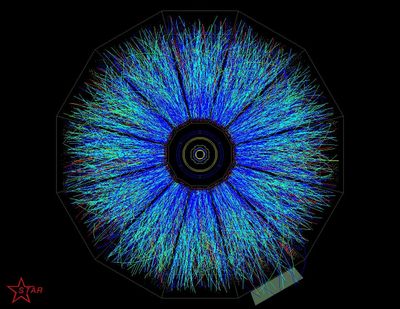
star rhic goldFollowing on from her earlier post (with Stefan) on the research effort to understand Brookhaven’s RHIC physics with string theory, Bee reports some things she heard about a nuclear physics conference in Shanghai (Quark Matter ‘06). Apparently Larry McLerran -who is at Brookhaven- did a 20 minute anti-string (and anti-Brian Greene) rant. You can see some slides, etc, over there.

(Note for the non-expert:- RHIC means “Relativistic Heavy Ion Collider”. Picture on right (click for larger): Tracks from collision of two beams of gold nuclei -the heavy ions- recorded by the STAR detector at the RHIC experiment. More here. In a sense, a new form of matter is formed in these conditions - the issue is how to understand its properties.)

This sort of thing is rather funny, so far (apparently Brian Greene was given a “Pinocchio award” in the talk?! ). Let’s hope it does not turn into something serious.

In moving forward:

Continue reading ‘Nuclear Guy Goes Nuclear’

Some Things I Like About The Doo Dah Parade, II

(Continuing from previous…)

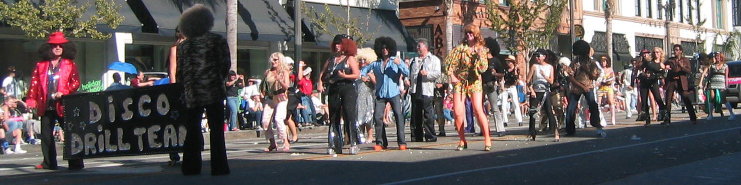
…Then there’s the Disco drill team, which was really excellent.

doo dah disco

Their drill? Some serious synchronized Disco dancing, of course. They did the “Hustle”, along with various standard Saturday Night fever moves, and the crowd were very appreciative. Inevitably they did “YMCA”… and just as inevitably the crowd spontaneously joined in with the arm movements. (I think that this is hard-wired into a whole generation - rather like the reaction you get from all the women at a party if anyone puts on “I will Survive”.)

You know that they did not have to make those costumes… they probably sit in wardrobes (closets) every year since being retired in the late 70s, waiting for their Continue reading ‘Some Things I Like About The Doo Dah Parade, II’

Fusion In Our Future?

ITERTuesday saw the official agreement between a consortium of countries to construct a fully functional fusion reactor, at a cost of 12.8 billion dollars, or thereabouts. The project is called the International Thermonuclear Experimental Reactor, ITER. It is indeed a huge undertaking, and we could end up with nothing to show for it, but on the other hand it would be a miniscule price to pay if we were to get the scheme off the ground. The promise of an abundant source of energy that is (supposedly) less polluting and safer to run than fission and does not add to our upcoming woes caused by climate change is too tantalizing not to pursue.

In case you’re wondering, the image to the right (click for larger) is a schematic representation of the 500MW reactor. It is of the classic “Tokamak” type, in which there is a torus (doughnut) shaped region where the plasma will be magnetically contained, at a temperature of 100 million K. To learn more about fusion, you can go to the article from the UKAEA here, and the article on ITER here at their website. From the latter, you can learn about the specific scientific objectives of ITER:
Continue reading ‘Fusion In Our Future?’

The Sports Movie Script

Every other time I go to the movies, there is a trailer for yet another sports movie which has exactly the same plot as all the others. Every time I sit there stunned and open-mouthed after the trailer and have a little internal rant (sparing my companion(s)), wonder to myself about what it is about the national psyche that needs this same simplistic story quite so often, and wonder why nobody else seems to notice the phenomenon. It is also noticable that it is one of the rites of passage of a famous male Hollywood star (even really good ones) to play the grizzled coach of the no-hope team….. blah blah blah…. why is that?

Well, to my delight, this morning the programme Morning Edition on NPR played Continue reading ‘The Sports Movie Script’

Some Things I Like About The Doo Dah Parade, I

Ah! The Doo Dah Parade! I do love it so. Why?

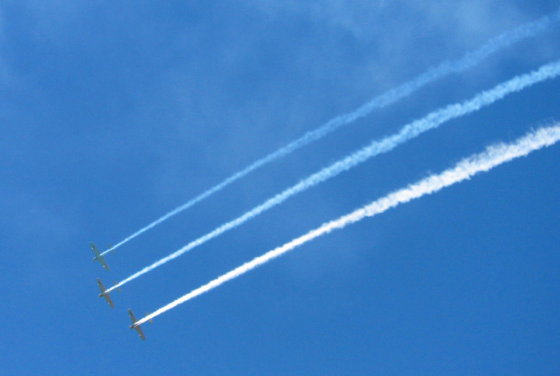
First of all, they began with a fly-over by three planes with pleasant coloured smoke streaming out the back.

doo dah flyover

Big deal, you say. Fair enough, but compare this to how the Rose Parade (which runs along a similar route six weeks later) starts… with a fly-by of a Stealth Bomber flanked by two Stealth Fighters. People cheered. I first saw this in 2004 when the USA had already reached out with this power to invade Iraq, and we were all depressed about the recent re-election of the leaders who committed that crime. [Later correction: Of course, I got my date wrong… The election was to come later that year… the depressed feeling was just from the ongoing Iraq situation.] My reaction as the Stealths flew overhead? Wanting to clasp my hands over my ears and run screaming - just like the orcs and trolls of Sauron’s army do whenever the chief symbols of his air power (the winged Nazgul led by the Witch-King of Angmar) fly over the battlefield. You wield your terrible weapons and scare the crap out of your enemy and your friends - what does that say about you? So this is why I like that the Doo Dah parade starts with those less in-your-face planes.

I digress, losing half my audience (all seven of you) by making a Lord of the Rings reference. Should have chosen Homer. Oh well. So, remembering that the Doo Dah is the antidote to the cookie-cutter perfection of your typical Rose-type parade or Macy’s Thanksgiving Day parade, have a look at some things that caught my eye.

Continue reading ‘Some Things I Like About The Doo Dah Parade, I’

Will People Please Stop Saying God Particle?

LHC OverheadWhile looking for something else I’ll blog about in a short while, I stumbled upon one of the most annoying of the articles on the Large Hadron Collider (LHC) at CERN (or any other particle physics experiment) that I’ve read in a long time. This is because of this utterly ridiculous business of calling the Higgs particle the “God particle”. Who started this? It really is so misleading and annoying. The title of the Guardian article is “In the beginning: scientists get ready to hunt for God particle”, and it is by Ian Sample. Some random bits:

It should certainly discover what some call the “God particle”, finally answering the embarrassingly simple but elusive question of why things have mass.

and…

Finding the Higgs boson will confirm scientists’ most complete theory of the universe and the matter from which it is created. “It’s probably the closest to God that we’ll get,” said Jos Engelen, Cern’s chief scientist.

Aaaaargh!!!

Some?! Who are these people who call it the “God particle”?! If you know anybody in the field who calls it the “God particle” (or even out of the field, for that matter) please Continue reading ‘Will People Please Stop Saying God Particle?’

The Paper

I learned from Often In Error that the paper of Riess et al, reporting on the research that was in the recent NASA press release, is out. It is here.

(Aside:- I must use the term “cosmic jerk” in an everyday sentence one day…. probably not as a term of endearment….)

-cvj

Poincaré In Our Time

I don’t know whether you caught this already, but if not, do consider listening to the 2nd November edition of BBC Radio 4’s “In Our Time”. It is about Poincaré, his work, and the famous conjecture. From their website’s page on the programme:

The great French mathematician Henri Poincaré declared: “The scientist does not study mathematics because it is useful; he studies it because he delights in it, and he delights in it because it is beautiful. If nature were not beautiful, it would not be worth knowing and life would not be worth living. And it is because simplicity, because grandeur, is beautiful that we preferably seek simple facts, sublime facts, and that we delight now to follow the majestic course of the stars.”
Poincaré’s ground-breaking work in the 19th and early 20th century has indeed led us to the stars and the consideration of the shape of the universe itself. He is known as the father of topology – the study of the properties of shapes and how they can be deformed. His famous Conjecture in this field has been causing mathematicians sleepless nights ever since. He is also credited as the Father of Chaos Theory.

So how did this great polymath change the way we understand the world and indeed the universe? Why did his conjecture remain unproved for almost a century? And has it finally been cracked?

It is a particulalry good programme this time. This is a programme that focuses mostly on philosophy, and is often accused of being only rather superficial when it comes to covering the more hardcore and up-to-date science, but not this time. The guests are Continue reading ‘Poincaré In Our Time’

Doo Dah! Doo Dah!

Yikes! I woke up a short while ago and realized that it is the weekend before Thanksgiving. You know what that means? The Doo Dah Parade!

housing drill team

It is the antidote to the (sometimes nauseatingly wholesome) Rose Parade that takes place at New Year’s, or the Macy’s Thanksgiving Day Parade. Here is what I said in a blog post last year:

Continue reading ‘Doo Dah! Doo Dah!’

Tales From The Industry, IX

Friday saw me involved in the shooting of two more segments for a television show. Seems that the ones from last time did not work out too badly, so the program makers wanted to do more. Hurrah!

Friday shoot

This session was also a lot of fun, and one of the segments (especially) could end up being a particularly good example of getting a good chunk of a whole science story - showing the actual processes involved in doing science - on TV, er, depending upon how it is edited, of course. This is one of the major reasons that I do this sort of thing. At least as important (in my opinion) as talking, as I also sometimes do, to the press about the fancier things we do (perhaps involving the origin of mass, and whether the universe may or may not have extra dimensions, etc) is the process of getting involved with people in the media (the “Industry”) to help them bring the foundations and cornerstones of science to a general audience. No fancy stuff, just the basic but ever so important connection between the physical world around them and simple scientific reasoning. This achieves some very important things, which I bet will last longer in a person’s mind and everyday life than Continue reading ‘Tales From The Industry, IX’

A Tasty Phase Diagram?

I love making pies. I perfected my current pie-making technique when I was a graduate student in Southampton. I was in a rented house with four other students, and the house had a splendid apple tree in the back garden. I could not bear to see them all go to waste when it was in full crop. So I made apple pies. Lots of them.

A crucial part of the process of making a good pie is the making of the pastry that will constitute the crust. Very important indeed, unless you are cheating and buying a ready-made crust, in which case you are not making a pie any more - the actual work has been done for you. (Ok, sure, go ahead - shout at me…)

Well, I don’t need to do one of my long cooking posts about this just yet, since the Lab Lemming is concerned about these issues too, I noticed, and has gone to the trouble of preparing what looks like a careful study of the process (including the pitfalls) just in time for the beginning of the primary pie-making season (Thanksgiving, etc…). Here’s a phase diagram from that discussion, which made me laugh quite a bit:

pie crust phases

Here’s a bit of the discussions below it, to whet your appetite…

Continue reading ‘A Tasty Phase Diagram?’

The Lion’s Share

Remember the Orionids? Well, it is the turn of the Leonids, this Saturday and Sunday (although those are just the peak days). These comets are the result of us passing through the debris left by comet Tempel-Tuttle. The peak will be on the 19th November…. Viewing and other information here (Armagh Observatory), here (a NASA site), and here, from Gary W. Kronk’s site (as is the diagram below). Here’s a nice Space.com article by Joe Rao.

There is expected to be quite a spike in the viewing rate this year… enhanced by a factor of ten to maybe as many as 100 or 200 per hour. This is for the lucky viewers in Western Europe (and the British Isles :-) ), North Western Africa, North Eastern USA and Eastern Canada, Continue reading ‘The Lion’s Share’

Further Information on Dark Energy

So the press conference is over. I did not listen to it, but the gist of it, from the press release, seems to be that they’ve observed several more supernovae to pin down even more accurately what the universe’s expansion rate was at very early times (up to nine or ten billion years ago). Image below from their site:

supernovae from hubble

From the site, we learn (for background):

Continue reading ‘Further Information on Dark Energy’

Less In The Dark Than Before?

From NASA, tomorrow, at 1:00pm EST: An announcement about Dark Energy. If the pattern of last time is to be followed, there must be new evidence from the space telescope team (represented by Riess and Livio at the press conference) in favour of one interpretation or another. Since they are saying that they will “announce the Continue reading ‘Less In The Dark Than Before?’

Out of Step, Out of Arguments and Out of Time

Those are the words of Kofi Annan at the UN conference on Climate Change earlier today (see AP story by Charles Hanley). His speech emphasized the “frightening lack of leadership” in forming strategies for how to tackle the huge task that lies ahead for our planet with regards emissions. Getting the job done here of course means us realigning our entire global culture’s priorities, taking our eyes off short term gain and looking to prospects for the future. The typical stance of the current US government that strong emissions controls (and treaties to enforce them, such as the Kyoto protocol) will hurt economies is one example of the short-sightedness that we are up against. Their delegates at the conference continue to reject arguments such as Continue reading ‘Out of Step, Out of Arguments and Out of Time’

We’re Not Doomed

video gamerUSC has launched a Bachelor’s degree in video games. I know what you’re thinking. Stop it! No, civilisation is not doomed. (Image on right grabbed from Chip Chick). In fact, this could be rather wonderful, as it will create the opportunity to develop the potential of this medium in so many wonderful ways. It will not be about kids sitting there blowing up stuff and shooting up people. Why do I say this?

I remind you that in 1929 USC founded the first film school (at least in the USA)…. I imagine that people turned up their noses at this. Film is now recognized as a major art form, and a powerful tool for education and expression, with USC continuing to lead the pack in educating artists, visionaries and technicians in that area, feeding the local Industry and well beyond.

Doing a degree in film or movie-making (or “The Cinematic Arts”, as we are supposed Continue reading ‘We’re Not Doomed’

When Chaos Goes Quantum

Mark SrednickiNot many Mondays ago we had a Departmental Colloquium here at USC entitled “Quantum Chaos and the Foundations of Statistical Mechanics”, by Mark Srednicki, of UCSB.

This was a double treat for me, since I’ve known Mark since my days in Santa Barbara, and remember many happy lunchtimes sitting at lunch with him overlooking the lagoon talking about everything from physics to Bablyon 5. That was during those truly amazing days of being a postdoc in string theory at the time when D-brane technology was turning the field upside down, and a lot of the torque needed for this was being generated right there in Santa Barbara, sometimes in lunchtime conversations. I was reminiscing about those days just a week before in Cambridge, having run into Karl Landsteiner and Roberto Emparan, two other postdocs from those fantastic times. The reason for us all being in Cambridge was to attend the Andrew Chamblin memorial conference, which I told you about in an earlier post. Andrew was also a postdoc there, around the same time as us, and we rapidly forged the good friendships that you’ve read about in a number of earlier posts linked from the previous link.

Mark used to tell me a bit about Quantum Chaos back then too, and I found it interesting, but always wanted to hear the story laid out properly, and to hear what he Continue reading ‘When Chaos Goes Quantum’

More Uncertainty

walt disney concert hallYou may recall the very successful event called “Uncertainty”, back at the end of August. I blogged about it here and here, among other places.

Well it is time for the second one in the series. Recall that it is part of the Provost’s Visions and Voices series, which has been running since August, with a huge program of events of all sorts.

Here are some words about the event:
Continue reading ‘More Uncertainty’

Here Not There

Just to let you know… I’ll not be blogging at Cosmic Variance any more.

The five of us started an excellent thing over there, and had some fun times (with the help of many of you - thanks). I imagine that will continue, so don’t forget to make sure to pop over there from time to time to see what’s going on.

-cvj

Grand

Spent most of the daylight hours downtown today. Well worth it.

grand central market

Been a while since I’ve been to Grand Central Market. Continue reading ‘Grand’

Keeping an Eye on Saturn

The Eye of Sauron is rising again, but now on Saturn!?

cassini saturn storm

No, here’s what’s actually going on:

Continue reading ‘Keeping an Eye on Saturn’

Better To Burn Out, Or To Fade Away?

On the site Space.com, I found a nice article by David Powell about the Cassini spacecraft’s future. (Cassini has done some wonderful work recently, including bringing us wonderful images such as the one below of Titan and Epimetheus, and Saturn’s rings.)

cassini-titan-epimetheus

Cassini’s NASA handlers are wondering about what they will do with it when its mission is over. Here are some of the options they are considering: Continue reading ‘Better To Burn Out, Or To Fade Away?’

Little Urchin

sea urchinNo, not pictures of little urchins doing science, as I sometimes have on this blog.

Instead, it’s a story about the sea urchin’s genome being completely mapped out by researchers. Quite a story, and an important one, since about 70 percent (I learned) of the creature’s genes have analogues in human. This is more overlap than we have with Drosophila, for example, the fruit fly being another well-studied system.

Lots to read about (try here , here, and here for example -the latter is where I got the nice image by Alexandra Eaves, above), and a nice piece on NPR to listen to. So I’ll leave you to it.

-cvj

The 2006 Nobel Prizes: Who, What and Why!

Not long after the colloquium on the Fields Medal work, we had a joint presentation by three colloquium speakers on the topics of the three science prizes awarded from the good folks in Stockholm this year. This was another very popular Monday talk, with people from various other departments joining us, given the topics being discussed. The speakers talked about the science of the prizes, and also reflected upon how it drives or interfaces with future research, perhaps their own research program.

First up was Lin Chen, of Chemistry and Molecular and Computational Biology. He told us about the Chemistry prize, awarded to Roger Kornberg, “for his studies of the molecular basis of eukaryotic transcription”.

lin chen

Starting out by reminding us about the basic chain of relationships within organisms concerning the movement of genetic information, (the “Central Dogma”) he explained Continue reading ‘The 2006 Nobel Prizes: Who, What and Why!’

More Scenes From the Storm in a Teacup, VI

A quick update:

  • There was a second installment of the discussion led by George Johnson about press coverage of string theory. He went back to look to see what exactly some of those early articles said… How much coverage was there to start with? When did it start? When did it begin get out of hand? Did it get out of hand? Is this all just part of a standard bubble that happens for any field that the press decides to cover, a sort of manufactured (my word not his) boom and bust cycle? All issues that were touched upon in the discussion. Note also that the discussion broadens out considerably -as it should, (finally!)- to talk about the broader issue of coverage of topics in physics and science in general. The positive and negative effects of press coverage on attracting the next generation of students was also discussed. The discussion (this aspect in particular) was especially interesting because of the remarks by a number of senior people in the audience who were able to talk about their experiences over the years having seen the cycles recruitment of students in their own departments. Worth a listen/look at the archive here.
  • Lee Smolin has written a “Dear Friends” letter in response to some of the things that have been pointed out about his book, and about other points he’s made publicly in various discussions*. He’s given over some time to write quite a bit, which in general is a good thing to have done. You can find it here.

I’ll leave it to you to form your own opinion about Smolin’s remarks (I’ve not had time to read it in detail yet), and start a discussion here. Maybe ask him some followup questions here, for example. To help with context and build a more complete picture, do read some of the earlier comments and discussions involving him -and questions put directly to him- on the threads that share the name of this post. (e.g., Here and here.) Put those alongside the discussion with Peter Woit and of the central thesis of Woit’s book too. They are inseparable.

My set of opinions on the issue is the same as it was before. Even though I’ve said it all so many times here, since blogs seem to have no memory, I will summarize a bit:

Continue reading ‘More Scenes From the Storm in a Teacup, VI’

Mercury Passing

transit of mercury

So did you see yesterday’s event? (Above is a snapshot of a movie of the event from a SOHO image capture sequence. Mercury is a tiny dot just below the structure on the right that is not far from one of the remarkably few sunspots on the sun at present (it is low season for them). Go there for more images to see Mercury in action.)

Joe Vandiver (centre, below) here at USC had a telescope set up for all on campus to view:

Continue reading ‘Mercury Passing’

Elemental

Yesterday in Physics 100 we started a discussion of the structure of matter. This inevitably brings up the early ideas from 400 BC about atoms, from Democritus (and others) at least in the Greek line of thought. These ideas were later brushed aside by Aristotle who declared that the elements from which everything can be constructed were Earth, Air, Fire, and Water.

Of course, one is obliged to show a slide at this point. I could not resist this one: Continue reading ‘Elemental’

Mass Transit

(Oh no! another post from cvj about buses and trains and the environment to make us all feel bad?! Scroll away, scroll away!)

No.

Just a reminder about the transit of Mercury today!

mercury transit

The innermost planet passes across the face of the sun, from our point of view. At USC Continue reading ‘Mass Transit’

A Man Out Standing In His Field

Two of our colloquia this semester were concerned with work very much in the public eye this year. The first was from Francis Bonahan of the Mathematics Department here at USC.

F bonahan colloquium

He talked about the work that won the Fields medal - the proof, by Grigori Perelman, of the Poincaré conjecture. Or better, I should say the work toward the proof, since the citation does not explicitly mention the conjecture, but his larger body of work. (MathWorld link, Wikipedia link.) In fact, Francis spoke about a lot more than just the Poincaré conjecture.

F bonahan colloquium

He talked about the larger setting in which that work fits, something mathematicians call the “geometrization conjecture”, which Mathematicians care a lot more about. Perelman’s work does more than just prove the Poincaré, it addresses the whole (3-)ball of wax, so to speak. He told us quite a bit about that in the talk, spending most Continue reading ‘A Man Out Standing In His Field’

Inside the Academics Studio

Well, do you know the show on Bravo, “Inside the Actors Studio”? The host interviews an actor of some sort -pick your favourite- and you get an in-depth conversation about their life, work, motivations, loves, hates, passions, etc. Not in the service of frivolity, but in pursuit of an understanding and further appreciation of the craft of acting itself. A lot of people like the show for those reasons.

Imagine the same thing, but with an academic in the hot seat. This is what happens tomorrow, hence the title of this post. I will be the interviewer, and my new colleague cosmologist/astrophysicist Elena Pierpaoli will be the interviewee. It will be in front of a live audience.

No, it won’t be on Bravo, or any other tv channel, as far as I know. It is a local USC event, part of a series, and a jolly good idea I must say. It got me thinking:- What academic in history would I like to have sit in my interview chair, and if I only had one question, what would it be? Off the top of my head (and stretching the definition of the word “academic” a bit, I’d like very much to have Galileo, Leonardo da Vinci, Beethoven, Dirac… oh and several more… But what would I ask them? Don’t know yet…. need to think about it.

Here is blurb about it. And yes, I’ve already been teased by my students and a colleague about being described as a “super string theorist” in the advertising.

I may well wear a cape to the event.

-cvj