Below (nearer the end of this post) is the description of the “Uncertainty” event (Thursday 31st August, 7:00pm, USC’s Annenberg auditorium; much more here) part of USC’s Visions and Voices program I told you about in the previous post.
These are, as I said, events that build upon the Categorically Not! series held at Santa Monica arts studios on Sundays, and about which I have blogged extensively on Cosmic Variance (see some recent descriptions here and here). The old Categorically Not! series will not stop. The Santa Monica series will continue, but there will be some gaps to accommodate the USC events. We hope that the regular Santa Monica crowd will make the short trip across the city to USC on those nights. For more information on all Categorically Not! – type events, visit the Categorically Not! website.
We will start on the USC campus -in the Visions and Voices program- with Uncertainty, and we will do this theme twice this semester. We did this theme before, actually (we had K.C. Cole, Jonathan Kirsch, and Julia Sweeney) and it was very successful. We were planning to redo this first event with the same presenters, but at the time of planning, Julia (who did extracts from her monologue/show “Letting Go of God” (which you must see if it comes to a theatre anywhere near you)) was thinking of leaving LA for a bit -nooooo!- to go away for a year to New York to do her show there. So we modified things and added a different component – from actress Chloe Webb instead (which will no doubt also be thought-provoking, entertaining, and funny …see below). (I’ve since heard from Julia that her plans have changed and she’ll be staying in LA -hurrah!- and so I’m already thinking of some ways of collaborating with her on arts-meets-science related projects in the near future, which I’ll probably tell you about – as soon as there is something to tell.)
Why redo the theme? Why twice? What other themes will we do there? Have a read of the Science and Serendipity blurb at this link to get an idea of what we had in mind. An extract:
Science, Serendipity and the Search for Truth puts science on stage in an informal series of conversations and performances alongside music, theater, journalism, religion, film, dance and other disciplines to see what serendipitous connections might bubble up. The informality of the presentations and discussions will encourage intellectual risk-taking–both on the part of the presenters and the audience. People will feel free to “play” with ideas in any way they like–falling on their faces if need be, rather than bending over backwards to please some arbitrary convention. Nothing will be rigged, staged, hyped or in any way polished and sanitized or overly practiced. Because of this, we have reason to believe that real discoveries can be made.
“Uncertainty” is just an excellent theme for this, and we’ll use it this Fall semester. “Point of View” is also an excellent theme, and we’ll use that in the Spring Semester. We did that latter theme before too. We’ll get a chance to revisit both with performances and presentations similar to the ones done before, and then we and the participants will look at themes all over again with a fresh set of performances and presentations, having had time to discuss everything over the intervening weeks (maybe on this blog if you’re game?). It should be fun and instructive, I hope you agree.
Here is the blurb for the first Uncertainty event:
Click to continue reading this post →

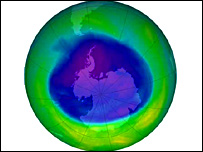 Apparently the hole in the ozone layer above Antartica is stabilizing. Some of you will remember the late 80s, when the hole was discussed a lot in the popular press. It was a huge problem. The hole we made meant that we were losing our protection from the sun’s ultraviolet rays. We identified that chloroflourocarbons -CFCs- which at the time were used everywhere (such as propellants in aerosol cans, refrigerator coolants) were the chief ozone-depleting substances that we produced.
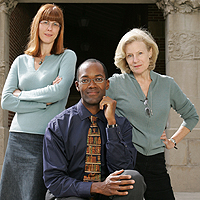 Well, one of them was selected! When a campus news story was being prepared to announce it, somehow the Annenberg School’s K.C. Cole, the Cinema-Television School’s Tara McPherson (who chaired the selection committee) and myself were chosen to be the poster children of the event. This explains the purpose of the photo shoot, about which I blogged some time ago at this
  Speaking of