But is it Real? (Part One)
After my colloquium at UC Riverside some weeks back, I was asked an important question I’ve been asked before, and no doubt will be asked again. The same question may have occurred to you given things I’ve written here about the subject of my research concerning applications of string theory (particularly, ideas from quantum gravity) to understanding (relatively) recent experimentally measured phenomena. (The technique of “gauge/gravity dualities”: See also the special Physics Today May issue with articles on all of this. I wrote about that here. It tells you some of what we can and can’t do with the computational technology, and prospects for improvement, etc.)
So the question is “Is it real?”. This is particularly referring to the black hole in the discussion. Recall, one computes properties of new novel liquid phases of matter (that seem to be closely related to what shows up in the lab) by using a toolbox that involves the equations of gravity, in a higher dimensional spacetime, and much of the thermal nature of the system is controlled by a black hole solution of those equations. So people want to know if that black hole is real. A version of the conversation is like this: (Imagine I’ve already introduced the technique, the higher dimensional spacetime, and the black hole…)
 One of the things I worked a lot on in earlier months this year (and late ones of last year) was the lead article in a cluster of articles that has appeared in the last few days in May’s special edition of Physics Today. They are sort of departmental-colloquium-level articles, so for a general physics audience, more or less. It’s about some of the things I’ve told you about here in the past, concerning exciting and interesting applications of string theory to various experiments in nuclear physics, as well as atomic and condensed matter physics (although we do not have an article on the latter in this cluster). I had a fun time working with Peter Steinberg on the article and remain grateful to him for getting us all together in the first place to talk about this topic way back in that AAAS symposium of 2009. It was there that Steven Blau of Physics Today got the idea to approach us all to do an article, which resulted in this special issue.
 [/caption]
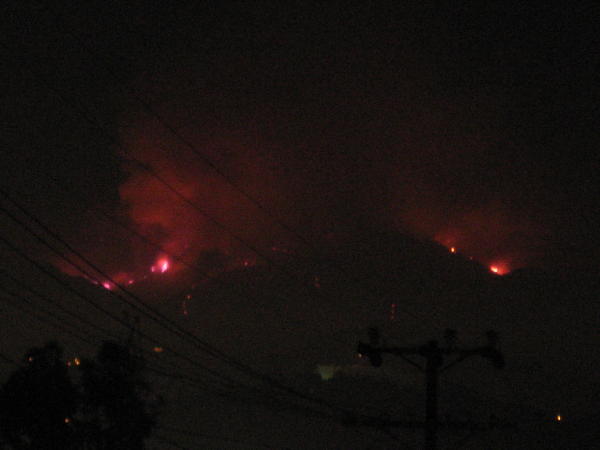 You may recall the terrible fires of last year in the San Gabriel mountains, and the scare about whether the Mount Wilson facility might have been overrun by flames. There were