Some years ago I speculated that it would nice if a certain mathematical object existed, and even nicer if it were to satisfy an ordinary differential equation of a special sort. I was motivated by a particular physical question, and it seemed very natural to me to imagine such an object… So natural that I was sure that it must already have been studied, the equation for it known. As a result, every so often I’d go down a rabbit hole of a literature dig, but not with much success because it isn’t entirely clear where best to look. Then I’d get involved with other projects and forget all about the matter.
Last year I began to think about it again because it might be useful in a method I was developing for a paper, went through the cycle of wondering, and looking for a while, then forgot all about it in thinking about other things.
Then, a little over a month ago at the end of March, while starting on a long flight across the continent, I started thinking about it again, and given that I did not have a connection to the internet to hand, took another approach: I got out a pencil and began mess around in my notebook and just derive what I thought the equation for this object should be, given certain properties it should have. One property is that it should in some circumstances reduce to a known powerful equation (often associated with the legendary 1975 work of Gel’fand and Dikii*) satisfied by the diagonal resolvent 


Here, 


The object itself would be a generalisation of the diagonal resolvent 


With nothing but a piece of paper and a hunch of an idea as to how to begin, no internet connection to distract me with the business of trying to lay my hands on a paper where it already exists, and nobody knocking on my door or meetings to go to, my head was bent over my scribbling for a decent bunch of time during the flight.
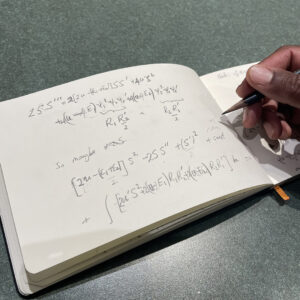 By the end of the flight, my notebook contained a lovely new (as far as I can tell) equation, for what seems to be a new object. It’s a nice feeling. After returning from that short trip I got busy for some time after that happy situation, and it was only a week or two later that I began to see how well the equation worked. It turns out to be a spectacularly nice equation, as a bit of analytic and numerical exploration showed, and definitely does what I’d hoped it would were it to exist.
Thing is, I’ve sat on it for a while, partly due to being busy, but mostly since I still can’t believe that the equation isn’t well known. It did not take a spectacular tour-de-force of technical know-how to derive the equation – it could have been guessed (should have been guessed?) decades ago, particularly in the 70s, when related objects were freshly in vogue (Gel’fand-Dikii and related papers that used the resolvent equation a lot early on were in 1975 and onwards). So I still think that maybe somehow I’ve been rather silly, or that eventually someone will tell me how obvious this all is, everybody knows this equation, and so what am I making a big deal over it for?
In truth, I’d be delighted to know if there was a literature on this equation and this object because then I’ll be able to just jump in and use it. Instead, I’m in this interesting situation where I’ve maybe uncovered some long-forgotten or never-before-found thing, and having to develop knowledge of its properties afresh. That’s interesting too, of course, and a lot of fun!
So what’s the equation?

Here, I defined: 


You can read more about the new equation (why I wanted it, how I derived it, and some of the things I tested about it) because I decided to not sit on it any longer and write it up and post it on the ArXiv. I dared to call it a “new” equation and we’ll see if that’s true. It has just appeared here.
So I’m in an interesting situation: Maybe within a few minutes or hours after it appears I’ll get an email from someone saying one of the following few things:
- This is a well known equation, pointing me to a large literature I don’t know.
- This is an obvious triviality.
- This is a (somehow) wrong equation. I’d love to learn what the somehow bit means since it passes a lot of nice tests with very interesting solutions.
- I found it a while back, before you did.
If I get the first one, then I’ve simply performed my literature search by crowd-sourcing it, which would be fine. The last three are the classic stages of acceptance of a new idea in my field. I get those a lot when I say things to my colleagues in the field, and am used to it.
But, most likely, however (and quite typical in my experience, sadly) is that I’ll get no reaction at all from anyone in any subfield, and this equation will remain unmarked by most until it is discovered again by someone else.
-cvj
(* I. M. Gel’fand and L. A. Dikii, Russ. Math. Surveys 30, 77 (1975).)

AI has gotten very good with literature searching. If that equation already exists, it may be able to tell you.
Do you have a list of the occasions on which something you discovered was rediscovered by someone else?
I’m sure it’s considered a faux pas to talk about this, but the phenomenon interests me…