 Well, it’s the middle of the Bleak Midwinter, and the first day of classes of the new semester. Mine start tomorrow. It is time to get myself back into the classroom-teaching frame of mind -although to be honest I don’t think the break was long enough for me to have got sufficiently far removed from it: 85% of the research tasks that I wanted to do during the break remain undone.
Anyway, I must sit and contemplate what I am going to talk about in the graduate course entitled “Selected Topics in Particle Physics”. It’s my lunch break, so I thought I’d chat to you for a bit.
Rumour has it that everyone is expecting some sort of string theory course, reasonably complementary to the one that my colleague Nick Warner taught here two years ago. I’ve no interest in just teaching the standard string theory topics – a good and motivated graduate student can just look them up in a book if motivated enough (if they can’t they’re in the wrong business) – and so I’d like to throw in some material that is not packaged together in the standard way, and give them an education that emphasizes powerful ideas and techniques that are relevant to more than just standard string theory research, but theoretical physics in general.
You see, this is one of the wonderful things about the topic that you don’t hear about much when people say things (and write books for a general audience) about how much it is supposedly taking over smart young minds and leading them astray: It is a fantastic framework for training good physicists for whatever new and useful ideas and physics will come along in the future, whether it is string theory or some other topic. The point is that string theory has developed in so many different ways, and […] Click to continue reading this post →


 So imagine that you’re standing at some spot, holding a big round bulb that can shine in all directions. At a particular time, you switch on the bulb and it shines out brightly. Who has a chance to see the light from your bulb? Let’s not worry about things like buildings, cars, etc., getting in the way of the light, but just imagine it can shine free in all directions. You’ll realize that there is a whole ball of light expanding away from the bulb – light going away from you in all directions. (The edge of that ball describes what is called a sphere, a two-sphere to be precise, denoted [tex]S^2[/tex] in the trade.) The sphere expands at the speed of light. You might imagine that eventually every point in space around you would be reached by your expanding sphere (let’s stay local and not worry about the expanding universe and so forth), and you’d be right. But when? When does it get to some particular point that you might care about? As soon as it takes the light the time it takes to get there, of course. It can’t get there any sooner than that.
 EDGE here stands for “Evolutionarily Distinct and Globally Endangered” and is a term that was coined to refer specifically to certain threatened species of animal around the world. They’re not always your big marquee animals (Lions and Tigers and Bears! Oh My!), and a great deal of them will be unfamiliar to you. (I’d never encountered the Golden-Rumped Elephant Shrew before, and I’ll admit that my life has been all the poorer for not having known about it before. It’s so cute! Furthermore, it has a golden rump. What’s not to like? Apparently, it is related to an elephant, somewhat distantly. Yes, it has a trunk, but it takes more than that to detemine its relationship to elephants! Update: – Here’s a Wikipedia article on elephant shrews, which could be a starting point for finding out more. The EDGE site has a lot of information too: here.
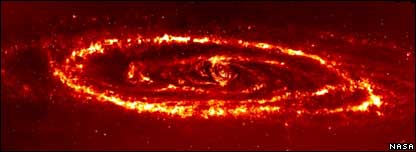 The Andromeda Galaxy is bigger than previously thought. Perhaps as much as five times bigger. I know that you’re thinking – “Oh, that’s because most of it is dark matter, right?” No, this is not another dark matter story. In fact, there are many newly discovered stars from a recent study! The suburbs of the galaxy are much more extensive than previously identified. It’s rather good news, since the galaxy makes more sense than it did before, in the context of our understanding of how galaxies form and evolve. (Image above is of Andromeda in the infra-red, from NASA.)