Archive for the 'women in science' Category

Hurdles

I noticed that over on Backreaction, Bee talks about a letter she wrote to Time Magazine to respond to a spectacularly uninformed remark by Jeffrey Kluger about women in physics. It was made in one of the “Person of the Year” runner-up articles surrounding a description of Fabiola Gianotti, one of the physicists who presented the Higgs particle discovery announcement at CERN last year. The spectacularly uninformed remark? Here it is:

Physics is a male-dominated field, and the assumption is that a woman has to overcome hurdles and face down biases that men don’t.

But that just isn’t so. Women in physics are familiar with this misconception and acknowledge it mostly with jokes.

I should say that it is nice to see an article about physics in this context (Time, person of the year, etc) since it gets the general public interested, but it is dismaying to see such a hugely important issue brushed over. I don’t think it helps the younger people trying to get into the field, and it certainly is frustrating and unhelpful for people already in the field who are having to deal with all the preconceptions and Continue reading ‘Hurdles’

Valerie Weiss on Women, Science, and Film

You’ll recall me mentioning filmmaker Valerie Weiss from earlier posts this year about her debut feature film “Losing Control”. Well, she wrote a guest post* for the website Women and Hollywood this week. It was about a recent film made for the European Commission to encourage girls to go into science. Apparently it was awful. (I’d heard about it from someone else too, but did not get to see it. [Update: Yikes! Seen it... Yikes!**]) Valerie shares some thoughts Continue reading ‘Valerie Weiss on Women, Science, and Film’

She Blinded Me With Science…

The funny video below* is good for a bit of nostalgia for the time of the Thomas Dolby song, the song itself, and perhaps for the X-Files TV show (but not for me, I saw only a few episodes). Scully fans will love this, and although I never regularly watched the show, I did appreciate her character. Strong skepticism, insistence on using the scientific method, etc. Excellent. Good character overall, and broke a lot of ground as a female lead with these characteristics too.

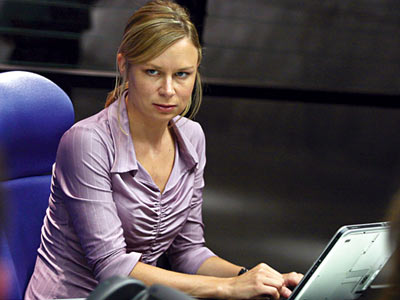
chloe_obrian_24Now here’s an idea. Would someone please do such a video for 24′s Chloe O’Brian? (Pictured left.) She’s definitely one of my favourite technical expert engineer/scientist types on a major show, and Mary Lynn Rajskub does an excellent job giving her life, depth and likeability even though she’s fighting against all the geek/nerd stereotype characteristics they’ve endowed her with. In essence, she does it by embracing them. Her attention to detail regularly saves the day (world, city, state, whatever), and the lives of her colleagues, and in the last episode they even had her supposedly determining that light in a video was daylight by Continue reading ‘She Blinded Me With Science…’

Why So Few?

I’d like to pass on a link (sent to me in email*) to the New York Times article about the new NSF-sponsored study and report (links to it are within) on the under-representation of Women in science and mathematics. Reporter Tamar Levin summarizes it there and quotes a number of interviewees. Sample extract:

The report found ample evidence of continuing cultural bias. One study of postdoctoral applicants, for example, found that women had to publish 3 more papers in prestigious journals, or 20 more in less-known publications, to be judged as productive as male applicants.

Making judgments about an individual’s abilities based on his or her sex is a classic form of discrimination, said Nancy Hopkins, an M.I.T. biology professor who created an academic stir in the 1990s by documenting pervasive, but largely unintentional, discrimination against women at the university.

Have a look.

I note that an email in my inbox just half an hour after the one telling me about the above link was news Continue reading ‘Why So Few?’

Shirley Tilghman on Charlie Rose

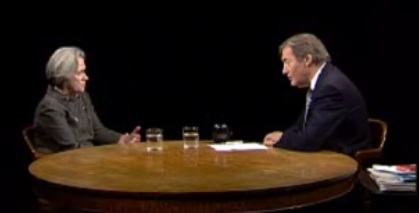
shirley_tilghman_charlie_rose

An excellent interview, coming in at slightly over 18 minutes. Well worth your time. Shirley Tilghman talks about science and the humanities, funding for them, their role Continue reading ‘Shirley Tilghman on Charlie Rose’

All Too Familiar


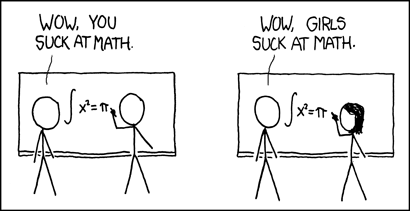
xkcd 'How It Works' cartoon
xkcd: “How It Works”

Continue reading ‘All Too Familiar’

Women in Physics – USC Conference

This is a quick note to point you to the Women in Physics conference (aimed primarily at undergraduates) being held at USC again this year. It’s on Saturday and Sunday coming. It looks like another excellent program (see here), so well done to the organizers for keeping going what Amy and Katie started (it has also spread elsewhere – see the site for more conferences, and consider starting one in your area). Parenthetically, I’ve heard that one or two readers of the blog will be attending, so don’t hesitate to say Hi! if you see me around.

Enjoy!

-cvj

Swept

Not a big surprise, but a notable event nonetheless – the top Siemens Mathematics, Science and Technology annual prizes were all taken by girls this year. From the New York Times*:

Janelle Schlossberger and Amanda Marinoff, both 17 and seniors at Plainview-Old Bethpage John F. Kennedy High School on Long Island, split the first prize — a $100,000 scholarship — in the team category for creating a molecule that helps block the reproduction of drug-resistant tuberculosis bacteria.

Isha Himani Jain, 16, a senior at Freedom High School in Bethlehem, Pa., placed first in the individual category for her studies of bone growth in zebra fish, whose tail fins grow in spurts, similar to the way children’s bones do. She will get a $100,000 scholarship.

Congratulations to them – and all the winners and finalists, male or female – for their achievements!!

On another note, I was reading the project descriptions of the rather well-resourced Continue reading ‘Swept’

Some of What Matters

Below I’ve reproduced the text of the approximately 20 minutes of that which I presented at the What Matters to Me and Why event on Wednesday. I mentioned my preparations for it in a previous post. The event was well attended, in an excellent setting (a hidden campus cafe I’d somehow not known about before, Ground Zero). There were students, faculty, staff, alumni, and several others. I chose to give a structured address to start so as to make sure that I did not go on for too long, as I might in a more off-the-cuff delivery. I very much wanted to leave plenty of time to interact with the audience through their observations and questions. I delivered it partly from memory and partly from reading, and wanted it to have a bit of a feel of being read a story, rather than a formal speech. I don’t know how successful that was, but it was fun for me. I think I might try that approach again some time.

[Update: - Audio of the event here.]

Overall, I think the event worked well, and I had a great time. A number of people (kindly) said at the end that they had a good time, and I hope everyone else did too!

___________________________________________________________________________________
Hello Everyone.

First let me say that it is an honour to be here. I’d like to thank everyone concerned for inviting me to speak in this series. I imagine that everyone starts their piece by saying that they struggled to find a way of saying What Matters to them and Why in a short time. So I won’t dwell on that, except to say that it’s especially hard when, the day before preparing, you realize that it’s not going to be that hour long presentation you were expecting to squeeze your essence into, but 20 minutes!

Some time ago, when people started mentioning that they’d seen that I was a guest in this event, and that they were looking forward to hearing what I will say (!), I’d respond that I too was curious about what I was going to say, and would also try to show up and find out. This was actually true. The other thing that I (half-)joked was Continue reading ‘Some of What Matters’

What Matters?

palm flower frondsI’ll let you know.

Huh? Today, I’ve to think about two things I have to talk about over the next couple of days. I’ve to give a physics seminar on Thursday at UCSB, but more urgently, I have to think about What Matters To Me and Why. Why? This is because in the Spring I agreed to be one of the presenters of the four-times-a-semester USC event of the same title, hosted by the Center for Religious Life. This excellent series is run by Rabbi Susan Laemmle, the Dean of Religious Life, with a committee of students. Here’s how it is supposed to work (extract from their site):

At each WMMW session, the featured guest spends about twenty minutes addressing the topic “What Matters to Me and Why,” and then the floor is opened to informal dialogue for the remainder of the hour. Just as there is no one way to address the topic, so there will be no one direction in which dialogue will proceed. The student contact from the WMMW committee introduces the speaker and makes sure that the session goes forward in a professional yet friendly manner. An indirect purpose of WMMW is to maintain an arena in which people can talk about important, personally charged questions in an open, mutually respectful way.

A typical session is described here. This is going to be a tough one. Not because nothing matters to me but because everything seems to matter, and I cannot effectively rank these things to say what matters most in any way. I only learned yesterday that I only have about 20 minutes to say what it is that matters. This either makes things harder or easier, I can’t decide yet. Probably harder. Now I really have to think.

I jokingly thought a few months ago that I ought to just look at my last few blog posts the day before and just talk about what’s in those. What can I see… Well, there’s public transport, community and the environment, composting and gardening, science and television (and scientific honesty). Not bad. (Good thing I did not do that post on dating. Probably not a good topic for WMMW…) I can probably weave something out of those. Do I blog about those things by accident, or because there are some themes there that are being brought out? What are the big themes in those then? Random scattered thoughts follow….
Continue reading ‘What Matters?’

ScienceWoman’s New Digs

Just thought I’d let you know that the blog of ScienceWoman (that I talked about in an earlier post) has now moved. Her blogging about her day to day experiences and thoughts as an early career woman scientist will be getting a whole lot more attention now that it is under the ScienceBlogs umbrella. Go and have a look at her new digs. She’s already started off nicely with a post asking readers to name their favourite woman scientist, with the resulting interesting contributions and discussions you’d expect in the comments. Go and add your two cents.

While I was over at ScienceBlogs (haven’t been in a long while) I spotted a rather Continue reading ‘ScienceWoman’s New Digs’

Home School

simpsons schoolThis is very interesting to me. I just heard a story (by Nancy Mullane) on NPR’s Weekend Edition about home schooling. (The link is here, and audio will be available at that page shortly). It focuses on the issue that African Americans are the fastest growing group of adopters among minorities in the US. I was also not aware that homeschooling is on a rapid rise.

This raises all sorts of questions for me. Very basic ones. How well does homeschooling work? Does the “product” – an educated person – perform well afterwards, once they’ve rejoined educational settings with the more traditional social environments (colleges and universities). Does the reduced level of social interaction during those homeschooling years have an adverse effect, or is it compensated for by social interaction that presumably takes place after school? Perhaps there are arguments that the reduction in social interaction even helps in some ways? I really don’t know much about this. Do you? I presume there’s all sorts of statistics on this, but I’d be curious to hear a bit of anecdotal discussion in the comments. Perhaps you were homeschooled? Have friends who were? Are homeschooling someone now? Are being homeschooled now? Tell us what you think!

I wonder about this since I’m curious as to whether this results in a different (better, Continue reading ‘Home School’

Good Luck Brittney Exline!

Just spotted this AP article (by Kathy Matheson) about Brittney Exline:

brittney exline[...] at the age of just 15 she is beginning her Ivy League career Wednesday when classes start at the University of Pennsylvania.

Which is very good indeed, but I was especially pleased to see:

She excels at math and science and is really interested in politics, so she enrolled in a Penn program that will award her degrees from both the engineering and liberal arts schools when she graduates in 2011.

Hurrah!

Have a look at the AP story for quotes, information about her background, other Continue reading ‘Good Luck Brittney Exline!’

Still So Far To Go

Sometimes one deludes oneself into thinking that progress has been made on some important social issue, and then out of the blue, there’s a reminder of just how far things still have to go. Check out this post – supposedly a report on the contents of a physics seminar given by a woman – on the blog “A Quantum Diaries Survivor”, and get a reminder of what women in physics are up against. Near the beginning of the post he spends one of the longest paragraphs of the piece talking about how her hair was done, how fit and attractive he thinks she looks, wondering whether she works out…(!) It’s so completely awful to do this sort of thing and he does it so spectacularly completely that I actually thought it was meant to be a parody of some sort! From his comments in response to people pointing out the inappropriateness of it, it turns out that he really does not get it at all. Not a bit.

It is really sad. It is so embarrassing too, when anyone female shows up in a physics context and guys just start behaving like they’ve never seen a woman before. That silliness alone is simply embarrassing, but this is quite a bit worse I would say, since it is damaging to the cause of women in the field.

I really shouldn’t go on, and I will risk sounding preachy and self-righteous (and I’ll just get yelled at and nobody will learn anything) but it’s important, so I will try some words:

Of course there are contexts in which we can discuss things about each other that take note of (even celebrate) our differences in gender, race, and so forth. I’ll be so bold Continue reading ‘Still So Far To Go’

The Walk Up Mount Wilson

[A friend of mine in LA told me today that she was planning to go with a group of friends to do some observing up at the big telescope on Mount Wilson. This put me in mind of a post that I did on CV two years ago (how time flies!) about some of the science done up there at the Mount Wilson Observatory, thoughts surrounding, all combined with a hike up to it that I felt compelled to do upon seeing it from the air. I thought I'd bring that old post back for you to read, with enlargeable pictures as a bonus. Enjoy. -cvj]
___________________________________________________________________________________

sign to mount wilsonAs you know from an earlier post, I left Aspen on Friday and headed home. This involves changing planes at Denver, and then flying over the strange, beautiful, and changing landscape West to Los Angeles. It only takes about a couple of hours. I was thinking hard about our discussion about the Greatest Physics Paper! and trying to think of those forgotten examples of great work. The people who’s songs are seldom sung. The unglamourous “bread and butter” works that seldom get written up in the newspapers near the time that they are produced, if ever. These solid works are examples of what every scientist should do as a matter of course: You look at the evidence you have before you, gather more if necessary, make some assumptions, form a hypothesis, and test it against the data. Next, come to a conclusion, and report your results as clearly and honestly as you can, and so on.

Whether or not you have some vision about what it all means does not necessarily qualify or disqualify the resulting paper as a candidate for being a great paper. It can still take its place in the tapestry that is the sum of efforts of generation after generation of physicist to make sense of our world, and find its meaning there.

Mount Wilson Hike -  foliageSo I was thinking about this all, and my mind switched to some recent reading I’d been doing. Simon Singh’s excellent book, “Big Bang” had been on my bedside table recently, and although I’d not had a lot of time to read it, I was curious to dip into it from time to time. This is partly because, while I know several of the stories and the history that he tells, it is always of great value to see how another tells those stories. I always learn something, either in the facts or in the telling.

As we’d been discussing before, Einstein’s papers are modern examples of work that changed our entire view of how the universe that we inhabit is really put together. How can those fail to be top candidates for the best physics papers ever? Same thing for Newton, and for Galileo, etc.

However, it’s easy to forget that for several years after Einstein’s breakthrough with General Relativity [see a later post I did here], the world still thought that the entire universe was just the Milky Way Galaxy. It was not until the year 1923 that Edwin Hubble (in one of his many great contributions) established extremely cleanly that the Andromeda Galaxy was several times further away from the center of the Milky Way than the edge of the Milky Way itself. This was a truly shattering change of perspective Continue reading ‘The Walk Up Mount Wilson’

Showing a Different Way

danica mckellar Getty imagesDanica McKellar (the actress who played Winnie in that show The Wonder Years that many of you might remember) has been working to try to encourage young girls to go more for “Cute and Smart”, as opposed to “Cute and Dumb”. Bottom line: Less Lindsay Lohan, and Paris Hilton, and more…. well, Danica. (I’m sure there are other Tinseltown examples here… can I have some help?).

Danica sets an excellent example of why the two (being considered attractive on the one hand, and smart on the other) are not mutually exclusive, while not suffering from the “geek” or “nerd” label that is attached by the entertainment industry to certain groups of people who enjoy using their brains a lot. She trained as a mathematician, in fact, doing her undergraduate work at UCLA so well that she did rather good published research work (NPR piece here Update: It is actually more of a theoretical physics problem, it appears.). This is from someone who struggled with the subject in sixth grade. Why is she in the news? She’s written a new book “Math Doesn’t Suck”, the aim being to encourage girls to avoid the (social) barriers to getting into mathematics. Excellent title. (I wonder if they’ll change it to “Maths Doesn’t Suck” if they publish it in Britain? “Suck” British kids have adopted from the USA cultural juggernaut, but “Math”? Not yet.)

danica mckellar math doesn't suckActually, looking at her website, I see that the full title appears to be “Math Doesn’t Suck: How to Survive Middle School Math Without Losing Your Mind or Breaking a Nail”, which is more of a mouthful, a bit less zippy, but oh well. It’s all very Clueless, in a good way. Here’s a link to the book’s site, and it is due out tomorrow.

There’s an article1 on her recent Newsweek quote at CNN, from which I grabbed this:

“When girls see the antics of Paris Hilton and Lindsay Lohan, they think that being fun and glamorous also means being dumb and irresponsible,” the 32-year-old McKellar told Newsweek for editions to hit newsstands Monday.

“But I want to show them that being smart is cool,” she said. “Being good at math is cool. And not only that, it can help them get what they want out of life.”

but you should go and read the whole thing, by clicking here. [Update: Better article here by Corey Binns in Good Magazine. Extract:

"The book hones in on middle school’s trickiest points-––like fractions, ratios, and percentages—and presents them in a style that’s appropriate for the cool kids’ lunch table. Figure out your “type” in boys and you’ll understand greatest common factors. All of those iced lattes celebrities drink make multiplying fractions tasty. Plus, savvy shopping requires killer decimal skills."

]

Go Danica!

In other news, I learned2 that particle physicist Lisa Randall (author of the popular book with the curious title “Warped Passages”) appears in Vogue this month. Lisa Continue reading ‘Showing a Different Way’

Science Woman

I don’t know if you read ScienceWoman’s posts at the blog “On being a scientist and a woman”, but if you don’t, go over there from time to time. The same thing can be said for the blog “Female Science Professor”. They are both very internal sorts of blogs. You won’t find overly-opinionated rants and pontifications about various things nearly as often as you’ll read thoughtful anecdotes and internal debates about what it is like to be a scientist (who also happens to be a woman) in a science department somewhere in America*. They are both anonymous, which allows them to speak more freely, and probably makes them more interesting blogs – especially when they talk about the difficulties of being both a scientist and a woman in their job.

Here’s a simple but poignant post from Science Woman that should motivate you: It is entitled “I will not be a foregone conclusion.” I thought it was great, and so that’s why I thought I’d point you to it.

-cvj

(*This is a good thing, from my point of view… ranty and/or overly-opinionated blogs have their place, but I find that they can tire me out… and very easily these days. So I tend to look at other types of blog in my downtime.)

Is there a Perfect Pitch?

And the immediate followup question is “Should there be?” I’m referring to the story on NPR’s Marketplace the other day about the effects that some women’s voices have on whether they are taken seriously in the workplace. The audio is here, along with a transcript. The article, entitled “Professional women? With little-girl voices?”, is by Ashley Milne-Tyte.

The piece begins with a clip from the recent news, of Monica Goodling (Former Justice Department White House liaison) speaking in her defense during the hearings over the Justice Department firings. She has a noticeably “little-girl”-pitched voice. (I’m sure you remember hearing her during the news or the live broadcasts, and possibly your first instinct was to ask yourself why – in the political feeding frenzy aimed at bringing down Alberto Gonzales from the Attorney General position – the Congressional Democrats were now rounding up and grilling small children. (Or at least that was how it was for me for a split second since I mostly don’t watch television news – I find it too slow and otherwise annoying – and so I heard her on the radio.) It was then announced in the news piece who it was and I thought nothing more of it at the time…)

My own take on this is that it does not matter. You just learn, and move on. Since coming to the USA long ago, I adjusted my expectations about what are considered Continue reading ‘Is there a Perfect Pitch?’

Candace Partridge: Women in Physics at USC

Rather than just sit around and wring our hands about the severe underrepresentation of women and minorities in science and engineering, it’s worth getting out there and trying to do things to help make a change. Here at Asymptotia, I describe things of that nature from time to time. At other times, I like to just shut up and listen, since (for example) it is also important to hear about the opinions and experiences of a range of different people who are trying to make their way in some aspect of these fields.

candace partridgeToday we have a guest post from Asymptotia regular commenter Candace Partridge (clickable image on right). Candace is doing an undergraduate degree in Physics at the University of London (Birkbeck College), having come to study the subject at this level rather later than is traditional, and having studied other subjects, and worked professionally in another career. This gives her an unusual perspective, and one that is of considerable value. Candace attended the Women in Physics conference that was held at USC in January, and of which I spoke earlier. She tells us a bit about it below, along with some thoughts about her own path in Physics. There is some overlap with an article she wrote for Inkling, but Candace has expanded on several aspects for her post here.

-cvj

___________________________________________________________________________________

candace tripAhhh…what’s better than a trip to LA? How about a travel grant to get to LA to attend the 2nd annual Undergraduate Women in Physics conference held at USC? Most students view MLK Day as a sort of bonus extension the to holidays, a way to ease back into the usual routine. However, for 50-odd physics students, this long weekend was a chance to make the journey to USC to meet other female (and a few male) physics students.

Of course, where I’m now from (London), we don’t get MLK day off. In fact, I was only on native soil because I had cleverly timed a three-week trip to visit my parents in Mississippi to coincide with this conference. After all, once I’ve flown 5000 miles, what’s a couple of thousand more? No problem! I landed in LAX to bright and sunny weather but with a cold wind blowing out of the north, heralding the arrival of that cold wave that destroyed the citrus crops and brought snow flurries to Malibu. It was far colder in LA than in London that weekend.

candace tripThis was my first trip to a physics-related conference, and I was a wee bit out of the target demographic. See, I am still a lowly undergrad — I say ‘still’ because here I am a woman pushing thirty who is barely halfway through her BSc as opposed to the young striplings a full decade younger than myself. Also, I was the only attendee from overseas…kind of. But I am happy to mix with people of all sorts, especially other women like me who are studying physics because, let’s face it, some of us are still feeling a little alone over here.

So I’m a female mature student, which in undergrad physics makes me a bit of an Continue reading ‘Candace Partridge: Women in Physics at USC’

Sabine Hossenfelder: My Inspiration

Sabine HossenfelderToday, a guest post. I’m excited, because it’s from one of my favourite bloggers, Sabine Hossenfelder, or “Bee” as you may know her from her comments here, and of course her blog Backreaction.

Bee giving a guest post here on Asymptotia originated in a suggestion I made in the comments of an earlier post of mine. Bee had asked me to do a post on her blog as part of her excellent series of guest posts about what made her guest choose to go into physics. Pressed for time, and not sure whether I’d really have anything new or interesting to say about myself, I stalled for time (I thought) by saying I’d do it in exchange for her doing a post here on a similar subject. She rapidly came up with the post. And of course it’s a great one. I’m so on the spot now.

Anyway, here’s Bee! -cvj
___________________________________________________________________________________

I just sat down with the best intention to write a lengthy blah on Clifford’s question what inspires me. Now that I sit here, hands above the keyboard, I am facing a problem. It’s not that the question is too difficult, it’s too easy to answer. I get inspiration everywhere. Reading books, seeing movies, taking a walk – ah yes, also from scrolling through blogs. Most of all by talking to my friends and colleagues. The problem is now that I’m too inspired not to shamelessly use the opportunity of writing a guest post for Clifford ;-) So let me redirect the question to your opportunity to use your inspiration.

Had you been born some thousand years ago, your life would have been pretty much determined by where and when you were born, and whether you happened to be a man or a woman. You’d have spent most of your time striving to survive. Undoubtedly, you’d have considered your generation very progressive, still you’d have worked hard to make a better future for those coming after you. And of course our generation says since then we’ve made a lot of progress! But what is it? Is it a 6 lane highway, 50 different Jelly Bean flavors, the size of a 2 GB USB stick, a life expectation of 80 years, plastic surgery, weblogs for everybody?

In my opinion, a society’s maturity is measured not by the development (alias shrinking) of more and more technological gadgets, but by its ability to let (wo)men follow their passion. Progress is what makes our life easier. It is what gives us more time, more freedom. It is our understanding of nature that has allowed us to spend less time on the struggle to survive, and given us the opportunity to live. It has given us the freedom to follow all the stray thoughts that came with the evolution of the homo sapiens’ large brain: the everlasting wish to find and understand our place in the universe that we are part of.

A search that everybody of us undergoes in his or her own way. Some find their place Continue reading ‘Sabine Hossenfelder: My Inspiration’

What Inspired You?

It’s always interesting to hear from others about what set them on the path they’re on, no matter what career path that is. I just read Chanda’s guest post on the matter over at Backreaction. Chanda is a theoretical physicist in training, and so from my point of view it is interesting to hear about her choices since I chose the same career myself.

Since I’m also keen that talented women and people of colour can learn that they can choose to do science careers, and hope that it continues to become increasingly likely that they make their way in such careers with the same opportunities as everyone else, it was also interesting -and encouraging- to read her thoughts (since she is in both categories). Have a look at her post yourself, and also her post on Cosmic Variance about some of those issues.

Whether or not you read it, don’t hesitate to share with us your own recollections. What Continue reading ‘What Inspired You?’

Conference in Progress

Well, I checked in on the Women in Physics conference today, and it seems to be going very well. I went to lunch and sat with a number of the students (and some faculty) and I also chatted to some in private about their interests, current stages in their careers, etc. It’s always so wonderful to hear people so enthusiastic about physics, and listen to them wondering what their part in the great story of science will be.

Here are a couple of shots of the delegates at lunch – it is a sort of panorama (click each component for larger view):

  women in physics conference   women in physics conference

I’m off to paint the town red, so I’ll post a bit more about this either later tonight or Continue reading ‘Conference in Progress’

Women in Physics

This is a reminder that the Women in Physics Conference that I mentioned earlier takes place this weekend. In case you are in the area and interested in some of the Continue reading ‘Women in Physics’

Women in Science – What to Do Next?

Cornelia Dean has written a very interesting article for the New York Times about the things people are doing to change the current situation concerning the underrepresentation of Women in Science in academia. It continues on from the discussion we were having after the September release of the report by the National Academy of Science on the issue.

The key point under discussion? From the article:

Since the 1970s, women have surged into science and engineering classes in larger and larger numbers, even at top-tier institutions like the Massachusetts Institute of Technology, where half the undergraduate science majors and more than a third of the engineering students are women. Half of the nation’s medical students are women, and for decades the numbers have been rising similarly in disciplines like biology and mathematics.

However…

Yet studies show that women in science still routinely receive less research support than their male colleagues, and they have not reached the top academic ranks in numbers anything like their growing presence would suggest.

In fact, it is only in the social, behavioral or life sciences that the proportion of women full professors has risen into double digits – 15 percent or so. Something goes wrong. What is it?

at each step on the academic ladder, more women than men leave science and engineering.

The current article reports on a number of gatherings on various campuses – conferences organised to network, share, and brainstorm a bit on the issue. There are interviews with several people, and experiences and anecdotes are shared. Very much worth your time to read. Discussed are a wide range of topics, the most central being that it is still the case that women are judged by different standards than men. Even though often times it might seem to be something as simple as what to wear to a meeting – it makes a difference. These things all add up. Other things mentioned are the two-body problem, mentoring, letters of recommendation, children and motherhood, and negotiating skills, among others.

I’ll let you read the article, but do come back and let us know what you think. We’ve been through a lot of this discussion before, so one aspect I’d like to hear about is the following: What are you doing about the issue in your own sphere of influence? Are Continue reading ‘Women in Science – What to Do Next?’

Hang In There, Rob Knop!

Hang in there, Rob! Keep up the good fight for a better climate for, (and representation of) women in your department, and in departments everywhere.

-cvj

Those Self-Fulfilling Prophecies

You may recall that we were recently discussing stereotypes as a result of an earlier post. Particularly, I was talking about the effects those sterotypes can produce as a result of modifying the expectations of others, making it hard for some people to be taken seriously, and resulting in them having to go that extra mile (or several) as a result.

Well, I’d like to point your attention to a recent study about the direct effects of those stereotypes on the stereotyped. Quoting from an article by AP science writer Randolph E. Schmid:

[Steven J.] Heine and doctoral student Ilan Dar-Nimrod wanted to see how people are affected by stereotypes about themselves. They divided more than 220 women into four groups and administered math and reading comprehension tests between 2003 and 2006. Their results are reported in Friday’s issue of the journal Science.

What they actually did was to provide the different groups with different images and reading materials before they did the tests. They seem to have found significant differences in the results that suggest that having a negative stereotype of yourself in mind actually makes things worse. In other words:

It’s a process psychologists call a stereotype threat, Heine explained. “If a member of a group for which there is a negative stereotype is in a position to test the stereotype, they are likely to choke under the pressure.”

So reminding them of the stereotype affects them.

Here’s what they found:

Continue reading ‘Those Self-Fulfilling Prophecies’

Strings on Sunset

So I heard something on Studio 60 on the Sunset Strip just now. (This is the new show written by Aaron Sorkin that I instinctively started to watch a couple of weeks ago because I like his writing, and it is actually a drama about the process of writing, so what’s not to like? -Ok, I’m a bit bothered by the overall annoyingness of the lead actress’ performance, but I imagine she’ll get better.)

I caught a line that went something like “we’re not looking for a girl with a phd in… string theory or anything, ok? There’ll be at least half a dozen women there who’ve Continue reading ‘Strings on Sunset’

On The Potential of Women Scientists and Engineers in Academia

Today, the National Academies released their long awaited report on the potential of women scientists and engineers in academia. The title is “Beyond Bias and Barriers: Fulfilling the Potential of Women in Academic Science and Engineering”, and it can be obtained here. This is a hugely important topic, and they seem to have done quite an extensive amount of work on this. Here are some quotes from the press release, and then I’ll make some comments of my own at the end:

“Women are capable of contributing more to the nation’s science and engineering research enterprise, but bias and outmoded practices governing academic success impede their progress almost every step of the way,” said Donna E. Shalala, president of the University of Miami, former secretary of the U.S. Department of Health and Human Services, and chair of the committee that wrote the report. “Fundamental changes in the culture and opportunities at America’s research universities are urgently needed. The United States should enhance its talent pool by making the most of its entire population.”

Much the same can be said (and has been said in, e.g., my earlier blog posts on CV) about the largely untapped talent pool of minorities in general, of course. Continue reading ‘On The Potential of Women Scientists and Engineers in Academia’