Archive for the 'research' Category

Particle Physics on TV Tonight

marcela carena in atom smashers independent lens

I learned from Katherine on the US/LHC blog earlier that tonight on PBS is an airing of a documentary called “The Atom Smashers”. It’s about particle physicists at Fermilab, in Illinois (including my friend Marcela Carena in the photo above). I’m curious to see what they’ve put together, hoping that it’ll give the public some insights into the life of the various kinds of scientist involved, and the exciting physics that engages them - and those of us on the outside who eagerly await the results of their work. The search for the Higgs boson is a focus. You can see a trailer here. I’ll be watching, I think. It is at 10:30pm on PBS, in the Independent Lens series, but be sure to check your local listings since times and days may vary.

Enjoy!

-cvj

Tiring, but Good

mount hood oregonTo the left is Mount Hood, in Oregon. I often see it when I fly on my way up North. I love seeing it as it emerges from the clouds rather pleasantly, looking a bit like a cloud itself for a moment, perhaps oddly shaped, but then becoming something rather different entirely.

I was in Vancouver for a few days last week, and chatted with a few friends and colleagues (such as Moshe Rozali, Mark Van Raamsdonk, and Joanna Karczmarek) at the Physics department at UBC, and gave a seminar. I talked about ongoing work on ideas I’m still struggling to beat into shape (mentioned a lot in earlier posts about my retreat at Aspen this Summer). This was a deliberate choice. Sometimes it is very useful to force oneself to do a pedagogical seminar on work in progress. This is not so much because someone in the audience might toss up an idea that you did not consider (this can happen, sometimes as a result of a good question - but it is less likely when the audience has no expertise in the area under discussion, as was the case here) but mostly because of the very act of preparing the seminar itself. It forces you to take the wider view, consider the big picture, and try to motivate why you are doing what you’re doing, or why you picked on path over another along the way. I find this process can be quite valuable as an internal pruning and self-checking exercise.

So it was that I spent three hours at LAX writing the first 2/3 of the talk. This is not Continue reading ‘Tiring, but Good’

Smashing…

lhc panelActually, this is a bit of a late announcement, but worth doing anyway, in case you happen to be looking for something fun to do with the Society of Physics Students. From yesterday’s talk at the Center For Inquiry on particle physics and string theory (thanks to the many of you who came!), I now go to join a panel tonight here on the USC campus to talk about the Large Hadron Collider (LHC). There have been many posts here on that… search the archives for more information, or type LHC into the search engine on the right. It should be fun and there’s free food from Mama’s Hot Tamales! It should be noted, for anyone keeping track, that in order to serve on this panel, I am giving up a dream: An Evening With Helen Mirren. Sigh. Also taking part on campus tonight. Click the poster for a larger view.

-cvj

Brian on the LHC

Via the excellent new blog by two (so far) of our regular commenters, “Shores of the Dirac Sea”, (check it out!), I noticed that Brian Greene has an op-ed in the New York Times today.

For those of you who want a short version of some of the things that are hoped for from the large hadron collider (LHC), Brian’s piece is the article you might want to start with!

-cvj

Tales From The Industry XXII - Live LHC Chats

Just the other day, while coordinating some work being done on my house, I was thinking that it is time I learned Spanish. Most of the people working in the construction industry here in Los Angeles have Spanish as their first language, and besides the usefulness it would give in communicating difficult ideas about a piece of work to be carried out, I really don’t like the feeling that I’m disconnected from them. I’d like to be able at least to, in Spanish, offer a cup of coffee, or a glass of iced water, and have a little small talk - treat them like fellow human beings as opposed to “the help” as is done so much in this city, to my disgust. I interact a lot with the Spanish-speaking parts of the city through my use of public transport, places I go to grab tasty food from time to time, and so on, but there is still a sense that there is an entire alternative Los Angeles out there that I am only barely touching upon by not knowing the language.

Then yesterday this whole Spanish language issue came up again in a big way. There was a phone call to the department from Univision, the Spanish-language TV network. Probably most of you are wondering what that is. You know those several channels that you never watch and when you flick by them, all clustered together, they’re always speaking Spanish and discussing issues or people that you seldom (if ever) have heard of? Yes. This is one of those channels. There’s a huge part of America (and elsewhere) that tune to those channels primarily.

Well, the people at Univision had heard about the excitement about the Large Hadron Collider (see, e.g. last post) and wanted to do a piece on it, and have someone in the studio to talk about it live on their breakfast show. They were looking for a Continue reading ‘Tales From The Industry XXII - Live LHC Chats’

It Works!!!

Well, it seems that the largest and most complicated experiment in the history of humankind is…. working so far. They circulated the first beams at the Large Hadron Collider (LHC) earlier today! Even Google is excited. Check out their front page:

google\'s LHC graphic!

Fun live blogging reports from the scene of events over at Resonaances, US/LHC Blogs (several posts), and Superweak, for example. I got the ATLAS readout/image below from the latter. (Presumably this is the shower of particles produced when they did the “dumping” described in Resonaances? Or just stuff produced by the edges of the beam as it passes through?) Press release from CERN here.

first event at ATLAS

Update: NPR’s Morning Edition had a nice report this morning in the form of a chat between Rene Montagne and reporter David Kestenbaum. Fun to hear the audio clip of the control room. Link here.

Oh, right. The silliness. Click on that useful site I mentioned earlier to see if the earth Continue reading ‘It Works!!!’

Reconfiguring

usc campusWell, it is the first day of the new semester here at USC, and of the new academic year. Whether I like it or not, everything changes today, in terms of my work patterns. I have to squeeze the sprawl of my research (recent posts about that here, here, here, and here) back into a more confined space to make room for other things. Chief among those is my Physics 151 class, where I teach about 90 freshmen (science and engineering majors) the ins and outs (but mostly the ins) of mechanics and thermodynamics. I’ll also be dealing with a number of service and outreach projects that I’ve had on hold for a few months, and, of course, I’ll be serving on a number of committees doing various things in the department and the university at large.

Am I ready? Not entirely. I’m not fully in the right frame of mind, it has to be said. The various research projects I was working on did not get as far as I would have liked, and I could benefit from more of the full-immersion mode that Summer affords in order to follow up lots of ideas and computations. Also, there are entire projects I did not even get to.

But you do what you can, and that’s all there is. I’ve been dumped into a weird time Continue reading ‘Reconfiguring’

Bit Like Watching The Olympics…

(…but without the relentless parade of bikinis, happily.)

What am I talking about? You can watch live over the web the proceedings of the Strings 2008 conference taking place at CERN. The official site is here, with links to the webcast, schedule, talk titles, and so forth. (Sorry I’m a bit late in pointing to it!)

Enjoy!

-cvj

Draw

game of naughts and crosses, spotted in the bar/lobby of an Aspen hotel.I’ve been quiet here recently, I know. Was mostly working, thinking and reading on the weekend. Did not even go on a huge hike (although I did do a nice walk or two). Sometimes, on an evening, I go and read a novel in a bar. (I’m weird that way, I know.) I’ve not been going to the noisy bars full of yelling and the party crowd, but instead like to find a nice sofa in one of the bar/lobby areas of the nicer hotels. Great for reading, and the drink prices are merely extortionate, as opposed to just plain offensive in the more popular places. (Photo: a naughts and crosses game I spotted on a table in one such lobby.)

Well, it’s a draw so far in the battle with my equations and ideas, but I think I’m developing a stronger position. (From this you can deduce that I decided to stick with the same project and hold my ground and struggle on some more.) Perhaps the next Continue reading ‘Draw’

Quantum Black Holes - Why Worry?

susskind_by_matthew_black for LA TimesWell, you may not have gone to the chat between K C Cole and Leonard Susskind that I mentioned a while ago at the LA Central Library downtown. I couldn’t make it either, being away at the Aspen Center for Physics. I expect it was good. Anyway, I found a little bit of a report on the conversation, done by reporter John Johnson for the LA Times. It is here. (Clickable image of Susskind to the right is by Matthew Black, for the LA Times.)

It gives you some of the simply-stated reasons as to why there was a big argument between Stephen Hawking and Leonard Susskind in the first place (and between several other physicists too… there are hosts of people working on these things, and it took hosts of people to sort it out to where we are now, not just those two, giants though they are). I recommend having a look, as it is especially for the lay-person, and will give you a good idea of what the fuss is about.

You can also see a little bit about his new book on the subject and a link to a video interview with Brian Cox (the physicist, not the actor) at the LA Times blogs here. There are also links to his Stanford continuing education course on quantum mechanics, including the online lectures you can view at your convenience. What a resource!

You might wonder why we care about all this, since currently the only way we know for sure to make black holes in the universe (astrophysical processes making stellar black Continue reading ‘Quantum Black Holes - Why Worry?’

Humps

Now playing: I’m Confessin’ (That I love You), Thelonious Monk [Solo Monk]

Well, I’m now beyond the halfway mark of my retreat and I’ve been on the one project all this time. I’ve made progress here and there, had some setbacks, and have got very stuck at times. It’s just one of those things with this sort of work. Par for the course.

humps in road warning sign, UKThere are times when you think that if you do just a bit more on the project, it’ll get over the hump, as it were, and then coast along. So far I worry that there may be simply an infinite set of equally spaced humps of similar height all the way down the road**, in that every now and again I discover a rather pretty little gem of a result that’s quite encouraging, but these gems don’t seem to have anything to do with each other. So it’s a little scattered gravel pit of gems as opposed to a lovely… Ok, cvj, enough with the gem metaphor.

Now playing: Totem Pole (Alt. take), Lee Morgan [The Sidewinder]

The issue here is whether I should jump ship and use the last of my quality time here Continue reading ‘Humps’

A Hop Over To Canada

Well, as I said in the previous post, I’m leaving my hideaway/retreat mode and popping over to Vancouver for a short spell to help out at a Summer School. It’s the PIMS (Pacific Institute for Mathematical Sciences) Summer School on Particles, Fields, and Strings. I’m giving four lectures on some of the techniques in string theory that it helps to know in order to do some of the fun things we do to get at interesting physics (such as the topic of the post before). My title is something like “Perturbative and non-perturbative string theory”, and I’ve no clue what the level of the students really is, so goodness knows how far I will get in four one hour lectures. But it does not hurt to try. I’ll be laying the groundwork for several of the lecturers who will be talking about the more advanced stuff closer to their research work, and so I hope to at least help the students gain confidence with ideas and language that will show up all over the place in the two weeks following my presentations.

So what will I cover? Well, I’m going to tailor things to the responses of the students as Continue reading ‘A Hop Over To Canada’

Atoms and Strings in the Laboratory?

depiction of lithium trap from the Kastler Brossel lab in france

A depiction of a lithium trap from the Kastler Brossel laboratory, in France. Details here.

[Despite appearances, I did not choose the music in what is to follow. I just put on iTunes set to random, and started typing, reporting on what was playing as I went along. Nevertheless, there were some nice resonances.]

Now playing: Mr Day, John Coltrane.

So. I must put the Aspen time on hold for a short while, as I promised to give four lectures in Vancouver starting tomorrow. While I sit here in a lounge in Denver at 8:00am, wondering why I booked a 7:00am flight out of Aspen, and also wondering exactly what is in this muffin that I picked up to have with the (rather good) tea they have here this morning, I thought I’d tell you about a little bit of really nice physics that’s going on in the neighbourhoood of my world. Since I’m too cheap and too disinterested to pay for a connection to the web, this’ll only get uploaded quite a bit later when I get a free hookup. (This is a bit more technical in places than usual. Please don’t give up too easily. Oh, and you might have to read some things I point to from earlier to get everything I’m saying - I’m not one for endless repeating myself I’m afraid.)

You can think of this as another story in the line of development I’ve been pushing (and telling people about here and elsewhere) for many years now. Applications of string theory to a broader range of physics areas than the popular discussions of the topic seem to touch upon. I told you last year about the exciting work going on in understanding properties of new phases of nuclear matter being unlocked at the Brookhaven experiment RHIC (colliding heavy nuclei together to create a sort of hot quark-gluon soup). That work continues. This new work pertains to experiments as well, and this time, these are closer to the human scale bench top experiments we all get misty-eyed over (ok, I do, maybe no-one else). It is super-cute stuff. I should Continue reading ‘Atoms and Strings in the Laboratory?’

On Good Ideas

A commenter, slim potato, implicitly asked a really good question earlier. It was a working in a notebook comment on a post I did yesterday about my struggles with a computation I was working on. I gave an answer, but since I know that a lot of readers don’t read the comments, and because one of the missions of this blog is to give a window on what scientists such as myself do and (importantly) how we do it, I thought I’d elevate the comment and my response into a post. Feel free to add your own thoughts to it in the comments, either as a non-scientist, a scientist, a specialist from another field, or other.

slim wrote:

I would have assumed that most of your time when working on a paper was involved on catching good ideas, not getting muddled with conventions and calculations.

cvj wrote:

Hi,

Thanks. That’s a common misunderstanding of what we do. What makes a field of physical science like physics work is computations - all of that business with calculations (including checking that your computations conventions are internally consistent) is vital to the field.

Frankly, “Good Ideas” are a dime a dozen. Anyone in my field ought to be able to think of at least six of them before breakfast. What makes a good idea go Continue reading ‘On Good Ideas’

Fourth Thoughts

Have a Fantastic Fourth of July, to everyone who is celebrating it!

fantastic four promotional skywriting over LA on the July 2005

It’s been several days since my last confession. Sorry about the silence. I’m honestly not sure exactly what I’ve been doing, since it has been a mostly fragmented set of things, coupled with a generally down mood of introspection over matters personal. Hmm… So nothing new there.

Physics-wise I’m a bit stuck. Not on a particular project this time, but stuck on Continue reading ‘Fourth Thoughts’

News From The Front, III

[Note: Originally posted on CV on 4th November 2005. 25 comments on it here.
Feel free to add new ones here.]

___________________________________________________________________________________

[Warning! This is an unusually technical post.]

Ok, so last time, I told you a bit about the motivations for what I’ve been up to. Now I want to simply show you some of the product. I’m going to use pictures, words, and equations. I will lose some of you, and for that I’m sorry. But I hope that the words will still give you the gist of the thing. I’ll answer some of your questions in the comments.

Consider the following equation (first found and studied in this context in about 1991/1992 and reported e.g. here, and here, and here):

string equation

Continue reading ‘News From The Front, III’

News From The Front, II

[Note: Originally posted on CV on 31st October 2005. 31 comments on it here.
Feel free to add new ones here.]

___________________________________________________________________________________

Well, I suddenly have 45 extra minutes on my hands as I was supposed to be at a very interesting two hour lunch meeting which I’ve now missed. I learned the hard way that we have in addition to the Annenberg School for Communication, the Annenberg Center for Communication, which is of course in a completely different location, North of main campus. I spent half the meeting running around the wrong place trying to find it, and no-one at the School could help me because they did not know anything about it, until after a long time someone had the bright idea of telling me about the existence of the other place….sigh. So I have some time to devote to you, dear Reader, and it will help me calm down from the frustration of it all.

Well, I promised a long time ago (since some of you asked) to tell you what it is that I am working on in my physics research. The problem always was that if I had time to Continue reading ‘News From The Front, II’

News From The Front, I

[Note: Originally posted on CV on 3rd October 2005. 65 comments on it here.
Feel free to add new ones here.]

___________________________________________________________________________________

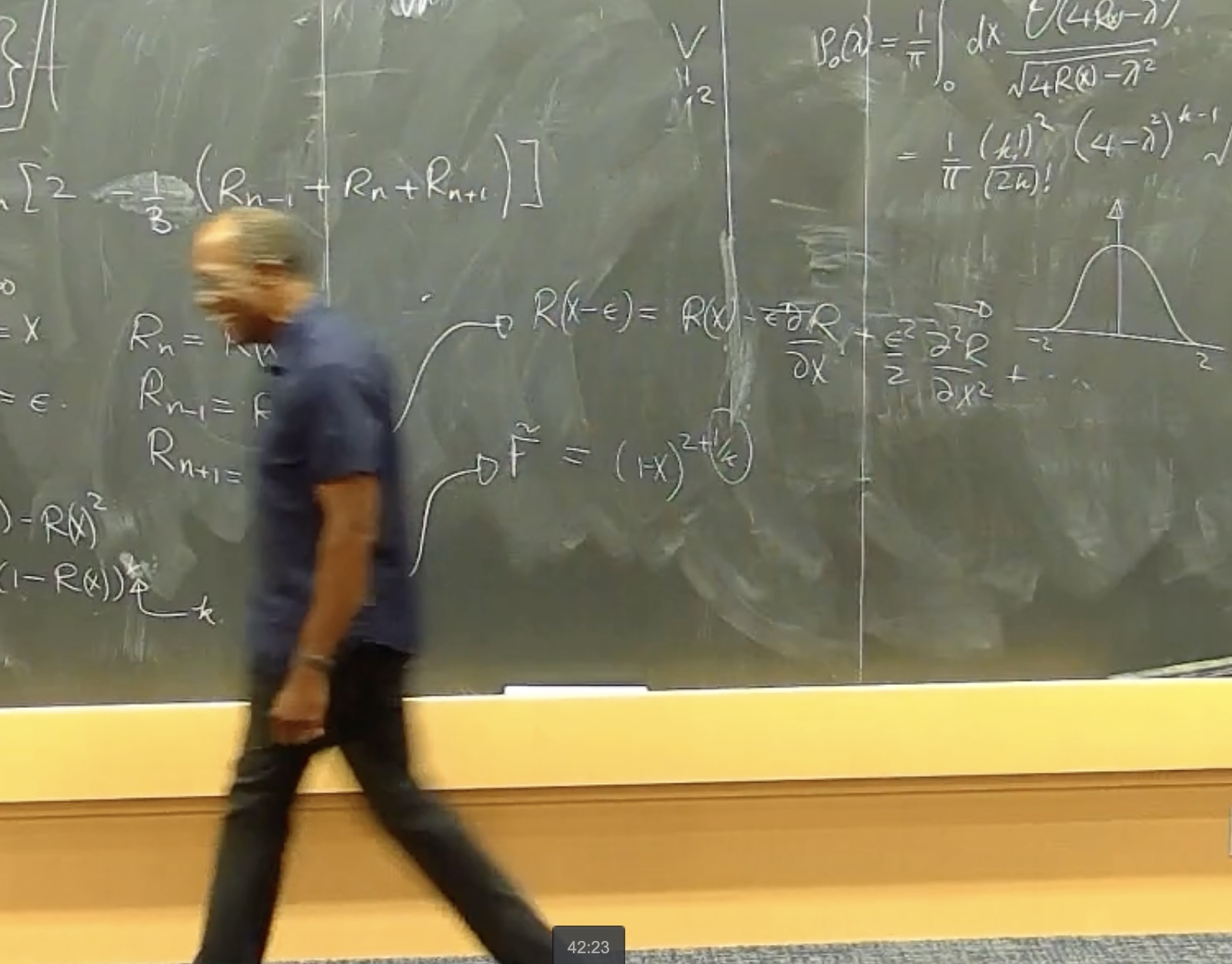
Below is a snapshot of a computation I was working on earlier this Summer. Will explain later. Spoke about it at the Southern California Strings Seminar.

I’m curious about what a physicist’s scribblings look like to others, regardless of field (science or non-science). So, non-specialists: What does this all look like, to you? What impressions do you get, if any? Do tell.

There’s no wrong answer here.

aspen black board

-cvj

Old News

The next three posts are repeats of posts I did on CV in 2005. They were the first three in the series entitled “News From The Front”, and their subject matter partly lay the groundwork for a post on some new results that I hope to write soon.

Enjoy!

-cvj

Southern California Strings Seminar

Takuya Okuda  talking at the SCSS at UCLA, Dec. 2007Takuya Okuda talking about Wilson Loops at the most recent SCSS, UCLA, Dec. 2007. Click to enlarge.

The next regional string meeting is a two-day one at Caltech, this Friday and Saturday, organized by Joseph Marsano. It’s going to be full of interesting talks and conversations, as usual. Please encourage your graduate students to come, especially, since special effort is made to make sure that each talk begins with a pedagogical portion to help non-experts in that subfield navigate and see the motivation.

The speakers are:
Continue reading ‘Southern California Strings Seminar’

Southern California Strings Seminar

michael gutperle talking at the first SCSS at USC, Sept. 2005The next regional string meeting is a one-day one at UCLA, organized by Michael Gutperle and Per Kraus. It’s going to be full of interesting talks and conversations, as usual. Please encourage your graduate students to come, especially, since special effort is made to make sure that each talk begins with a pedagogical portion to help non-experts in that subfield navigate and see the motivation. (Photo: Michael Gutperle talking at the first SCSS at USC, Sept. 2005; click for larger view.)

The speakers are:
Continue reading ‘Southern California Strings Seminar’

Talk Talk

[Post reconstructed after 25.10.07 hack]:

dbranesTwo Thursdays ago I went up to Santa Barbara to give a seminar. I had a great time, and it reminded me why it can be so much fun to go somewhere and visit for even a short time and do that. I got to catch up with several old friends, including Santa Barbara itself, where I lived for a number of years in the 90’s when I was a postdoc. I spent time chatting with the various people there before (at lunch) and after (individually) the seminar, learning about some of the research they’re doing, and also talking about other matters physics-wise and gossip-wise. I wish I’d had more time to talk since I did not get to talk to everyone I wanted to talk to, and not at as much length as I would have liked. (This was partly due to the fact that I spent the morning in my hotel room writing some of the slides for my talk. - I had a presentation the day before to focus on, along with a departmental visitor to host, and the day before I was also occupied. Don’t ask about any earlier than that - I never prepare new material that much in advance. Not because I don’t want to, but it just never happens… if I have more than a day or two, I will find that there’s other stuff I have to do.)

Anyway, a good time was had by all (I think). I can even post a picture of some of us at dinner in the evening after the talk. (Will update later with that, since it was downloaded to computer that’s not here.) We went to an old haunt of mine in downtown Santa Barbara - Roy’s. I’m pleased and surprised that it is still there and going strong, since it is the sort of highly individual restaurant that - since it is also reasonably priced - you’d expect to vanish from such a high value spot in town.

What was I talking about? Well, with three students (Tameem Albash, Veselin Filev, and Arnab Kundu), I’ve been involved in some fun work on some of the physics concerning Continue reading ‘Talk Talk’

Whither String Theory? - Too Soon To Tell

stringscape image from physics worldGosh, a thoughtfully-written general level (more or less) article on some of the general outcomes of string theory research! It’s written by Matthew Chalmers, and is in the Sept. ‘07 edition of Physics World*. The article can be read online here, and downloadable pdf is here. The graphic on the right came with the article. I don’t fully understand what it is, but the title, like that of the article, is “stringscape”… Look, let’s not over-think this cvj - it’s a pretty decoration.

I’ve done a quick read of it (should re-read more carefully later on - it will no doubt have some emphases with which I disagree somewhat**) and I’d say it is very much worth reading. While not a perfect summary (what is?), compared to a lot that’s been out there, you’ll find it rather more informed, less sensational, (refreshingly unpoisoned by various prejudices, such as the presentations of Smolin and Woit - see numerous earlier discussions in the “More Scenes from the Storm in a Teacup” series of posts, and others), and unafraid to go to some length to unpack the issues somewhat carefully.

Very importantly, it contains numerous quotes from various respected researchers in Continue reading ‘Whither String Theory? - Too Soon To Tell’

Lookin’ For Some Hot Stuff

___________________________________________________________________________________
Hot, hot, hot, hot stuff
hot, hot, hot
hot, hot, hot, hot stuff
hot, hot, hot

- from “Hot Stuff”, by Donna Summer (1979). I refer to not only the physics but the c. 100 oF temperatures we’ve been having here every day recently.
___________________________________________________________________________________

On my way back from the conference, I spotted this book (below left) last Saturday in Foyles (the booksellers) in London1. Quark Gluon Plasma book It is a collection of reprints of a lot of the papers forming the foundations of the physics of the quark-gluon plasma (QGP) idea, going back the early to mid 1970s with such papers as Collins and Perry (Gosh, I had no idea Malcolm was one of the early workers on this idea. He’s much more thought of as associated with black holes, gravity, strings and so forth, ideas which - ironically - have recently turned out to be relevant to the discussions of the physics too. See my recent post, and there are also various popular articles to be found2).

Putting aside the usual ridiculous price that Springer Elsevier charges for books, I found myself in two minds about this book, in view of the surprises being uncovered about the properties of this remarkable state of matter at the RHIC experiment. Is this collection of early papers a useful working tool, or is it now just of historical interest, since many of the basic expectations about the properties of the plasma seem now to be incorrect?

rhic collision of gold ionsWell, after a bit of thought, I decided that the latter view would be way too hasty. First and foremost, on a general level, even if some of the computations in some papers were done in the “wrong” light (it’s a strongly coupled liquid that flows, not a weakly coupled gas of quarks and gluons), much of their content will still be useful in many ways - good and correct calculations last for all time, it is the sense of the words decorating them that may crumble over time. More specifically, one can worry about whether there were assumptions (and approximations based on those) that went into Continue reading ‘Lookin’ For Some Hot Stuff’

Exploring QCD Online

krishna rajagopalTo save some of you the trouble of wading though my long post on the Newton Institute conference and the background to aspects of the physics, I’ll point here to the archive of online talks, which are here, and more are being added regularly. There are also talks from the umbrella programme being held at the Newton Institute (”Strong Fields, Integrability and Strings”), which are here. Continue reading ‘Exploring QCD Online’

Exploring QCD in Cambridge

exploring qcd sign

So the conference here at the Newton Institute in Cambridge is simply marvellous. I’m so glad I came, and so happy that I was invited to attend and make a contribution to it by giving a talk and having discussions. It’s a rather splendid combination of experimentalists, phenomenologists, and various hardcore theorists of various sorts, and there are ideas just flying around and bouncing off the walls. The title is “Exploring QCD: Deconfinement, Extreme Environments and Holography”, (it’s organized by Nick Evans, Simon Hands, and Mike Teper) and the focus is very much the fascinating nuclear physics of heavy ion collisions at the RHIC experiment at Brookhaven, and the experiments to come on heavy ion collisions at the LHC at CERN. The latter is an aspect of the physics to be done at the LHC that you don’t hear about much because it is sidestepped in favour of discussions about the Higgs, origin of mass, supersymmetry, theories of everything - such as strings, microscopic black holes, extra dimensions and all that other good stuff. (See earlier discussions here, here and here.)

Well, the great thing is that there’s been plenty of discussion of black holes, extra dimensions, strings, and so forth at the conference because of a great deal of promise of its relevance to nuclear physics. It’s been right alongside the discussion of experimental results, and other theoretical approaches such as work on computer simulations of aspects of QCD (”lattice QCD”) and studies involving other techniques. There’s very much a spirit of open-minded exchange among all the various parties Continue reading ‘Exploring QCD in Cambridge’

Blogging Strings 2007

I’ve just noticed that Jacques Distler will be blogging from Strings 2007 (his first post is here). Excellent! I hope that others will be too. If you learn of anyone else who will be blogging from the conference (either physics content or other aspects of the event), do let me know (either in comments or by email) and I’ll update this post with pointers. If you have anything interesting to share from it*, but don’t blog, consider sending it along too!

-cvj

(*You know, anything from supplementary physics discussion to incriminating photos from those notorious string theory after-parties that plague the conference circuit…)

Strings 2007

goya strings The main annual conference in my main field of interest starts today. Strings 2007 is in Madrid, and runs all week. The website is here (while there, have a play with the front page image of the Goya painting - quite entertaining - snapshot right). They promise to update the schedule/speakers page with scans of slides, and video, so you’ll be able to keep track of some of the new developments online. There’s no system for doing this live, or asking questions remotely, so if you want to quiz Ed Witten about his new 83-page monster paper on three dimensional gravity that came out yesterday (just in time for the conference!), or feel the buzz of event-anticipation whenever Witten talks about a huge new sets of results, you’ll still have to show up in person.

Why am I not there? Well, it would be nice, but there are lots of reasons I’m not going Continue reading ‘Strings 2007′

Mathematics and Strings

Not long after I told you about the TASI school and the excellent online lecture resource they were rapidly building, I heard* about a school in Utah that might be of interest, especially if you’re interested in the fruitful interface between mathematics and string theory. The title: “Derived Categories”, and it ran for two weeks with lectures on mathematical aspects and stringy aspects. The main reason I’m telling you Continue reading ‘Mathematics and Strings’

Hunting the Higgs is not a (D)Zero Sum Game

D0 data shotWriting in Slate magazine, James Owen Weatherall seems a little confused about how particle physics works. Based on a rumour that there’s a new and significant signal seen at the DZero detector at the Tevatron at Fermilab (Illinois), one of the article’s titles is “Why the rumored discovery of the Higgs Boson is bad news for particle physics”. Supposedly, the big new machine, the Large Hadron Collider (LHC - see more about it here, and what physicists are hoping for from it), about to switch on later this year, would have nothing to do, and would be a waste of billions of dollars. You can read about the original rumour here. (Above right: A random collision event I grabbed from the DZero experiment.)

Well, this is wrong for so many reasons. It is hard to know where to start with this. The major fallacy with the whole thing is that these machines are just somehow discovery devices (in the most naive sense) of some sort. You build it, switch it on, see what’s there, write the paper and the press release (not necessarily in that order) and then you’re done. Completely neglected is the notion of such an experiment as a device for Continue reading ‘Hunting the Higgs is not a (D)Zero Sum Game’

Read a Gravity Essay Today

The Gravity Research Foundation announced its awards for the 2007 essay competition. (Hmm: I think we should have more technical science essays, in more categories, to inform each other about what the big questions and answers are…. and maybe even just for fun (because I’m in a silly mood) -and to make an important point about how vital it is to communicate what we’re up to to each other- have a swanky awards ceremony, with speeches, and music, and an MC, and everything. And of course it should be held somewhere in LA… Like the LA Times Book Awards. It could be held at the same time as (another fantasy): awards we give to our peers for the important task of writing essays, books and other efforts in the service of communicating science to the general public.)

But anyway, you can read all about the winners of this year’s awards here. Nicking a bit of text from the site, here are the top prizes:
Continue reading ‘Read a Gravity Essay Today’

LHC Coverage

CMS at LHC NYTimes

One of the Large Hadron Collider’s detectors, the Compact Muon Solenoid (CMS).

As you gather a lot when there are discussions on the topic here and elsewhere, there’s a lot of excitement and anticipation among high energy physicists about a number of things. I would go as far as to say that we are already in a very rich experimental time for results pertaining to high energy physics (or, if you insist, “fundamental physics” issues (I have in mind, for example, all the wonderful cosmological and astrophysical data that continues to come in, with more to come), and it is set to possibly get much richer - maybe even a new Golden Age with a little bit of luck - when the Large Hadron Collider starts producing results. We are really going into the (relative) unknown with this experiment, and this will be a great time to be working in the field - with a little luck, as I keep repeating.

A number of substantial articles have recently appeared in the general media that give you a good sense of what is going on, more reasons (and more detail) for why there is Continue reading ‘LHC Coverage’

Taking the Time to Work it out

Itzhak BarsOne of my colleagues here at USC, Itzhak Bars (picture right, by Don Milici), spends a lot of effort trying to understand aspects of time. In fact, in his way of approaching things, the fact that we see a single time dimension (all the others being space dimensions) would be a consequence of certain choices (”gauge choices”, in the more technical language) made, whereas in the underlying formulation, there’s be two times. Yes, two.

You hear about extra dimensions, and you think “string theory”, no doubt. No, this is nothing to do with string theory. He’s developed this idea independently of string theory for Continue reading ‘Taking the Time to Work it out’

Quark Soup Al Dente

Here’s Rob Myers in action, giving Monday’s excellent departmental colloquium, entitled “Quark Soup Al Dente: Applied String Theory”:

robert c myers quark soup al dente

Here was his abstract:

In recent years, experiments at the Relativistic Heavy Ion Collider have discovered an exotic new state of matter known as the quark-gluon plasma. Simple theoretical considerations suggested that this plasma would behave like an ideal gas, however, the experiments show that it actually behaves very much like an ideal liquid. Thus the standard theoretical tools, such as perturbation theory and lattice gauge theory, are poorly suited to understand this new phase. However, recent progress in superstring theory has provided us with a theoretical laboratory for studying very similar systems of strongly interacting hot non-abelian plasmas. This surprising new perspective extracts the fluid properties of the plasma from physical processes in a black hole spacetime. At present, this approach seems to provide some of the best tools which theoretical physicists have to understand the heavy ion collisions at RHIC.

For a very good blog post on this issue, see Bee and Stefan’s post at Backreaction.

It was really excellent to see Rob and spend some time with him at dinner afterwards and at lunch the next day with my students. We got to chat over a nice Tapas-style meal and catch up a bit on what each other has been up to (both in and out of physics - Rob is one of my most long standing friends and collaborators in the field), and he even gave us a seminar on Tuesday before leaving.

Now, here’s a physics question for you:
Continue reading ‘Quark Soup Al Dente’