
Congratulations!

In other interesting announcements today, the great physicist Alexander Polyakov has been given the Fundamental Physics Prize. (See the announcement here.) There was a remarkable award ceremony in Geneva yesterday, hosted by Morgan Freeman, and with lots of Physicists and others celebrating great work in various areas of physics. Polyakov has been a key and brilliant leader in many areas of theoretical physics, and influenced so many ideas and techniques that have fed into the whole field, and so this is a well deserved recognition.

I must note that it is a bit sad (to say the least) to do a google search on the news about this prize and see so many articles with a lot of just plain stupid focussing on a big prize going to a “string theorist”, as though this is somehow negative or ironic, and also missing the fact that Polyakov’s contributions are so broad and far-reaching […] Click to continue reading this post
Known Unknowns Decreased a Bit

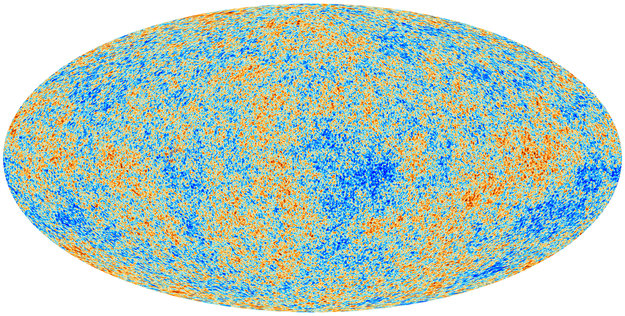
Well, the day is here. The Planck collaboration has announced a huge amount of results for the consumption of the scientific community and the media today. The Planck satellite looks with unprecedented precision at the very earliest radiation (“cosmic microwave background radiation”, CMB) from the universe when it was very young (a wee, cute 380,000 years old) and helps us deduce many things about what the universe was like then, and what it is like now. Here’s one of the representations of the universe using the new sky mapping Planck did (image courtesy ESA/Planck):

There’s a ton of data, and a raft of papers with analysis and conclusions. And there’s a very nice press release. I recommend looking at it. It is here, and the papers are here. The title of the press release is “Planck reveals an almost perfect Universe”, and some of the excitement is in the “almost” part. A number of anomalies that were hinted at by the previous explorer of the CMB, WMAP, seem to have been confirmed by Planck, and so there are some important things to be understood in order to figure out the origin of the anomalies (if they ultimately turn out to be real physics and not data artefacts). [Update: Andrew Jaffe has two nice posts I recommend. One on the science, and the other on the PR. Jester also has a nice post on the science from a particle physicist’s perspective.]

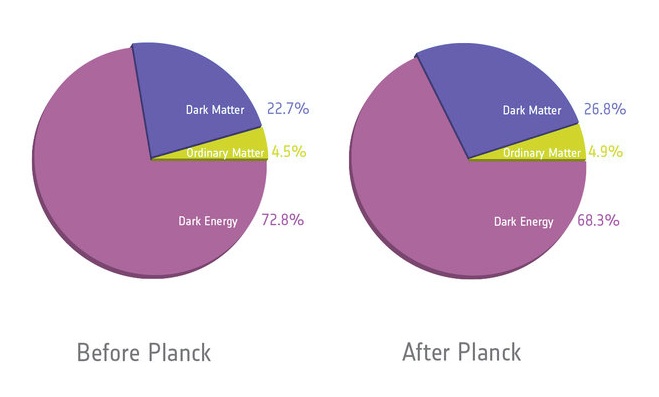
What is the title of my post referring to? Well, the refined measurements have allowed us to update some of the vital statistics of the universe. First, it is a bit older than previous measurements have indicated. The age is now measured as 13.82 billion years. (I’m already updating pages in the draft of my book…) Second, the proportion of ingredients […] Click to continue reading this post